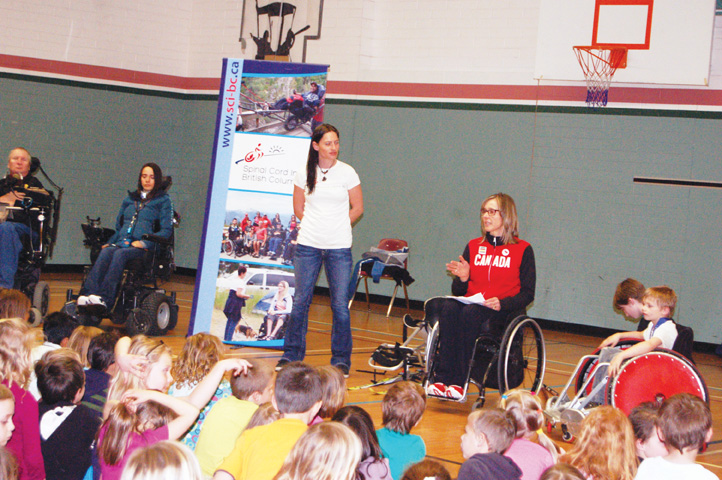

Paralympian Sonja Gaudet addresses the students at Tuc-el-Nuit Elementary School during SCI BC’s presentation on April 3.
Erin Christie photo
The Sochi Paralympic Games may be over but wheelchair curler Sonja Gaudet’s message of acceptance and inclusion continues to spread.
Gaudet was one of approximately seven guest speakers to bring that message to the students of Tuc-el-Nuit Elementary School on April 3.
The contingent, led by local advocate Rachel Allenbrand and her children Josh (11) and Ezra (7) spoke to the youngsters on behalf of Spinal Cord Injury BC (SCI BC), a not-for-profit group that aims to help people with spinal cord injuries (and those with related physical disabilities) and their families adjust after their injury.
Allenbrand and her father, Paul Gifford, who is a high-level quadriplegic (paralyzed from the neck down), were introduced to SCI BC nearly one year ago. Gifford was injured in a logging accident while working in Alberta in 1974.
Allenbrand, who has spoken publicly about the support offered through SCI BC at a number of events, said she felt Gaudet was the “perfect” representative.
Allenbrand hopes to bring the presentation to other local schools in the future.
“She’s a great example of what people in wheelchairs can do and I think the students were really receptive to her message,” said Allenbrand.
Born in North Vancouver, Sonja Gaudet fell from a horse and severed her spinal cord 16 years ago. Since then, the 47-year-old has become the most decorated wheelchair curler in history. She has won gold medals at both the 2006 and 2010 Paralympics and was named as Canada’s flag-bearer for the opening ceremony of the Sochi Paralympic Games.
In addition to her career as an athlete, Gaudet is a peer coordinator with SCI BC’s Vernon branch and an advocate for the organization.
“I didn’t want to believe my life was over after my injury,” she told the students last Thursday afternoon.
“I believed that if I kept playing sports I’d recover from my injury so I started looking around and I found that you can play just about any sport in an adapted chair,” she continued.
When the floor was opened up for questions the students asked guests, most of whom were paraplegic or quadriplegic, if they would ever be out of a wheelchair, or could feel their legs and how they ended up in their chair.
“I was in an accident,” explained James Hektner, peer coordinator for SCI’s Okanagan branch.
“Most of us were in accidents and we probably won’t ever get out of our chairs but we’re here to show you how much you can do, even if you are in a chair. We play rugby, we go camping, we even climb mountains.”
To find out more about Spinal Cord Injury BC visit SCI-bc.ca/
To find out more about the South Okanagan peer group or how you can get involved email [email protected]
Erin Christie
Oliver Chronicle