By Don Urquhart, Times-Chronicle
COVID-19 restrictions including mandatory masks indoors and limits on indoor and outdoor gathering have returned to the Southern Interior.
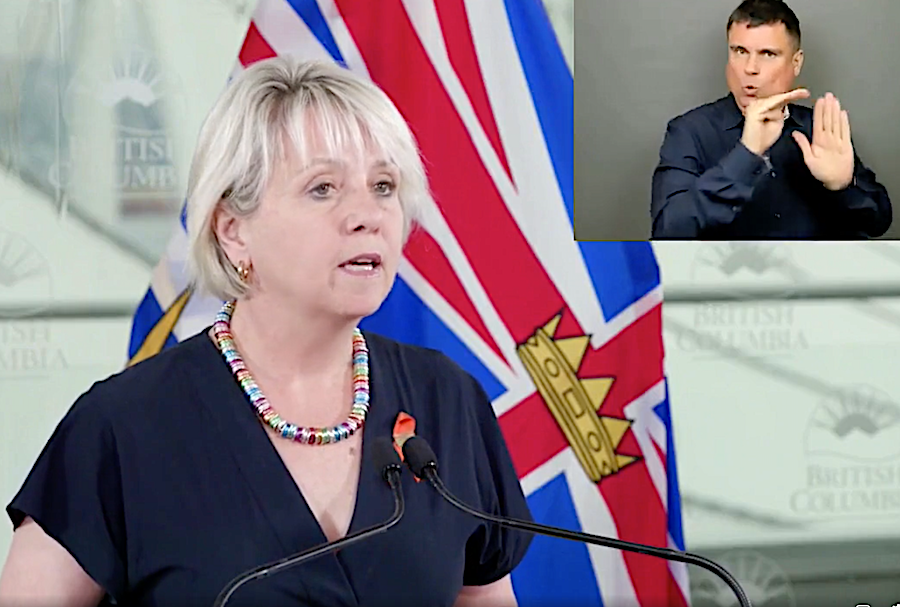
Provincial Health Officer Dr. Bonnie Henry said the restrictions were necessitated by rising cases of COVID-19 in the region where transmission is primarily happening in areas with lower vaccination rates.
Nearly 83 per cent of eligible people 12 and older in B.C. have received their first dose of COVID-19 vaccine and 74 per cent have received their second dose.
But these numbers are lower in the Interior Health region, with about 77 per cent of eligible people have received their first dose, and 68 per cent have had two doses.
Health Minister Adrian Dix noted that starting next week, they’ll be reporting the percentage of new cases who are unvaccinated on a daily basis.
From Aug 21 – midnight tonight – most restrictions already in place in the Central Okanagan will be extended to the entire Interior Health region.
The restrictions apply to all communities within the Interior Health region and will be under the following restrictions, starting at midnight Aug. 21:
- Mandatory masks for indoor, public spaces for those over 12;
- Low-intensity indoor group exercise is permitted to a maximum 10 people per class;
- High-intensity indoor group exercise is not permitted;
- Outdoor group exercise is permitted up to 50 people per class.
The following restrictions come into effect on Monday, Aug. 23 at 8 a.m.:
- Gatherings in vacation rentals limited to five guests or one additional household;
- Indoor personal gatherings limited to ten guests or one other household;
- Outdoor personal gatherings (e.g. birthday parties, backyard BBQs, block parties) are limited to no more than 50 people;
- Organized indoor gatherings (e.g. weddings, funerals, seated events) are limited to 50 people, and outdoor gatherings are limited to 100 people, both requiring a COVID-19 safety plan.
These measures will remain in place until the end of September and Interior Health experiences lower cases and higher vaccination rates, it says.
Travellers were also told to avoid B.C.’s Interior, regardless of their vaccination status, due to ongoing transmission and residents of the Interior were also urged not to travel out of the region.
Interior Health president and CEO, Susan Brown says there is some evidence of cases in the central Okanagan slowly plateau, “we are seeing more cases in other areas of Interior Health,” she said.
“We are calling on all young adults to get your vaccine, especially those who work in jobs where you interact with the public. It is the most effective way to protect yourself and to reduce transmission in the community,” Brown urged.
Most people are being exposed at social gatherings, workplaces or in private households. The delta variant is leading to faster transmission and more severe outcomes for younger people, and immunization remains the most effective prevention against COVID-19, Interior Health emphasizes.
“The vast majority of our cases are in people who are unimmunized or partially immunized and in adults between 20-40 years old. For those who haven’t yet gotten their first dose of the COVID-19 vaccine, please get it now. Getting immunized will help keep our hospital beds open for treating people with other illnesses and needing surgery,” says Interior Health medical health officer, Dr. Rob Parker.
Vaccinations are available in Osoyoos at the Osoyoos Health Centre, Mondays 9 a.m. to 3:30 p.m. and Wednesdays 11:30 a.m. to 6 p.m. and in Oliver at the Oliver Eastlink Curling Centre Tuesdays 11:30 a.m. to 6 p.m. and Thursdays 9 a.m. to 3:3o p.m.
New data this week from the B.C. Centre for Disease Control (BCCDC) showed 922 cases in the Central Okanagan between Aug. 8 and 14, breaking the record for the most ever in the region for the third week in a row.
In the South Okanagan, Penticton saw 33 cases while Oliver and Osoyoos registered 11 cases, and in neighbouring Similkameen, Keremeos recorded eight cases.
A new report from an independent COVID-19 modelling group which includes experts from the University of B.C., Simon Fraser University and the University of Victoria, says without strict health measures, the province could see up to 12,000 new cases per day by the beginning of fall.