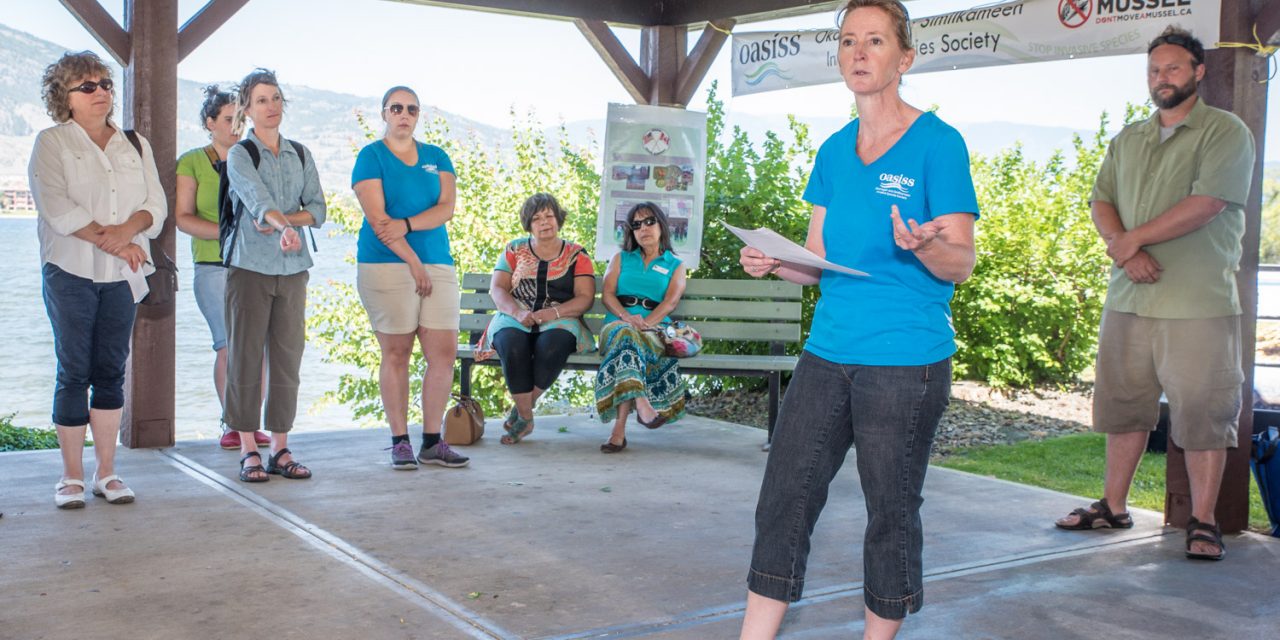
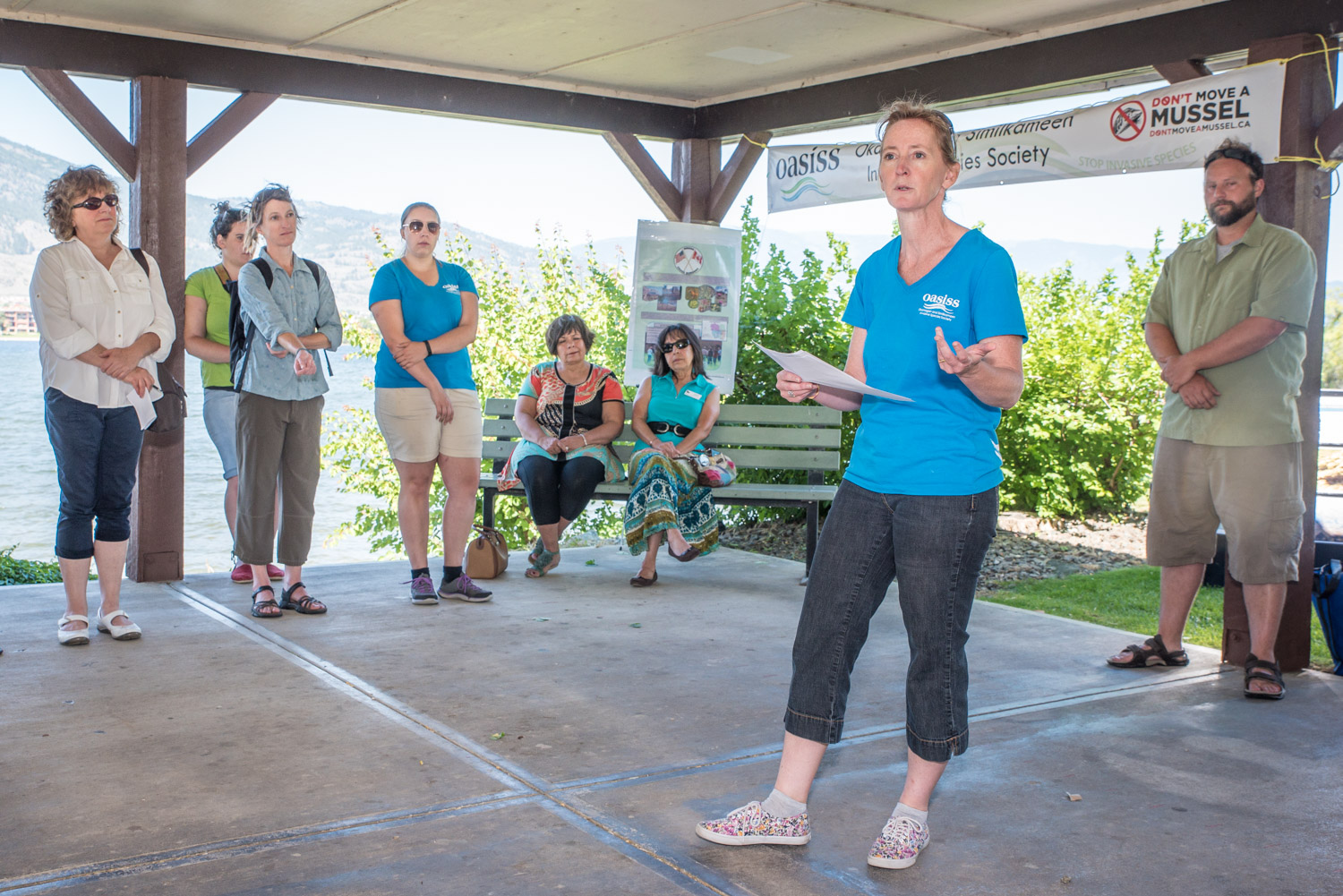
Lisa Scott, co-ordinator of the Okanagan and Similkameen Invasive Species Society (OASISS) welcomes guests from both sides of the border to Weeds Cross Borders 2015 Celebration at Cottonwood Park. A number of people spoke about invasive species at the event that celebrated 10 years of formal cross-border collaboration. (Richard McGuire photo)
People from both sides of the international border celebrated the 10th anniversary of cross-border co-operation on controlling invasive weeds at an event in Osoyoos last week.
The Weeds Cross Borders 2015 Celebration, held Wednesday, June 17 at Cottonwood Park, brought together representatives from the South Okanagan, Kootenay Boundary and Washington State.
Invasive weeds don’t respect borders or jurisdictions, said organizer Lisa Scott, co-ordinator of Okanagan and Similkameen Invasive Species Society (OASISS) as she kicked off the event in Cottonwood Park’s gazebo.
Scott later explained that there had been co-operation across the border on invasive weeds previously, but a formal agreement was only signed in 2004.
The key partners in B.C. are the Regional District of Okanagan-Similkameen (RDOS) and the Regional District of Kootenay Boundary.
In Washington State, the key partners are the counties of Okanogan and Ferry.
“When we first formalized, we created one big boundary around those four regions and that’s referred to as a co-operative weed management area,” said Scott.
The co-operation addresses such terrestrial weeds as puncture vine, which has become a scourge of the area, and hoary alyssum, a white flowering mustard that is toxic to horses.
Before the agreement was signed, there was no formal program on the Washington side to address puncture vine, Scott said.
While the U.S. participants remain focused on terrestrial pests, Scott said OASISS has extended its focus to include such potential aquatic invaders as zebra and quagga mussels.
Another aquatic invader, Eurasian milfoil, is handled by the Okanagan Basin Water Board (OBWB), she said.
Dave Caswell, who works on the milfoil program for OBWB, was one of the participants at the event.
Others included Osoyoos Mayor Sue McKortoff, RDOS Chair Mark Pendergraft, who is Area A director, and representatives of the Osoyoos Indian Band including Charlotte Stringham, manager of the Nk’Mip Desert Cultural Centre.
Conservation Officer Barb Leslie was also among those who spoke.
Scott said she was pleased that McKortoff and Pendergraft stayed for the entire event and were engaged and also that there was First Nations participation.
In a timely development, Scott was able to announce to participants that the federal government that morning announced that Fisheries regulations addressing aquatic invasive species are now in effect.
The regulations allow officers of the Canada Border Services Agency (CBSA) to stop and detain boats at the border that are carrying invasive zebra or quagga mussels and to order their decontamination. The regulations have been in development for a number of years.
Asked about challenges lying ahead, Scott said they would include the unknowns of what invasive species is next.
“When I started 20 years ago, I would never have thought I’d be talking about invasive mussels,” she said. “So the unknowns are the most fearful component.”
The biggest challenge, however, is apathy.
“Especially with something like puncture vine,” she said. “People kind of go, ‘it’s everywhere, what can I do?’ So engaging people I would say is our biggest challenge. Making them realize that we all need to take responsibility when it comes to invasive species.”
RICHARD McGUIRE
Osoyoos Times