By Lexi McFarlane, Times Chronicle
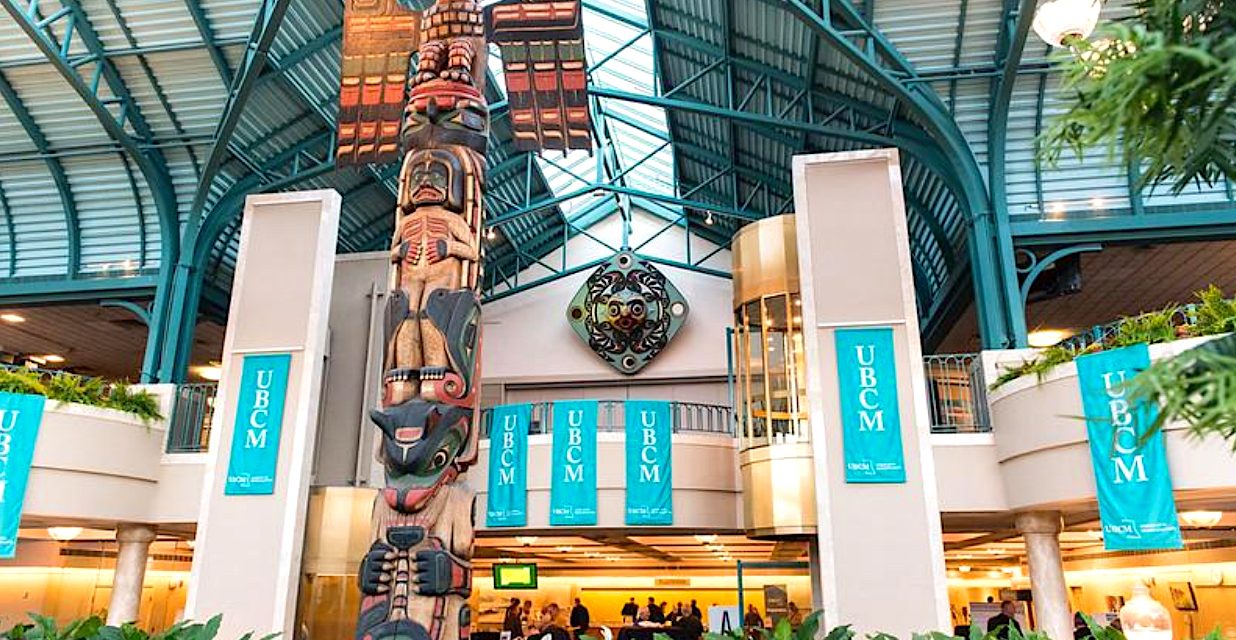
The Towns of Osoyoos and Oliver had jam packed agendas with a number of key meetings with elected officials wedged in between the official agenda at the 2025 Union of BC Municipalities Convention in Victoria from Sept. 22-26.
The annual UBCM Conventions provide an opportunity for municipalities across British Columbia to work together with one another, and with BC officials and ministers, to come up with ideas and solutions for the challenges each municipality faces. Both Osoyoos and Oliver were well represented for the 2025 edition of the UBCM Convention.
For Osoyoos, the major point of discussion centred around water supply. With plans for a new water treatment plant in the works, the Town’s pitch to the province was for an expedited water license amendment. Such an update to the Town’s water license is necessary for Osoyoos to be able to draw water supply from Osoyoos Lake, as opposed to being limited to just well water supply.
Rod Risling, the Chief Administrative Officer for the Town of Osoyoos, noted how all six of the Town’s water wells are heavily taxed.
“We have no quantity,” Risling said. “During the summer months, during irrigation times, they are maxed out. They are running full-bore, and even then, they are not keeping up. So our reservoirs are actually on a (capacity) decline, not filling up fast enough.
“In reality, we should have one well that is never turned on, maybe even two. So we are well beyond what our usage capacity should be.”
Furthering the issue is that what the wells provide isn’t the best quality, either, compared to what could be drawn from the Lake.
“The (new) wells were successful from a quantity perspective, however the quality wasn’t good at all,” he explained.
To get the amendment to Osoyoos’s water license to build and operate the new water treatment plant, the Town met with the Ministry for Water, Land and Resource Stewardship. Risling says the objective was to speed up progress in getting that amendment done.
“What our objective was with that Ministry was to inform them of the need for water, inform them that we’re a Resort Municipality, generating millions of dollars for the provincial and federal governments.
“To continue doing well from the tourism perspective, we need an expedited process for the approval of our water license amendment.”
Beyond the water front, tourism and resort municipality funding was brought up, with Risling and Mayor Sue McKortoff joining a morning meeting with provincial Tourism Minister Anne Kang.
“She was actually the Minister of Municipal Affairs when we got the grant (for the water treatment plant),” McKortoff chuckled, “so we know her quite well.”
McKortoff spoke to the importance of meeting with the Tourism Ministry during the UBCM Convention.
“Our MRDT – basically, the hotel tax – is collected, sent to the government, and then they use some of that to provide us with some money for the town to do tourism-related things such as concerts, such as building the washrooms at Gyro Park.
“Those kinds of things are important for us to (work on) at UBCM.”
The one issue both Osoyoos and Oliver addressed at the UBCM Convention was RCMP staffing, or a shortage thereof. The matter of public safety has been something municipalities across Canada have increasingly had to discuss in recent years, and in British Columbia, including the South Okanagan, it’s no different.
“That’s probably an interesting one for just about every municipality; we all seem be sort of in the same boat about that,” McKortoff noted.
“You just hope that at some point they (the province) realize that this is an important issue… and that they will help.”
Risling further elaborated on the importance of public safety, and better staffing for police.
“It’s (a matter of) ‘do what you can’, to support that industry,” he says, “because it’s critical for our jurisdiction to have adequate police services. And one of the big reasons is, regardless of crime in general, we want our public to not only be safe, but to feel safe. The presence in the streets means a lot.”
The Oliver town Council discussed the same matters with provincial Solicitor General Terry Young, but with a different approach. Oliver Mayor Martin Johansen said that the victim services program is an area of opportunity for the province to boost resources, and alleviate the burden on RCMP.
“What we were talking to (Young) about was wanting to do a review of the victim services program here in the South Okanagan,” Johansen explained.
“It’s a program that I think struggles from underfunding, and what we’re trying to do with that is make sure that the (RCMP) can spend their time working on core services of crime prevention and investigations, and victim services can be handled by another (provincial) organization.”
Johansen said the notion feels like it was received well.
“Good conversation. We’ve had that conversation a couple of times before. We did have a lady there that seemed to be very knowledgeable about the victim services program, and I got the sense that we’ll definitely get some follow-up on this.”
Other meetings that Oliver, and Mayor Johansen, had a seat at focused largely on public health, and hospital staffing. The South Okanagan General Hospital has seen emergency department closures due to staffing challenges, as have hospitals in other smaller BC locales.
“That was our main discussion with the Ministry of Health,” Johansen, who also served in his capacity as Chair of the regional Hospital District at UBCM, said.
“Really, trying to press on them, that we really need to circle back and look at rural communities, and the challenges we’re having. And some of the impacts of some of the programs that have come out that are negatively impacting our ability to attract positions, competing with urban communities.”
Under provincial rules for the rural locum program, towns no longer qualify if they have more than seven positions. Oliver sits at eight, and Osoyoos holds seven positions, meaning Oliver doesn’t qualify for those benefits and Osoyoos is on the verge.
Johansen says that acts as an impediment to bolstering hospital staffing.
“That was something that we chatted with (the Health Minister), that we need to have a look at that, because that’s a barrier as well.”
Similar conversations were had as the recently-formed Rural Mayors of BC collective met on the UBCM sidelines. The group, featuring mayors of other small municipalities such as Lilloet, 100 Mile House, and Clearwater, expressed a shared sentiment of needing to attract more health-care staff to their local facilities.
Creative thinking led to some solid ideas, as Johansen pointed out.
“One of the things in rural communities that could be an incentive would be a tax deduction for working in rural emergency departments, as long as there’s a certain amount of time commitment associated with that,” he described.
“So you put in, say, 24 shifts or something, in a rural community, and you get some kind of a tax deduction for that.”
Oliver, he points out, has already started work on another potential solution.
“One of the things we’re doing here, that I talked about in that meeting, is the Housing for Healthcare Workers program – we’re putting in two 2-bedroom homes here.
“Part of the money has already been funded from the Ministry of Health; the Medical Foundation… the hospital district has put in some money, Area C directors have put in some money. Fortis is thinking about it – I believe they’ve made a commitment as well.
“It makes it easier for physicians to come and work in our community, when they don’t have to search for a place to live.”
While guarantees aren’t made by the province at UBCM Conventions, the general feeling this time around is that the discussions that were had were very positive, and may prove fruitful quite soon.
Even without commitments, the social aspect and connecting with other communities is half the experience on its own.
“That’s always a very positive thing, because we get to spend time with our counterparts and other areas from around the province,” McKortoff said.