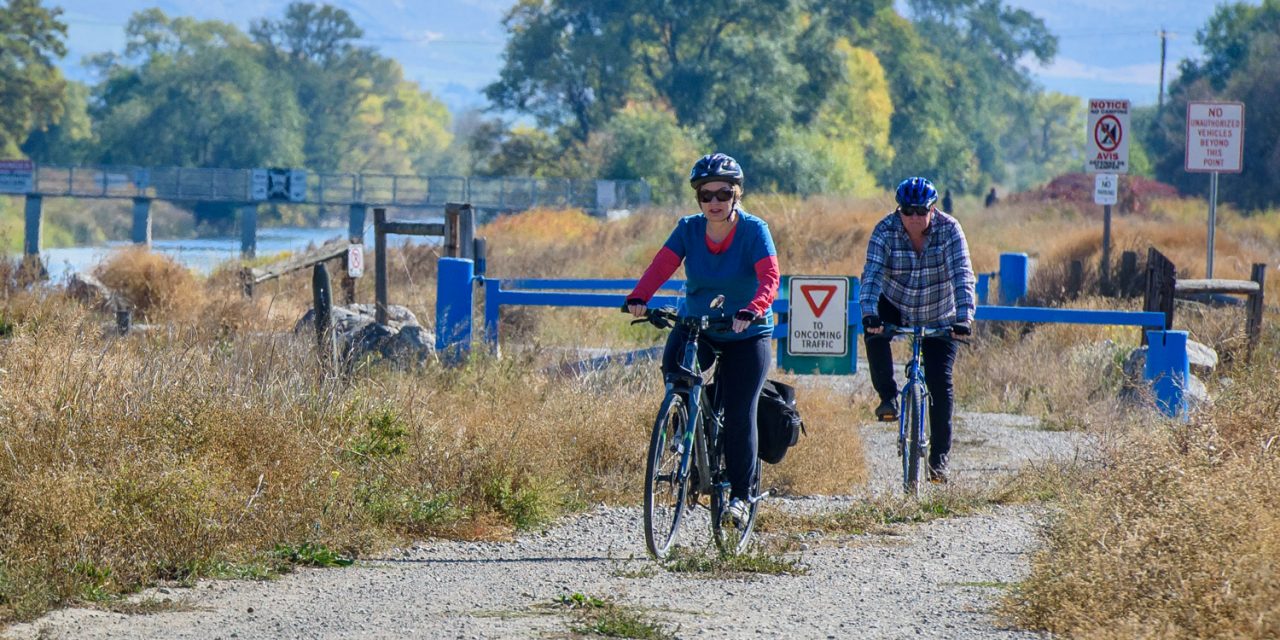
The dream of a continuous, uninterrupted 370 km hiking and cycling trail from Sicamous to Brewster, Washington is closer to reality than ever before.
With over 75 per cent of the trail now connected, it’s virtually a ‘mopping up’ exercise to complete the missing bits and make the Trail of the Okanagans whole.
The entire trail is comprised of rail trails, cycling and hiking trails all fused into one contiguous ‘active transportation’ corridor.
For organizational purposes, the trail can be divided into three sections: from Sicamous to Kelowna’s William R. Bennett Bridge, from the bridge to the border, and then a third section of 125 km in the US to Brewster.
“Our section from the Bennett Bridge to the border is the most challenging as there are more than 100 different trails sections to connect running through three First Nations reserves, two regional districts and seven communities,” says Janice Liebe, president of the Trail of the Okanagans Society.
In a presentation to Osoyoos Town Council recently, Liebe highlighted some of the missing links of the project which has brought together a whole slew of rail and trail groups cooperating to make this a reality. Liebe impressed upon council the importance of Osoyoos’s involvement in enabling a vital link to the US border.
Her presentation to council was in order “to discuss having the trail recognized and implemented in the relevant planning documents and to illustrate the benefit of prioritizing this pan-Okanagan active transportation corridor.
“Osoyoos is particularly fortunate that some of the longest sections of completed trail in the South Okanagan are just north of town and they’re about to get extended,” she says.
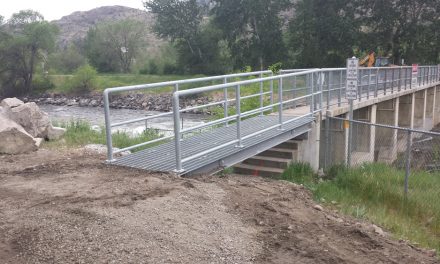
Notable exceptions are two spots on Highway 97 alongside Osoyoos Lake. Otherwise, the trail is complete all the way up north of Oliver and the new District Wine Village.
Liebe notes discussions are underway with the Osoyoos Indian Band and the Regional District of Okanagan-Similkameen to connect north to Gallagher Lake.
This also includes setting meetings with the three MLAs whose constituencies are involved and the B.C. Department of Transportation and Infrastructure to address a total of six highway gaps, including the two just north of Osoyoos.
Meanwhile, in town, “We are asking that Osoyoos prioritize the route we are suggesting in creating a continuous route through town from north to south – through 87th St., 74th Ave., and 89th St. to Jack Shaw Gardens,” Liebe says.
This includes following the trail standards code as indicated in the Osoyoos Parks and Trails Master Plan, that there be a consideration for a bike repair and water station in the vicinity of the museum, and that the trail society has some opportunity to work with the town’s planning department to establish the trail connection in the southern part of town that would allow for a link to the border.
The trail has significant benefits including not only recreational and community-based, but substantial economic benefits.
“What many people in the Okanagan don’t realize is that the region is ranked low in diversity of tourism amenities. So while we have really great beaches and warm sunshine and wineries, as a tourist destination we could actually do much better.”
Rail trails are proving to be highly popular across North America and Europe, Liebe says, with international cycle tourism a significantly growing sector.
She also notes that the federal government has earmarked nearly $400 million for active transportation projects.