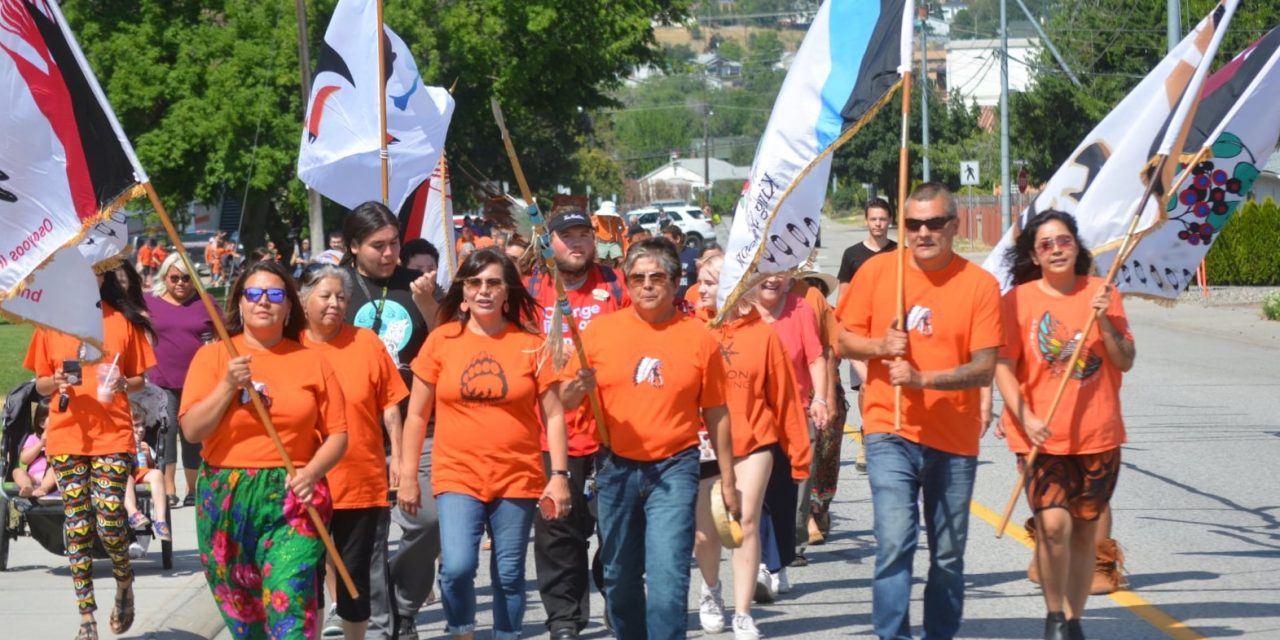
Hundreds of people gathered in Oliver on July 9 for the Residential School Walk to Remember to support the Osoyoos Indian Band in honour of those who suffered at the Kamloops and St. Eugene residential schools.
A river of orange ran from the community bandshell to the Osoyoos Indian Band (OIB) office as participants walked in solidarity with posters and signs in a show of support for local Indigenous people.
Sammy Louie, council member at OIB, said they were expecting a number of folks to show up but were quite surprised at the massive turnout.
“It’s overwhelming for us knowing that there is that support because you don’t know it until these kinds of things happen, so our community is really feeling the love.”
Louie explained that Carol Sheridan from Oliver Parks and Recreation approached the OIB in hopes of doing something in the community to show solidarity in light of the discovery of the mass burial of Indigenous children in residential schools all over the country.
“She approached OIB because a lot of the community was talking about how they can support the local First Nation, Osoyoos Indian Band,” said Louie. “We’ve been meaning to do something like this. And it’s just our dates just didn’t align with our community and what not. So just earlier this week we’ve finally picked a date.”
When the group of marchers reached the Osoyoos Indian Band gathering space, everyone circled around to listen to a number of speakers share their stories.
“Our people were sent to the Kamloops residential school or the St. Eugene residential school near Cranbrook,” said Chief Clarence Louie. “We’re so glad that we have in the front here many survivors from those residential schools who are still with us.”
Among the speaker at the event were Elders from the Osoyoos Indian Band, survivors from the two residential schools, the chief of the Tk’emlúps te Secwépemc (Kamloops Indian Band), Kukpi7 Rosanne Casimir, and Liz Adriane from the Akim Indian Band (Cranbrook).
“I am truly honored to be here, and be with you all, participating in the walk this morning,” said Casimir. “It is a very long journey we’re on when it comes to healing.”
“The government is finally acknowledging the history as well,” added Casimir. “It amazes me that these truths have all been said before, but these truths have really truly awakened so many who are hearing them for the first time; well they’ve heard it but they’re acknowledging it for the first time and actually grappling and understanding what it meant and what it means to us…We went through it and still go through it every day of our lives.”
Clarence later unveiled the new residential school monument that reads the names of the 70 members from the Osoyoos Indian Band who suffered at Kamloops and St. Eugene residential schools.
Sammy and Ryann McGinnis then read out the extensive list of people who attended and many who died at these institutions, with a few people beating their drums four times after each name.
The monument is built in red bricks, mirroring the structure of residential schools, and is titled “Honouring Our Children.”
There are two sculptures of kids touching the wall on the right and left side of the monument, and where their hand meets the wall are bricks taken from the Kamloops and St. Eugene residential schools.
The plaque on the wall reads: “From the early 1940’s to the early 1970’s, school age children from the Osoyoos Indian Band were sent to Indian residential schools in Kamloops, Cranbrook (St. Eugene’s) and Mission (St. Mary’s). Native children from Canada and the United States were taken from their reserves, and away from the influence of their homes, families, traditions, and cultures….survivors of the schools describe them as jails for the children.”
Participants were then invited to leave painted stones by the foot of the monument wall, many had messages of condolences and the names of children written on them.
“What you have done here today with this commemoration wall is honouring each and every single individual whose name is on the wall and their families. Honoring their memories so that the future generations will understand our history,” said Adriane.
“What’s also very important is for all Canadians having this wall here, they can never go back to a place of saying that they didn’t know anything about it.”