By Maureen Parriott
Special to the Times-Chronicle
The Okanagan abounds in plants with prickly personalities.
Puncture vine, the bane of bike tires and bare feet. Cacti. Russian olive, the invasive blue-green tree with impressive thorns. Burrs. Thistles. In our tame gardens, things like Oregon grape, holly, and pyracantha.
We go “Owowowow,” suck a finger, hop around, take our wounded inner tube to the bike shop.
But something more nefarious is afoot.
Spear grass.
It doesn’t attack us; it goes after our pets.
It looks so innocuous to be so noxious. A fine, green grass with soft-looking heads gently swaying in the rains of spring. Then summer arrives, the grass dries out, gets stiff, and grows teeth.
The heads are composed of sections called awns. They’re seeds, and their mission is to disperse themselves. The slightest touch makes the awns shatter into individual pointed projectiles. Passing animals are their target.
But they’re not content to ride along and get dropped off. Instead, they begin working into the host’s fur, where backward-facing “arms” like dainty arrowheads, keep them from backing out. They burrow into the skin, and often go deeper. That’s what makes them so dangerous.
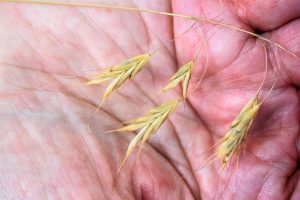
(Richard McGuire photo)
Dogs and cats with fluffy coats are particularly at risk. But even smooth-coated breeds can get the awns stuck between their toes, in their ears, in their noses, and even in their eyes. Once inside, they can form abscesses at the point of entry. They can migrate from the toes to higher on the leg, abscess, and burst out, like something out of “Alien.” More worrisomely, they can continue to burrow inward and actually invade organs, causing pain and internal abscesses. That calls for surgery.
Osoyoos resident James Gammie, a retired veterinarian who practiced for many years in Penticton and California, has treated enough grisly spear grass injuries that often, when he sees someone walking a dog on the side of a weed-lined road, he will pull over to warn them about what they’re exposing the animal to.
Prevention is simple, Gammie says.
“Keep your dog on a leash when you’re out for a walk, Don’t let it run around in fields of brown grass. Mow your yard. Inspect your pets when they come inside. Be sure to check your cat’s eyes because the awns can get stuck in the third eyelid. Part your pet’s toes and inspect between them. Check between their pads. Look in their ears. Look under their tail. Go over their coat.”
“Scruffling” the fur all over your pet’s body to detect a tiny hard thing lying against their skin can be a challenge, but can actually be enjoyable for both of you. It’s like giving them a combination good scratch and massage. Who doesn’t love that?
Heavy-coated animals do require some determination to get down to the skin. If you find an awn and pull it out, your pet might not be happy at first about having some fur accompany it. But if they’ve begun to feel the maddening itch of an invading tip, you will likely be rewarded with an expression of grateful relief.
Of course, should you discover an awn embedded so deeply that you cannot remove it, or if an abscess has begun to form, a trip to your veterinarian is warranted.