By Don Urquhart, Times Chronicle
Osoyoos’ Committee of the Whole has given the nod to town staff review and update the Five-Year Financial Plan to incorporate the costs associated with the design, construction and ongoing operations and maintenance of a surface water treatment facility at an estimated cost of $51.735 million.
The matter will then be brought before council in a regular open meeting for further discussion, including how to pay for the project, before committing to the path of lake water treatment.
Osoyoos councillors at the Committee of the Whole meeting on Tuesday, April 23 were presented with the “Source Water and Treatment Feasibility Study” by Carollo Engineers, a water-only consultancy firm which laid out the options for water treatment (see earlier report on the study here).
Following the presentation council members had the opportunity to ask questions of Carollo engineer Stephen Horsman.
Councillor Myers Bennett asked whether the hard water and brown water would be cleared by “back washing” as described in the report. Responding, Horsman said that using lake water would mean the “ground water events” would be reduced.
“I think, this is obviously on the operation side, but becoming ready to introduce a new water quality and new water characterization into your distribution system we want to precede that with a series of flushing exercises to reduce whatever buildup you have in your pipe network,” Horsman said.
Jared Brounstein, Director of Operational Services noted that the water hardness of the lake water is quite a bit lower than the current ground water adding “so that would be one bonus”. He added that “unidirectional flushing” would be necessary for a year to two years to completely clear out the system.
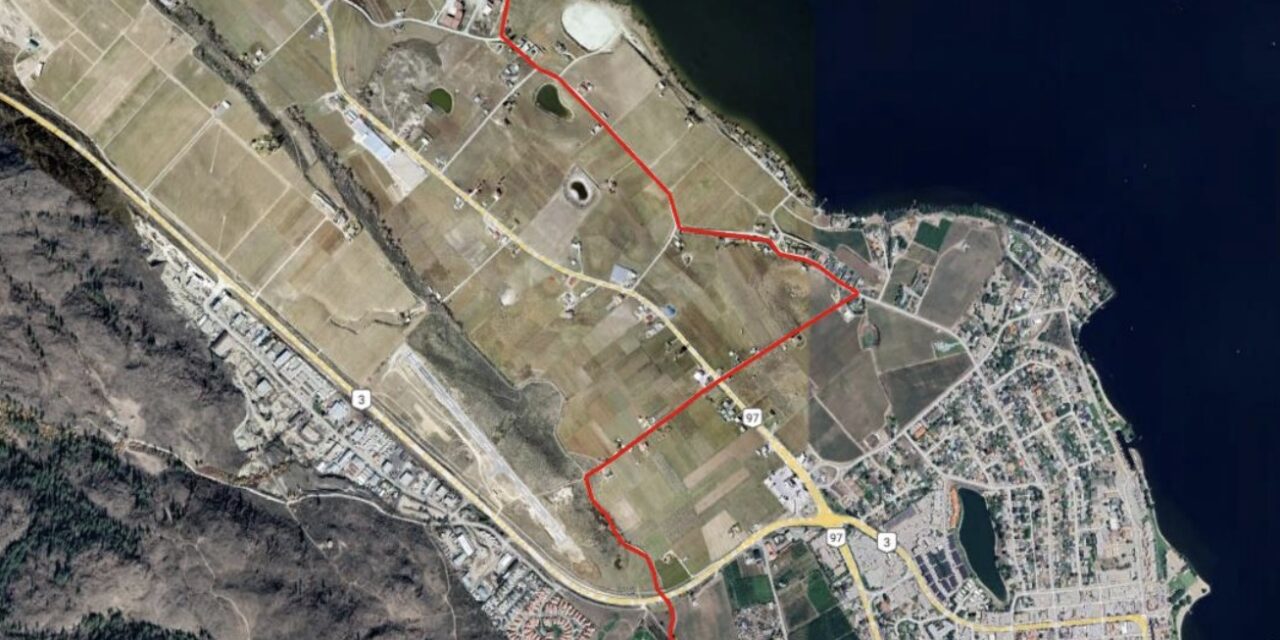
Mayor Sue McKortoff then inquired about the routing of the intake pipe from the lake to the treatment plant and whether it could follow a route along Hwy. 97 instead of through residential areas. Horsman replied that this level of detail was not fully fleshed out because other decisions – such as determining whether to go for surface or groundwater – took precedence at this stage.
Horsman noted that the next step is to make “the big decision” on which water source – ground or surface water – to go forward with and then “the next big decision is specifically around siting”.
He noted there are “probably a number of options depending on land costs or if you want to consider land purchase as part of that and/or an opportunity to optimize and identify the preferred site but that would come back into focus in the next phase,” he said.
McKortoff also asked if the softer lake water would mean Osoyoos residents would no longer require water softeners in their homes, to which Horsman confirmed they would no longer be needed.
Councillor Johnny Cheong then asked about the cost of refurbishing the existing wells. Horsman said that in preparation of their report, this issue was discussed with groundwater specialist firm Western Water Associates in the planning phase and they identified “a rough order of magnitude of a million dollars a well.”
This would include renewing the pump mechanics and cleaning and renewing the screen and gravel at the base of the well.
Cheong also brought up the issue of droughts and asked just how stable the Osoyoos Lake water supply is.
“Our assessment of the sustainability of the groundwater and surface water are effectively equivalent in the sense that hydraulic connectivity in your aquifer and the lake is so strong that they would behave very similar,” Horsman replied.
He also asked how scalable the system would be, for example, to supply water regionally or to the town of Oliver, to which Horsman noted the surface water system would be able to “more readily accommodate expansion”.
On questions of how this estimated $52 million project would be budgeted Brounstein highlighted that there is a $9 million grant from the province and $16.5 million that has been allocated and available for capital investment in water infrastructure and “there will be requirements to up that budget,” he added.
“How you find that is going to be the next step,” he said, highlighting that it will involve committing to a $52 million water treatment plant. “Once you start walking down the path we’ll start spending funding to move forward,” he said. This will then also start discussions with the province around a phased construction.
In response to Bennett’s queries about costs exceeding the estimate, Brounstein underscored that there is “risk in any construction right now,” adding that the cost estimates are very “high level numbers at this point”.
At this point McKortoff asked where the town stands in terms of being able to both apply for more grants and also enter into borrowing.
Zakall replied that the town is only allowed to borrow up to 30 per cent of its revenues. “Anything over that we would have to seek the Inspector of Municipalities approval on our borrowing. So that would be part of our process.”
He added that the number one priority would be to try and secure additional grant funding and the second one would be securing loans for the remainder which he said would likely mean seeking approval because the amount would push the town over the threshold.