By Don Urquhart, Times Chronicle
A new water treatment facility in Osoyoos based on lake water would be nearly $10 million cheaper than upgrading the current groundwater system according to a report from the largest water-only consultancy firm in the US.
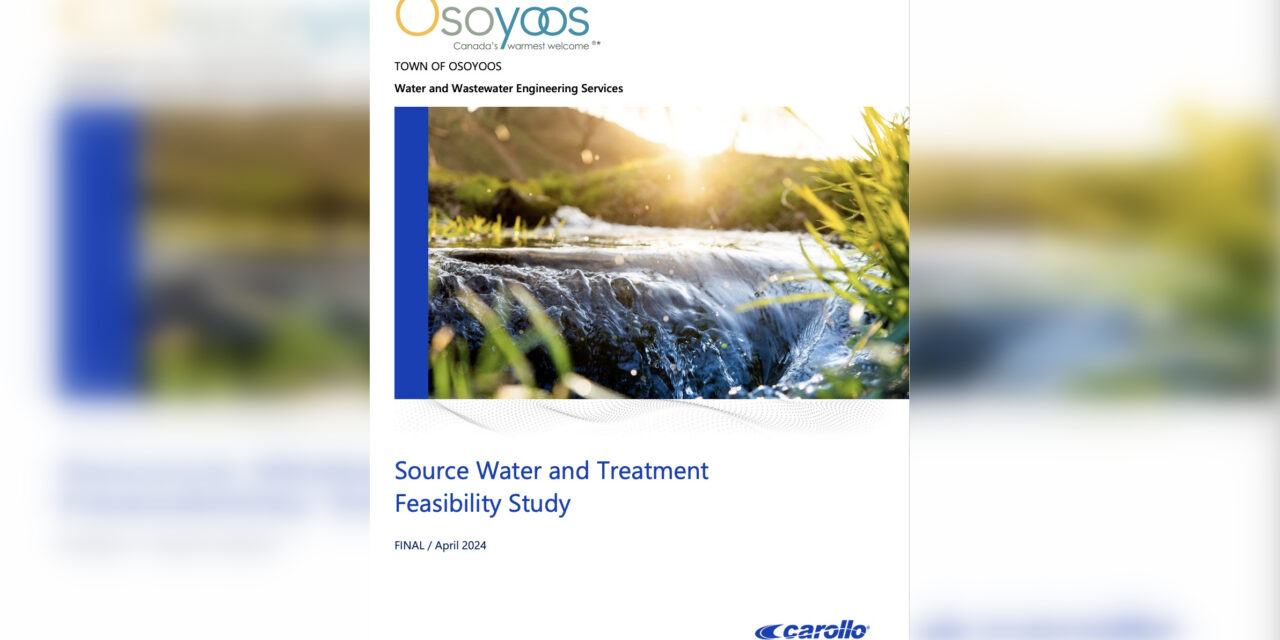
In its “Source Water and Treatment Feasibility Study” Carollo Engineers has estimated that the design, construction and ongoing operation and maintenance of a surface water treatment facility would have a capital cost of approximately $51.74 million.
This compares to $61.5 million for groundwater treatment. Both options would carry an annual operating budget of approximately $1.1 million.
Carollo provided the report at the town’s request after it won an open tender for consultancy services pertaining to Osoyoos’ water treatment strategy.
The report provides two options with regard to water sourcing and treatment – the first continuing to use groundwater with required upgrades and the second to move to a surface water system.
While noting that both the surface water and groundwater systems will involve substantial capital investment and operating budgets for the Town, Carollo said the surface water option is preferred for this category because of the lower capital costs and similar operational costs.
“Surface water provides greater flexibility, uses the highest available water quality, and has the lowest expected capital and lifecycle costs,” Carollo said.
“The surface water treatment option is recommended as the preferred approach to provide a reliable supply of drinking water that meets the provincial and federal drinking water quality guidelines,” it added.
The 75 page report will be considered at the next Committee of the Whole (COW) meeting on Apr. 23.
It follows from an earlier water treatment pilot study completed in the fall and winter of 2023 by RESEAU in partnership with UBC. That non-commercial research study showed that the groundwater is difficult to treat to meet compliance requirements.
“As a result of the complex process, the footprint and cost of a groundwater treatment facility has increased to the point where surface water (Osoyoos Lake) has become a more viable option to the community,” town staff said in a report to the COW.
While noting that both options – ground and surface water – have pros and cons as outlined in the report and presentation on Apr. 23 by Carollo, town administration is recommending a surface water system.
Should the COW agree, staff would then begin work on a phased construction and funding model would be developed over the next couple of months. Carollo will be engaged to develop the plan which will then go out for open tender under the RFP process for the actual construction.
The process will involve reviewing and finalizing procurement approaches, facility location would be confirmed (with the Golf Course Lands being the preferred site), discussions with the Province (changing the scope of the grant has already begun) and other related stakeholders would begin, and Interior Health reviews and approval would begin.
Staff anticipate 12 to 18 months to complete the permitting and preliminary design process, with a phased construction approach starting in the fall of 2025 with an anticipated project completion 2-3 years from the start of construction.
In its comparison of the two options – ground versus surface water – Carollo breaks it down into five categories: source water availability, raw water conveyance infrastructure, treatability, operations and maintenance, and financial.
On the availability of source water, Carollo says surface water is preferred due to being more “resilient” than ground water which can be repurposed as a backup source.
Groundwater is preferred for moving the raw water for treatment. Surface water would require new infrastructure next to the lake (and a new pub station) which would also require provincial and federal permitting whereas groundwater would rely partially on existing infrastructure (with refurbishment), but an extension of the transmission main by nearly 6 km.
On treatablity surface water wins out as a simpler option compared to groundwater which requires pathogen treatment, and issues with organics, ammonia and manganese.
When it comes to operations and maintenance the needle moves to groundwater as the preferred option because of its simpler mechanical operation, although Carollo notes that with the higher number of contaminants in raw water the operational complexity increases.
So too the complexity increases for surface water which has the additional aspects of dealing with algal events which include toxins, taste and odour issues.
The report can be found on the Town of Osoyoos website here.