By Lexi McFarlane, Times Chronicle
Stage 3 water restrictions have been enacted in the Town of Oliver, though not without some differences in opinion and the revelation that another well may need significant investment in the near-future.
In the new Drought Management Plan (DMP), which was formally approved just prior to the water restrictions discussion, Stage 3 water restrictions will see watering limited to just once per week, and a 50 per cent reduction in domestic water consumption.
This is a significant step up from Stage 2 restrictions, treated as more of an advisory, which permits lawn watering twice a week and does not require the same domestic water consumption cull.
Odd numbered houses will be allowed to water between 7 p.m. and 9 a.m. on Wednesdays, while even-numbered houses may water between the same times on Fridays. Micro and drip irrigation users will be permitted an extra day of watering, with odd-numbered properties permitted on Saturdays and even-numbered units on Tuesdays.
The decision was the recommended course of action by Kelly Mercer, the Town’s Director of Operations, and comes as the South Okanagan is about to experience more hot and dry weather. The Okanagan Lake has also seen its water levels decrease to their lowest since 1943, the Town noted in a separate statement.
Water levels in the Town of Oliver’s wells have significantly decreased in their running state compared to their static levels, with Rockcliffe Well and the Tucelnuit P2 well both falling below 2.4 metres.
In the case of Tucelnuit, it’s a 1.7 metre decrease, while for Rockcliffe, the three-quarters of a metre decrease is a larger July decrease than what has been recorded each of the past two years.
Adding to the problem of low water levels due to weather are issues affecting the Miller Well. Not only has the water level fallen below the minimum 1.5-litre threshold, but the Miller Well is also unable to maintain its levels after a full recharge.
Mercer noted that the well will need extra maintenance and repairs very soon. “We do feel that there (are) issues there, and it’s something I’m going to bring forward in 2027 to try and clear up,” he said.
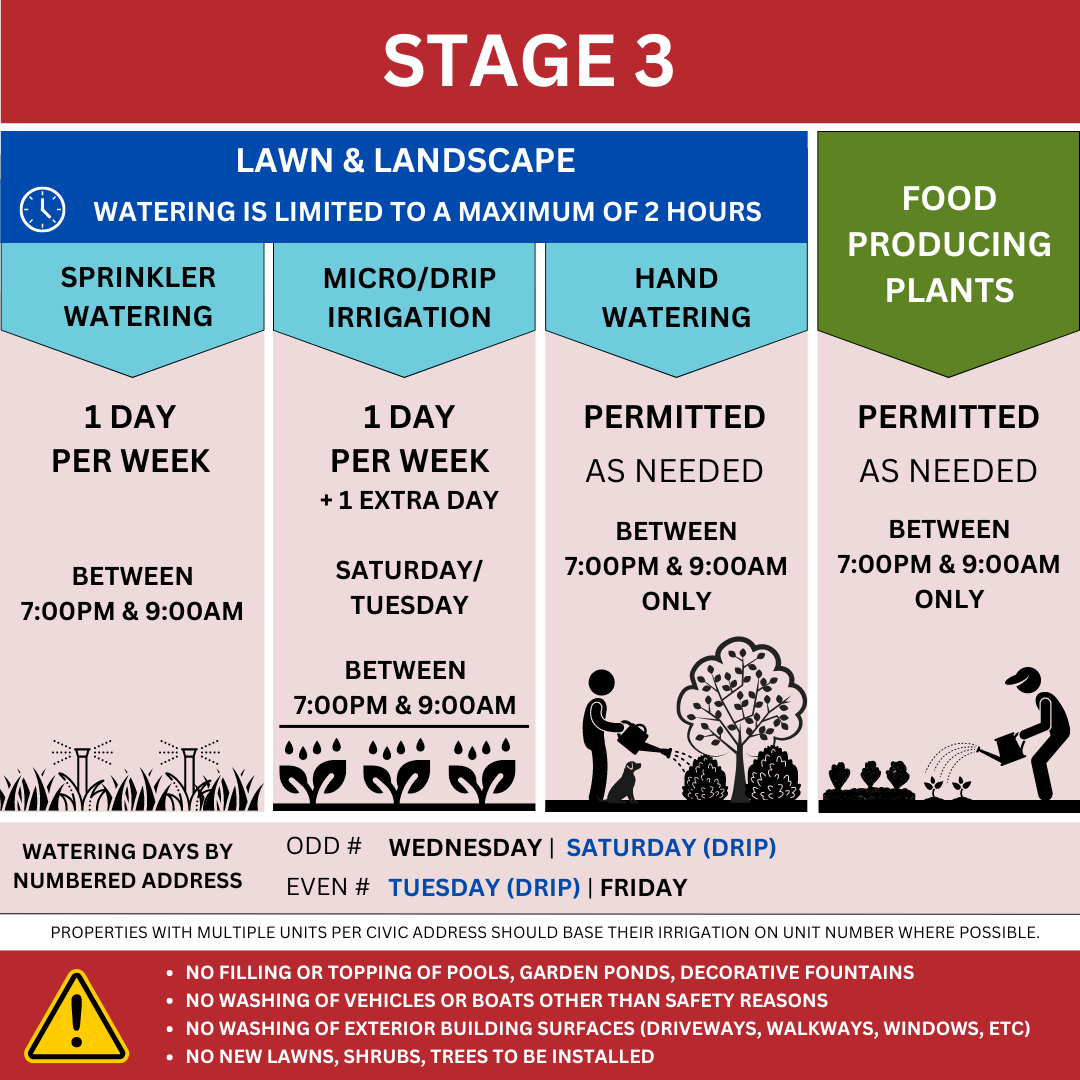
Town of Oliver graphic
In the new Drought Management Plan (DMP), which was formally approved just prior to the water restrictions discussion, Stage 3 water restrictions would see watering limited to just once per week, and a 50 per cent reduction in domestic water consumption.
This is a significant step up from Stage 2 restrictions, treated as more of an advisory, which permits lawn watering twice a week and does not require the same domestic water consumption cull.
Prior to the Council presentation, Mercer’s report suggested Stage 2 restrictions could be used for Systems 1 and 3, as opposed to Stage 3 restrictions for the other systems.
Those suggestions were based on indicators laid out in the DMP, such as groundwater levels in wells, water supply capacity, and the levels of the Okanagan River and Skaha Lake.
Mercer made it clear it wasn’t an appealing option, having to do Stage 3 restrictions across the board.
“I don’t like the fact that we’re looking to be in this stage, I don’t like the shape the wells are (in); it’s very nerve-wracking, to be honest, when we have three in-town wells and two of them are less than three feet above the pump and in danger of being shut down.”
Water Councillor Rick Machial wanted to see the Town enter Stage 2 restrictions first for all systems, to see if it would have a short-term impact.
“If we go to one day a week for watering (under Stage 3), our town’s going to turn brown,” Machial said. “All of the lawns are going to die in our town. So it might be a good idea to try Stage 2 for a week, and see what happens to our levels.”
Such a proposal would face logistical hurdles, however. While Mercer explained that daily monitoring is done on water restrictions, it was also pointed out by Joe McCulloch, the Town’s new Chief Administrative Officer, that a special meeting of Council would have to be called to approve a shift in water restrictions after just one week.
Councillor David Mattes was on board with that potential approach.“We’re available,” Mattes said.

Town of Oliver graphic
Some of Machial’s peers also weren’t keen on the idea of a trial of lighter restrictions prior to moving to Stage 3. The main voice suggesting that Council accept the staff recommendation was Councillor Petra Veintimilla, who said that trialing Stage 2 didn’t make the most sense and could be “confusing”.
“I also don’t like brown lawns,” Veintimilla said. “But given the information we’ve received, with most of our systems, the recommendation based on our own plan is to move to Stage 3, and it would be confusing to have two systems on Stage 2, and the rest on Stage 3.”
Ultimately, Stage 3 restrictions was the direction voted on, with Machial and Mattes opposed. Veintimilla, along with Water Councillor Bhupinder Dhaliwal, Councillor Terry Schafer, and Mayor Martin Johansen, voted in favour of activating Stage 3 restrictions.
Johansen agreed that being prudent was the better course of action to take.
“We need to be proactive, and get past feeling bad about brown lawns, and make sure we have enough water for our houses which is the most important thing, by far,” Johansen said.
Indicators for water restrictions will continue to be monitored, and the restrictions will be reviewed at a future Council date.