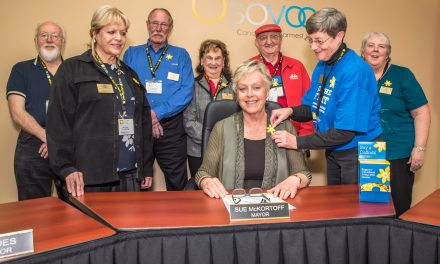
A free program aimed at those who have suffered a stroke is being offered for the first time in Osoyoos.
The new Living with Stroke program is being offered by the Heart and Stroke Foundation (HSF) weekly on Wednesdays from Sept. 17 to Nov. 5 at the Sonora Community Centre. The program runs from 10 a.m. to noon.
“The goal of the program is to help people be out in the community,” said Shelley Nicholl, manager of public relations and communications for B.C. and Yukon with HSF.
“It’s looking not just at physical changes but emotional changes, how stroke affects relationships, reducing future risk, changing your lifestyle and all those things that will make you comfortable going out into the community,” she said.
The program would benefit those who have recently had a stroke as well as those who have had one some time ago and are still dealing with the consequences, Nicholl said.
Family members are also encouraged to attend.
The program may fill up quickly as the target is about 12 participants. In other communities where it has been offered, it has been filled not long after the notice has gone out, Nicholl said.
“Obviously there’s a huge need for it,” she said.
Although strokes more often affect people in older age groups, they can happen at any age, and many people in the under-50 age group experience them, she said.
“People don’t always think it’s going to happen to you at that age, so it’s an important awareness that we’re trying to develop,” she said. “That it can happen at any age and to watch for signs of it.”
It is also possible that people experience a stroke and especially among younger people they may not realize they’ve had one.
“It is imperative that you get care immediately,” said Nicholl. “A lot of people don’t understand or recognize the signs. You have a much better chance of recovering if you get help immediately and that’s quite crucial.”
The impact of a stroke varies greatly from person to person, but impaired mobility is a common result.
It can, for example, affect one side of the body and a person may lose the use of their left or right sides or a portion of them, she said.
“Some people are affected to the extent of being wheelchair bound,” said Nicholl. “For some it’s just being not quite as strong doing things they used to do.”
Speech impairment is also a common result.
With physiotherapy and other treatments, many people are able to overcome or reduce the impact of a stroke.
“There are some really amazing cases where people are determined and go through a lot of physiotherapy,” said Nicholl. “Sometimes people feel that they’re going to lose everything and they’re very determined and they persevere and regain quite a bit.”
The program will discuss options for people to reduce the impact and reduce future risk, she added.
HSF is currently rolling out the first wave of the program in B.C. communities.
It is based on a model first offered in Ontario, Nicholl said.
To register, call 1-888-473-4636 or email [email protected]. More information can be found at www.heartandstroke.bc.ca/livingwithstroke.
RICHARD McGUIRE
Osoyoos Times