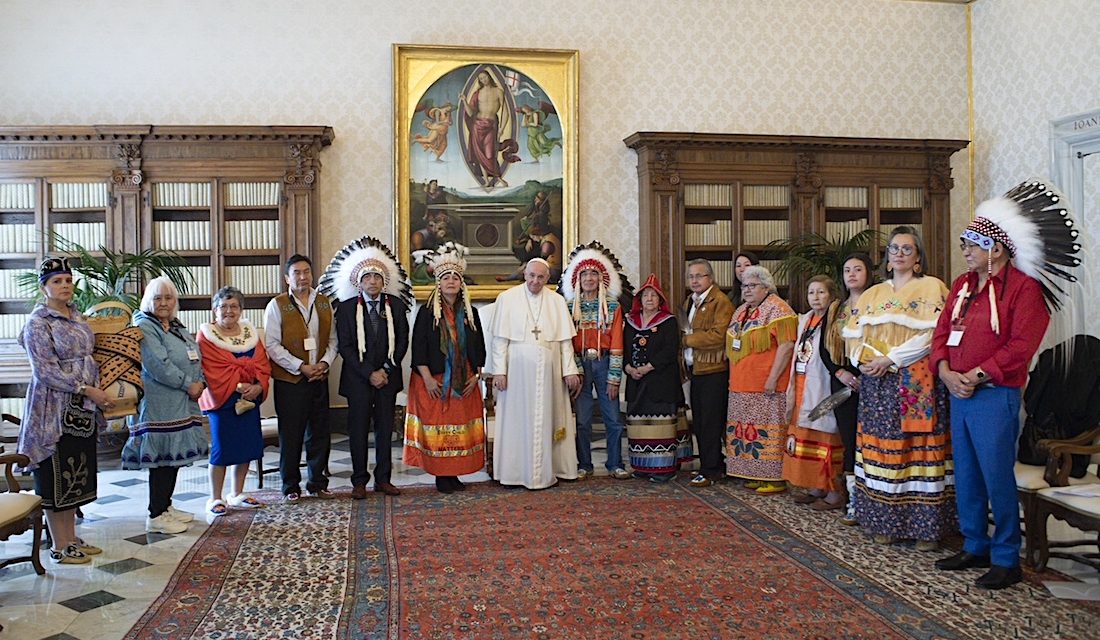
The long-awaited papal apology for the Roman Catholic Church’s role in wide-ranging abuses at Indian Residential Schools has been met with varying reactions from Canada’s Indigenous leaders, with all agreeing this is only a first step.
The Pope sat down with nearly 200 First Nations, Inuit and Métis delegates last week in Rome culminating in an apology that has received a mix of welcomed relief, a desire to do more and outright anger.
Between the 1880s and 1996 more than 150,000 Indigenous children were taken from their families and communities and forced to attend residential schools where physical, sexual and emotional abuse were rampant.
Giving his speech in Italian, Pope Francis told delegates that listening to their stories over the course of a few days “made me feel two things very strongly: indignation and shame. Indignation, because it is not right to accept evil and, even worse, to grow accustomed to evil, as if it were an inevitable part of the historical process.”
Pope Francis continued that he also felt “sorrow and shame – for the role that a number of Catholics, particularly those with educational responsibilities, have had in all these things that wounded you, in the abuses you suffered and in the lack of respect shown for your identity, your culture and even your spiritual values.”
“All these things are contrary to the Gospel of Jesus Christ. For the deplorable conduct of those members of the Catholic Church, I ask for God’s forgiveness, and I want to say to you with all my heart: I am very sorry. And I join my brothers, the Canadian bishops, in asking your pardon,” he said.
Pope Francis also noted that “any truly effective process of healing requires concrete actions.” As such the Pontiff encouraged the Bishops and the Catholic community to continue taking steps toward the “transparent search for truth and to foster healing and reconciliation.”
“These steps are part of a journey that can favour the rediscovery and revitalization of your culture while helping the Church to grow in love, respect and specific attention to your authentic traditions. I wish to tell you that the Church stands beside you and wants to continue journeying with you,” Pope Francis said.
He also expressed his desire to come to Canada, something Indigenous leaders have been calling for, for years.
“I have been enriched by your words and even more by your testimonies. You have brought here, to Rome, a living sense of your communities. I will be happy to benefit again from meeting you when I visit your native lands, where your families live. So I will close by saying ‘until we meet again’ in Canada, where I will be better able to express to you my closeness.”
Indigenous leaders react
Leading the Indigenous delegation was Assembly of First Nations (AFN) NWT Regional Chief Gerald Antoine who said he was pleased with the outcome of the meeting with the Pope.
“The acknowledgment of genocide and the apology offered today by Pope Francis is a significant gesture and a historic step to fulfilling the requests of the former residential school students which is supported by the Truth and Reconciliation Commission’s Call to Action #58. The next step is an apology to all our original nation of families in our home, Turtle Island.”
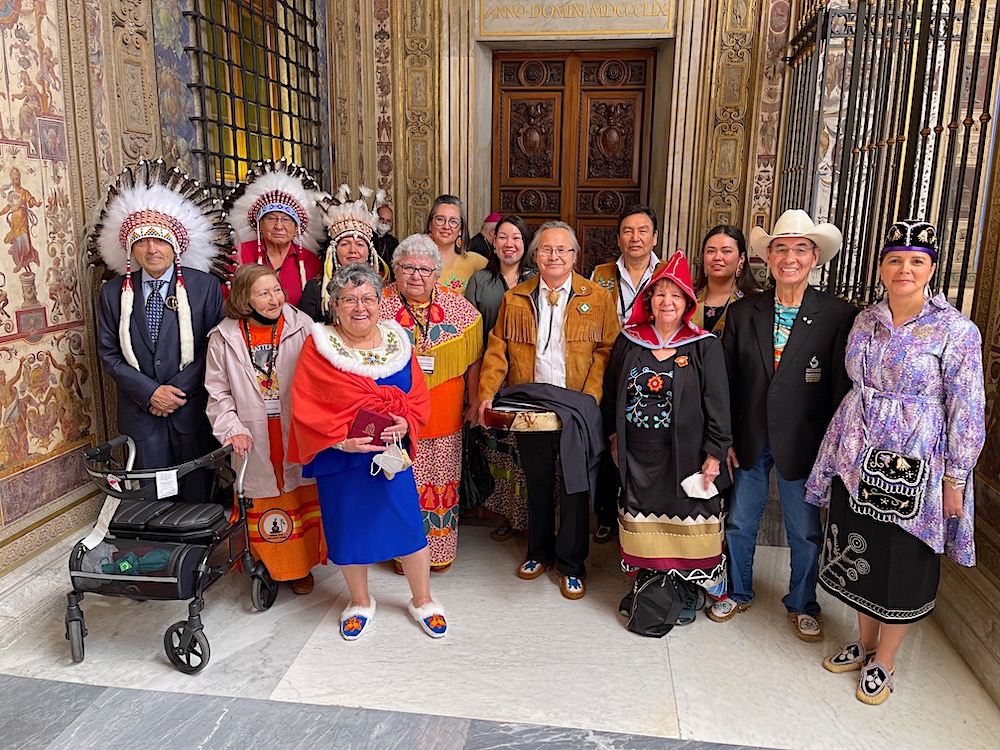
Photo courtesy of the Assembly of First Nations.
AFN National Chief RoseAnne Archibald also welcomed the “long overdue” apology saying work must urgently begin on the next steps on the healing path forward, which includes action on “reparations and revoking the Doctrine of Discovery.”
“The rescinding of the Doctrine of Discovery is the most important requirement as it is the seed that gave birth to genocidal processes which the residential institutions is one of these genocidal processes of domination,” Archibald highlighted.
This doctrine is embodied in the Papal Bull of 1493, issued by Pope Alexander, in which the church authorized Spain and Portugal to colonize the Americas and its Indigenous peoples.
The Bull stated that any land not inhabited by Christians was available to be “discovered,” claimed, and exploited by Christian rulers and declared that “the Catholic faith and the Christian religion be exalted and be everywhere increased and spread, that the health of souls be cared for and that barbarous nations be overthrown and brought to the faith itself.”
Judy Wilson, Union of BC Indian Chiefs (UBCIC) Secretary-Treasurer, similarly called for the renunciation of this doctrine. “The Pope must renounce the doctrine of discovery and the missionary mandate to Christianize First Nations peoples. He must directly involve those that experienced these atrocities and recognize those that didn’t make it home.”
“Respect for our language, culture and identity is not something we need to remind institutions is necessary—these are our fundamental human rights, protected by international and Canadian law.”
Wilson also underscored that prior to the Pope’s visit it is necessary for the Canadian Catholic entities to fulfill their obligations under the 2006 Indian Residential Schools Settlement Agreement and “fully pay their share that has remained outstanding since Canada let them off the hook in 2016.”
Grand Chief Stewart Phillip, UBCIC President, also highlighted the role that all of the Catholic entities and the Catholic Church played in the residential school system.
“This was more than abuses by a few individuals—it was in its entirety a massive human rights violation and part of a systemic and institutionalized attempt to destroy our communities that left deep intergenerational emotional damage and harm that continues to date,” he said.
He too expressed the importance of commitments to restitution and reparation, including to “repatriate lands used for church mission work and to enter into a new relationship based on mutual understanding, self-determination and respect.”
Referring to the church’s legacy of “missionary colonialism, racism and forced removal of children,” Chief Don Tom, UBCIC Vice-President said a full apology should be nothing less than the Pope’s contrition expressed to the Irish in 2018, which included a clear apology for the “crimes” committed by the clergy and church.
“I hope the words of the apology in Canada will be strong and promote real change. Today was a beginning, but not the end of the need for a full apology. We stand with all residential school survivors and seek real change,” Tom said.
Here in the Okanagan, the Okanagan Nation Alliance (ONA) referenced the Papal apology and the recent federal government pledge of an additional $2.9 million to assist in the “recovery” of unmarked remains from Indian Residential Schools across Canada. Over 7,000 unmarked graves have been identified in the last year.
The Syilx Nation said that collectively these actions “continue to fail to take responsibility for the criminal acts of genocide that occurred at Indian Residential Schools” and simply divert resources that are desperately needed on the ground to ensure that justice is served.
“We are past apologies – there is no forgiveness for the murder and attempted murder of our children,” Penticton Indian Band Chief Greg Gabriel said in response to the Papal apology.
“We have no faith in the processes being taken by colonial institutions and are demanding that the Vatican, Roman Catholic Church and Government of Canada move beyond empty apologies.”
“They have actively and explicitly tampered with evidence of their crimes and need to be investigated and held accountable. We will not be silent about those governments or organizations working to protect their own interests – tampering with evidence, deflection of responsibility and accountability,” Gabriel said.
Osoyoos Indian Band Chief Clarence Louie, who is also the current ONA Tribal Chair said the impact of genocide upon all Indigenous peoples is a horrific legacy of Canada’s history. It will “take more than Truth and Reconciliation talk to ever come to terms with what our people have had to live through to be here today.”
“We are demanding justice, equality, and actualization of human rights, not apologies without real action. This colonial history was a collusion of the State and the Church — that is the Truth.”
Cassidy Caron, president of the Métis National Council (MNC) reflected on the week-long visit saying it was “at times emotional and difficult,” but added that the trip was an opportunity to share with the world the experiences of the Métis in residential schools, “an often-neglected part of our Nation’s history.”
The Métis Nation invited the Pope on a “pathway forward of truth, healing, reconciliation, and justice. Today’s apology is historic,” explained Caron, “it opens a door for the Métis Nation to continue moving forward on our healing journey and it opens a door for us to continue to fight for action.”
Similarly, national Inuit Leader Natan Obed, one of seven Inuit delegates, called for specific actions by Pope Francis to advance reconciliation with Inuit. This includes delivering an apology in Canada to Inuit survivors of residential schools administered by the Catholic Church, including the Turquetil Hall residential school in Chesterfield Inlet, Nunavut, and Grollier Hall in Inuvik, Northwest Territories.
They also requested the Pope direct the Canadian Conference of Catholic Bishops to fulfill both the spirit and letter of the Church’s legal obligations under the Indian Residential Schools Settlement Agreement, including immediate payment of $25 million in financial restitution to survivors of residential schools and “provide complete and immediate access to relevant documents in the Church’s possession” that are necessary to identify Inuit children who may have died while at residential schools.
And the Church must commit to working with police, governments and Inuit to bring about justice for survivors of abuse and their families. This includes bringing French national, Johannes Rivoire, an Oblate who sexually abused Inuit children in several Inuit communities to justice through extradition to Canada or trial in France.
“Inuit, as with other Indigenous peoples, continue to struggle against the forces of colonialism and colonization that have eroded our language and culture, dispossessed us of parts of our spirituality and traditional territory, and caused significant social and economic challenges within our communities.
“I call on you as both the head of the Catholic Church and the head of state of one of strongest seats of power in the world, to do what is right, what is just, what is needed, and what is entirely within your power as Pontiff,” Obed said.