Madeline Baker, Times Chronicle
Political figures across Canada have already begun to speak out about the United States Supreme Court’s overturning of the Roe v. Wade decision that legalized abortion and affirmed a woman’s right to make the choice.
The historic 1973 ruling has long stood as a barometer of women’s rights in the United States, as it kept individual states from banning abortion and certain forms of contraception, such as the “morning-after” or Plan B pill. Friday’s supreme court decision will end constitutional protections for abortion and leave states to form their own laws.
Here in Canada, Prime Minister Justin Trudeau took to Twitter in defense of women’s reproductive rights when the decision was announced. He called the results of the vote “horrific,” and reassured Canadian women that “we will always stand up for your right to choose.”
He also expressed empathy for the American women who will be impacted by this choice, saying, “My heart goes out to the millions of American women who are now set to lose their legal right to an abortion. I can’t imagine the fear and anger you are feeling right now.”
Trudeau, who has been proud to identify as a feminist since his appointment as Prime Minister in 2015, took action when the decision was leaked earlier this year by allotting $3.5 million of his government’s funds to improve abortion access in Canada.
NDP leader Jagmeet Singh called the decision “disturbing” and “devastating,” and warned that lives will be lost due to this ruling despite the pro-life rhetoric that surround s the issue: “You cannot make abortion illegal,” he said, “you can only make safe abortion illegal.”
In BC, the provincial NDP government spoke out strongly against the possibility of this ruling when it was leaked as a draft. At the time, Finance Minister Selina Robinson said during question period that abortion rights for BC citizens would only be revoked “over my dead body.”
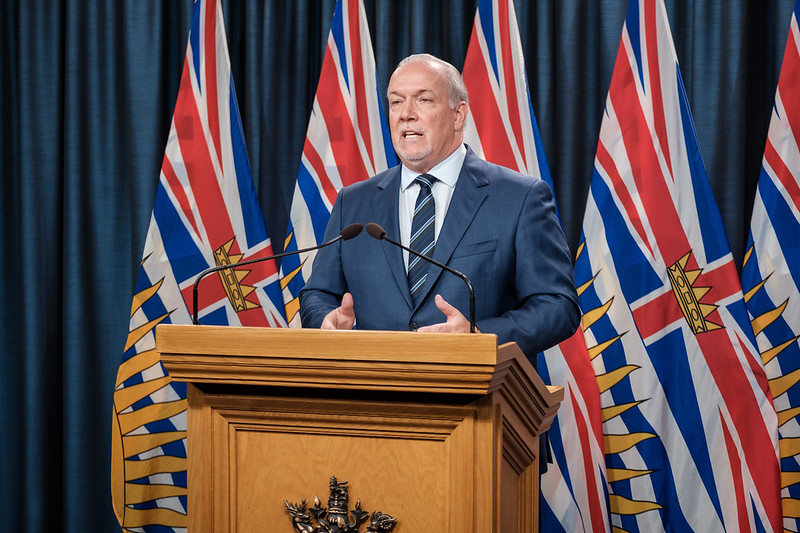
Upon learning that the ruling had become official, Robinson joined with Premier John Horgan and Secretary for Gender Equity Grace Lore to issue a statement that declared June 24, 2022 “a dark day” that will cause generations to endure “devastating consequences.”
“Today, we grieve alongside all those heartbroken by this news,” read their statement. “The U.S. Supreme Court’s decision to overturn Roe v. Wade represents a horrific turning back of the clock. Women in the United States are facing a future where they have less control over their reproductive rights than did their mothers and grandmothers.”
“Our government will never, ever back down from supporting a woman’s right to choose.”
Federal Conservative interim leader Candice Bergen was also quick to respond to Friday’s decision, saying in a statement that “access to abortion was not restricted under Prime Minister Stephen Harper, and the Conservative party will not introduce legislation or reopen the abortion debate.”
Tory leadership candidate Jean Charest agreed that “reproductive rights in Canada are non-negotiable,” though he acknowledged that “there are strongly held beliefs on this issue” here as well as in the United States.
The only historical push to criminalize abortion in Canada after its decriminalization in 1988 occurred under former Prime Minister Brian Mulroney, as declassified court documents revealed in 2013.
Mulroney’s health minister at the time, Jake Epp, argued along with other anti-abortionist members of cabinet for a complete ban on abortion from the moment of conception. The debate stagnated until 1990, when Mulroney’s Conservative government introduced Bill C-43 to the House of Commons.
Bill C-43 would have criminalized all abortions not “done by, or under the direction of, a physician who considered that the woman’s life or health was otherwise likely to be threatened,” with violations subject to a penalty of up to two years imprisonment.
While it passed in the House of Commons, the bill was struck down by the senate in a 43-43 vote that, according to senate rules, amounted to a negative vote.