
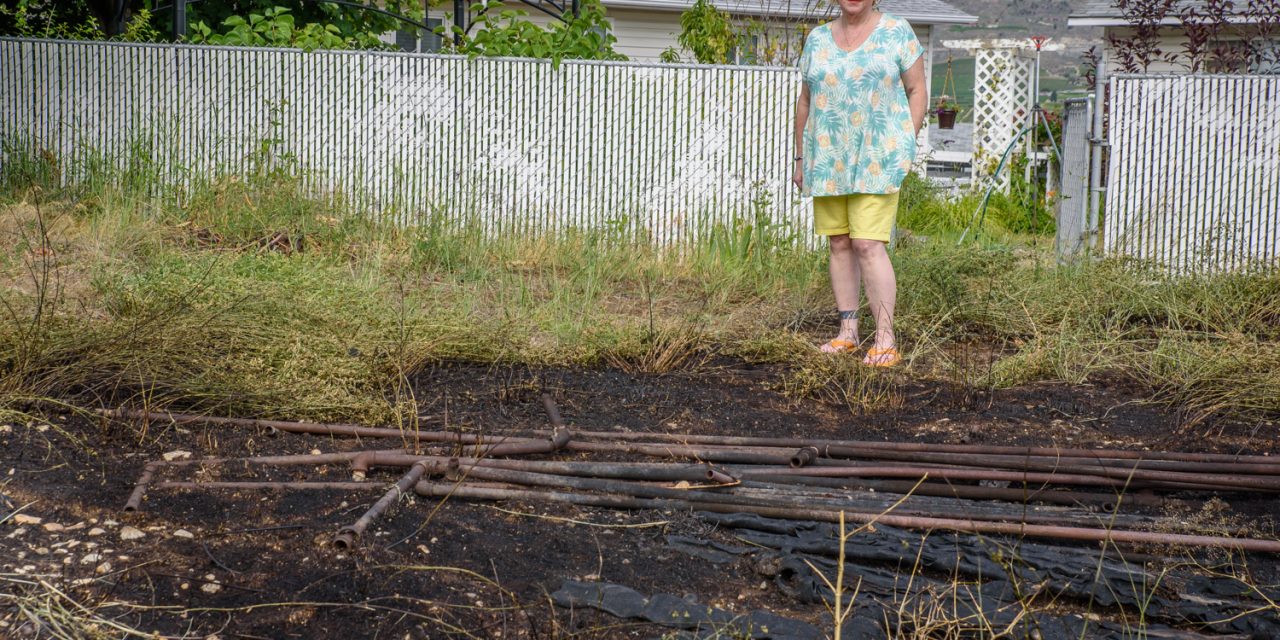

Sharon Kwong-Wah shows the charred remains of a fire that broke out next to Highway 97 next to her house last Wednesday. She blames lack of maintenance by the Ministry of Transportation and Infrastructure. The brush was overgrown and junk was dumped along the highway, including these pipes. (Richard McGuire photo)
First, thousands and thousands of elm seed bugs invaded residents of Larkspur Place.
Then, last Wednesday, a fire broke out in the dried brush and debris in the highway right of way, threatening their homes.
Sharon Kwong-Wah, who lives at the edge of the bug invasion zone, but was closest to the fire and had some of her plants singed, puts the blame on the Ministry of Transportation and Infrastructure (MOTI) for failing to maintain the land next to Highway 97.
“I was waiting for this to happen because that back is so bad and it’s so dry,” she said of the fire that broke out last Wednesday afternoon, apparently triggered by a spark from a neighbour’s welding.
“It’s just tinder waiting to explode,” she said. “I’ve asked a number of times in the last couple of years if the highways would please come out and clean up along here and they couldn’t care less. They don’t respond.”
Neighbours also blame MOTI for the bug invasion. The highway right of way next to their homes is also covered with invasive Siberian elm trees, many of them tall.
And, as the elm seed bug’s name suggests, these trees provide the perfect food.
In December, the B.C. Ministry of Agriculture released a Pest Alert about the invasive elm seed bug and its fellow traveller, the tuxedo bug.
The elm seed bug comes from the Mediterranean region of Europe and arrived in Kelowna in 2016.
Although they were seen here last year, this is the first year they’ve invaded parts of Osoyoos in full force.
Kwong-Wah says that when she sits down to try to read a book, the bugs cover her.
“They’re through the house, they’re all over the outside, they’re in your hair, they’re on your clothing,” she said. “We don’t have the bugs as bad as the rest of the neighbours, but still, I sit down in the evening to watch TV and I’m picking them all out of my carpet.”
A neighbour didn’t wish to be identified, but she was willing to show the Osoyoos Times how the elm seed bugs have invaded her home – inside and out.
They’re on the decks, in the windows, on the soffits and roof, and they’ve left their tarry brown excrement on the white sides of her house. Indoors, they’ve covered the floor, and there are thick clusters of them at the bottom of some sliding patio doors.
The neighbour, who calls herself “a big tree hugger,” normally won’t kill a fly. But she makes an exception for mosquitos and now elm seed bugs.
“It’s been absolutely overwhelming,” she said. “Extreme discomfort, anxiety and it’s from the moment I wake up.”
Trying to control the bugs, she said, has become “a full-time job.”
She said she was in tears when she called Mayor Sue McKortoff last week.
But there’s little the town can do because the debris that caused the fires and the invasive Siberian elms that cause the bug invasion are on the provincially controlled Highway 97 right of way. Nonetheless, the town did contact MOTI.
A spokesperson for MOTI says ministry staff are aware of the elm seed bug infestation, but they were not aware of the fire.
“Our maintenance contractor’s danger tree assessor inspected the site last Friday afternoon and the results of his assessment are expected this week,” she said Monday.
“Our maintenance contractor reports that there is dried vegetation within the right of way, but there is no requirement in the maintenance agreement for the contractor to remove dead vegetation in the highway right of way,” she continued. “If the danger tree assessment identifies any of the trees as being a danger tree, the ministry will have those trees removed.”
She added that the ministry mows grass from the shoulder’s edge to 1.8 metres beyond.
“The ministry’s maintenance contract does not require the maintenance contractor to remove combustible dried vegetation within its highway rights of ways,” the spokesperson continued. “The maintenance contractor is responsible for removing garbage within the right of way that is visible from the travelled portion of the road.”
Kwong-Wah points to a mass of discarded irrigation pipes lying on the charred ground. These would not be visible from the highway and therefore not the contractor’s responsibility, but who is responsible?
The MOTI spokesperson adds that the ministry partners with the regional district in a program to control the spread of invasive species and noxious weeds within its right of way.
Information about fire prevention and funding opportunities for communities to undertake fire mitigation is available through the Ministry of Forests, Lands and Natural Resources, she adds.
Kwong-Wah isn’t happy with the situation.
“Something’s got to be done with them,” she says of the elm trees that make the seeds that feed the bugs. “We’re not the only ones in town that are complaining about those things.”
RICHARD McGUIRE
Osoyoos Times

Sharon Kwong-Wah shows a few of the bugs captured that day at their house. Neighbours have it worse as thousands of elm seed bugs have descended upon them. She and neighbours blame the Siberian elm trees along Highway 97 behind them, which she says the Ministry of Transportation and Infrastructure doesn’t control. (Richard McGuire photo)




I live in the town of Osoyoos, and have the same problem with the bugs, we only have one tree on the lot next door to us. No one lives in the house that owns the lot, and tree. I might also say, the tree is right at the fence, and our driveway. It’s huge and now saplings are sprouting up on our side. They will die a lingering death as I will be spraying them with Round up as soon as it is still outside. Town says they can’t do anything, even send the owners a letter, because it’s private property. Find that hard to believe, because it is a evasive tree, and they should all be destroyed. If not, we are all in for trouble down the road. No one will escape these bugs.
Elm street bugs have invaded homes on 89th street, it’s a nightmare. Town should come up with a plan to help people rid Elm trees from their properties. We can’t live with these bugs every summer!