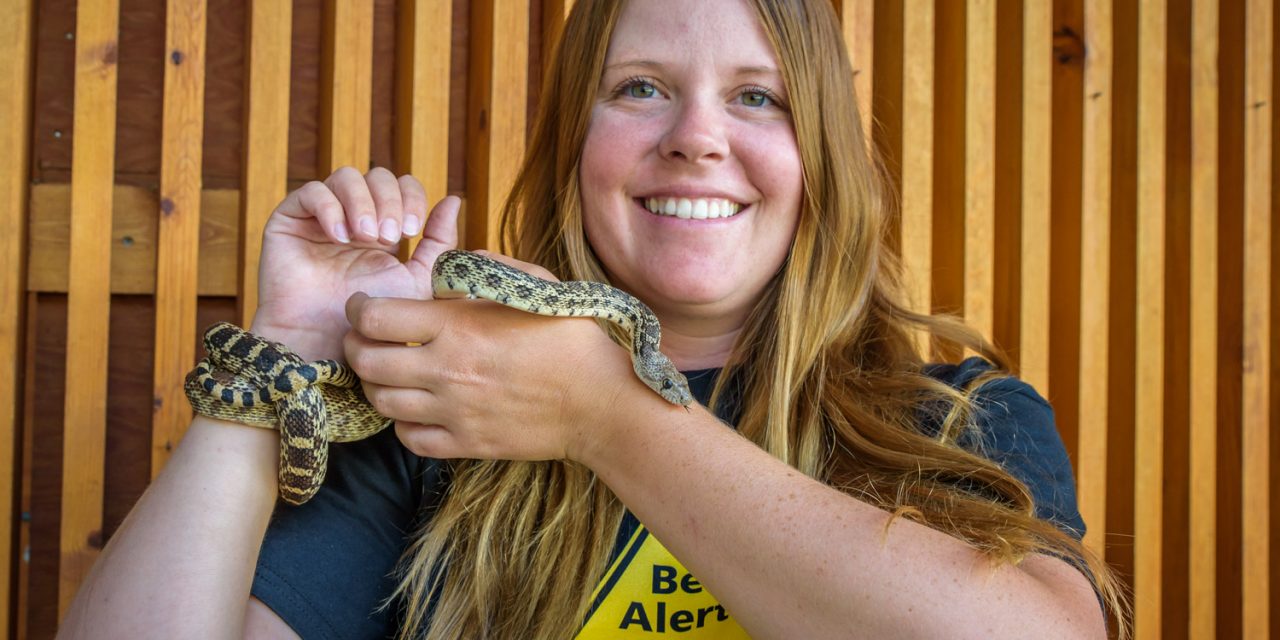

Biologist Dana Eye shows off a gopher snake at Nk’Mip Desert Cultural Centre. The centre will be holding a series of events on World Snake Day, July 16. Eye is a Masters student at Thompson Rivers University, and is in charge of the Snake Research Program, which is marking 15 years. (Richard McGuire photo)
Snakes probably aren’t the area’s most loved creatures, but biologist Dana Eye hopes some of those attitudes will change when Nk’Mip Desert Cultural Centre celebrates World Snake Day on Monday, July 16.
The centre plans various educational and fun activities throughout the day to raise awareness of these important, but maligned creatures.
“I think it’s really important to put snakes on a platform at least once a year,” says Eye, a Masters student at Thompson Rivers University (TRU), who is running the Snake Research Program at Nk’Mip.
“I just think that they are under-recognized and underappreciated, especially with the great fear that people have of rattlesnakes, for example,” she continued.
Next Monday’s program kicks off at 9:30 a.m. to 10:30 a.m. with an interpretive plant and snake ID walk on the Nk’Mip interpretive trail. This is led by biologists Vanessa Robinson and Anna Skurikhina.
As it gets hotter, the program moves indoors with the popular Snakes Alive presentation by Eye and Cole Hooper. This presentation runs in the theatre from 11 a.m. to noon and tells about the snakes that live in this area. Some of the snakes make appearances.
From 12:15 p.m. to 1:30 p.m. there is an open house in the Snake Research Lab, where people can see the equipment and learn about such things as how snakes are measured.
This is followed by a children’s colouring contest, which is new this year, from 1:30 to 2 p.m.
“We wanted to incorporate something for kids, so they’ll get to colour a special drawing made by an interpreter here,” said Eye.
Special guest speaker Dr. Karl Larsen, a wildlife professor from TRU, will speak about snakes, covering such topics as: “Why Brake for Snakes?” and “Snake Lore, Snake Fact and Something In Between.”
He’ll be accompanied by Omarah Talon Paul, an Nk’Mip interpreter.
Eye hopes the session with Larsen at 2 p.m. will be well attended.
“He’s a wildlife professor, so he has a background in giraffes, rattlesnakes, badgers – he’s done it all,” she said. “He has many areas of interest. He is a huge herpetologist and he really appreciates snakes, turtles and amphibians.”
Eye said she’s always been interested in wildlife, but her interest in snakes has grown.
“I started off just as a wildlife enthusiast, but I thought it would be neat to try something different,” she said. “It turns out I loved it. The first snake I held, I was hooked. I really do love working with them.”
The Snake Research Program at Nk’Mip, now 15 years old, monitors the daily migrations of snakes and also looks at other factors including stress hormones, snake diet, foraging areas, mating and more.
Usually the males are studied, but Eye said she’s the first biologist here to work with female rattlesnakes. She is studying pregnant females. This is a research field that hasn’t been studied much out of concern about stressing the snakes and causing them to abort.
New procedures, she said, allow the females to be studied without harming them.
Many snakes move around on the land behind the Nk’Mip Cultural Centre where their movements may be tracked with PIT tags (passive integrated transponder), small transmitters that are inserted into the snake and can be monitored with radio receivers.
The few snakes that are kept in captivity are those previously coming from captive situations, such as being confiscated from people who had them illegally.
“It is illegal to obtain any snakes in B.C. and keep them as a pet,” said Eye. “Any snake that we encounter in the wild, we take information from them and we release them back into the wild.”
Eye estimates that last year she encountered about 150 to 200 rattlesnakes and about 100 each of Western yellow-bellied racers and Great Basin gopher snakes.
But those are only the ones she sees – snakes are generally fearful of humans and they don’t normally advertise their presence.
Rubber boas and terrestrial garter snakes are also found in the area, but she hasn’t seen any at Nk’Mip.
Eye, who is in her second year working with the program, says she’s experienced both negative and positive attitudes to the snakes from visitors.
Some people are afraid of the snakes, but still appreciate the research that’s being done.
Some people, especially from other places such as the U.S., talk about killing rattlesnakes, she said.
“Often we encounter these people and we try to educate them,” she said, adding that it is illegal to kill them, but many snakes die both as a result of persecution and on roadways.
A lot of these attitudes result from misconceptions about snakes, such as the false idea that rattlesnakes will hunt people down and attack them.
“They are actually quite shy and they’re way more afraid of us than we realize,” she said, adding their first reaction is to hide. “They might rattle their tail to warn you that they are there, but the last resort is striking and attacking you. You have to really make a rattlesnake angry for them to resort to that.”
Snakes play a valuable role, especially in this agricultural area where there are so many vineyards, she said.
Notably, they keep the rodent population under control because rodents are their main food source.
They also serve as a barometer telling how well the local environment is doing.
“If snakes are doing well, other things are probably doing well in the ecosystem,” she said. “They tell us a lot about what’s happening in our environment.”
RICHARD McGUIRE
Osoyoos Times

Biologist Dana Eye shows off a gopher snake at Nk’Mip Desert Cultural Centre. The centre will be holding a series of events on World Snake Day, July 16. Eye is a Masters student at Thompson Rivers University, and is in charge of the Snake Research Program, which is marking 15 years. (Richard McGuire photo)