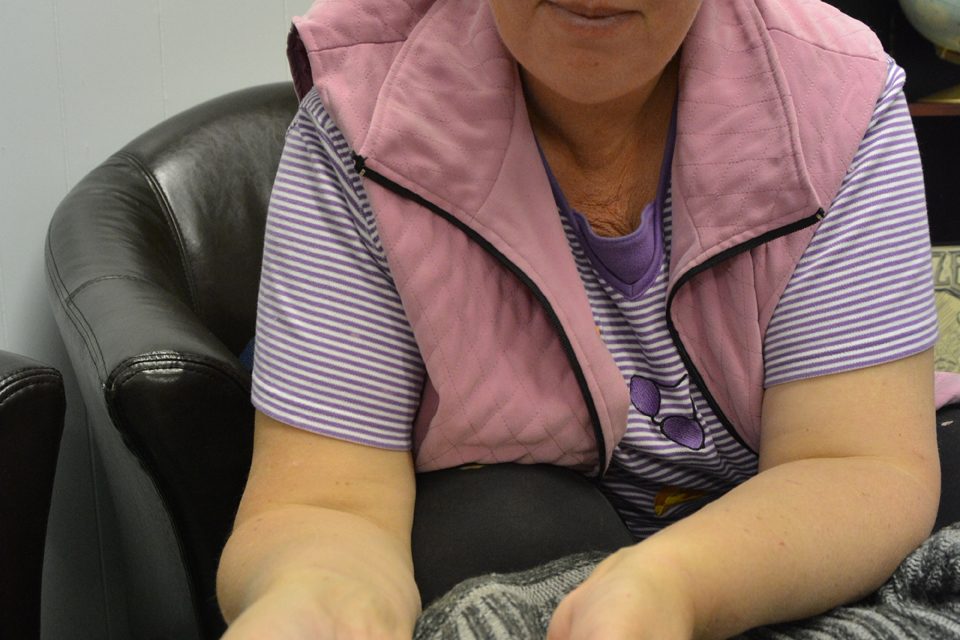

Roslyn Cassells feeds “Little Henry” every three hours to build up his strength. The kitten was found dying on some rocks in a local works yard. Cassells is advocating for affordable spay/neuter programs in order to control the population of cats in communities such as Oliver.
Lyonel Doherty photos
Hearing the desperate cry of a dying kitten in Oliver prompted a teacher to take desperate measures recently.
It was pitch dark and a group of teenagers must have thought Roslyn Cassells was a burglar as she awkwardly scaled the fence at a local works yard.
Cassells heard the heart-wrenching “meow” from a block away, so she quickly investigated. She couldn’t climb the fence, so she had to borrow a ladder. At one point, she got stuck on some barbed wire.
Once over, she located the kitten on some rocks, where it lay suffering in the cold. Part of the umbilical cord and afterbirth were still attached to the kitten.
Cassells wrapped him up in a sweater and took him home. She later called him “Little Henry,” named after an Osoyoos veterinarian who was the only animal doctor who answered the phone that late at night.
Cassells had to bottle-feet Henry every three hours. As a result, she didn’t sleep for days.
She went back to the area to check for more baby kittens, but didn’t see any. But she did see a young female cat that may have been the mother.
“It really made me sad . . . if you heard his (Henry’s) little voice, it was so sad, so desperate.”
Cassells was taken aback by some of the responses from people in the area. One person said, “It’s just one of the cats.” Another commented, “It’s not our problem.”
Yet another complained about all of the wild cats in Oliver, while the owner of a nearby business told Cassells she “better not be feeding the cats.” The lady then blamed the cats for attracting raccoons and other wildlife to town, Cassells said.
But the feline advocate is quick to state that the overpopulation problem is not the cats’ fault. Instead, she points to irresponsible people not spaying or neutering their pets.
“From what I see, there are a lot of unaltered animals living miserable lives. This year there will be hundreds of kittens dying in back alleys.”
Cassells said the most fiscally and ethically responsible way to control the cat population is an accessible and affordable (preferably free) spay/neuter program. According to Cassells, this type of population management is cheaper than trapping and killing the cats.
Without a sterilization program, female cats live on average one year, while males live two years, she pointed out.
“The females die from continuous pregnancies and the males from infections and injuries from fighting.”
 Once given the basic necessities, cats can live an average of 10 years, and over time, the colony dwindles due to attrition, Cassells noted.
She reiterated that trap, neuter and release programs have proved to be more effective than kill policies currently being used in many areas of the Okanagan. They are also more humane.
“We have a duty of care towards domestic animals as they are unable to survive well without human help.”
For more information, contact the Okanagan Humane Society at www.okanaganhumanesociety.ca/ or www.alleycatsalliance.org
Lyonel Doherty
Oliver Chronicle