By Don Urquhart, Times Chronicle
If you think the absence so far of typical spring flooding is going to mean less annoying mosquitos, you’re likely letting optimism get the best of you.
The regional district’s Mosquito Control Program is up and running again this year and early indications are showing less flooded areas but higher concentrations of mosquito larvae in smaller pockets of water.
This year there is less water as a result of the smaller snowpack in the mountains and there hasn’t been the typical freshet of recent years notes Shelley Fiorito, Projects Coordinator with the Regional District of Okanagan-Similkameen (RDOS).
“There’s less water, we haven’t really had the typical freshet so there hasn’t been that sort of early spring flooding that we would normally see,” she explains.
She references a recent update on the spring water (surface and groundwater) supply that the Okanagan Basin Water Board (OBWB) does each year in which the presenters were unanimous in their assessment that any spring freshet has already occurred.
“We just didn’t really notice it because it was that sort of low key,” she says, adding it took place three to four weeks earlier than it has been in the past few years.
From a mosquito control point of view, Fiorito quickly dispels the notion that less flooding equates to less mosquitos. While there hasn’t been a lot of flooded areas that would typically occur each spring, “ there’s a lot of very small pockets that have high counts of mosquito larvae in it.” And it’s “earlier than we would normally see the progression at this point.”
“So the temperature is right, we just haven’t had the flooding that we would normally see, but it is still quite early,” she cautions. “From what we’ve seen, up to this point, the small pockets of water that do exist have an exceptionally high count of mosquito larvae in them.
“So I think we have less water but at best we have the same level of mosquito larvae.” She adds that it’s very tricky to predict how the mosquito season will unfold because it could start raining next week and for ten days after that “and then the picture is entirely different,” she points out.
And if the temperature were to drop below freezing this makes little difference with the early spring Aedes Vexan mosquitos (aggressive daytime biters) as they can still hatch in ice water. The summer mosquito, Culex are the the dawn and dusk biters and can be vectors of disease like West Nile.
“It’s when it gets warmer. The hotter it is, the faster they will cycle through their life stages before they’re up and flying.”
It’s tricky to project, she notes because last year was a very bad year with all the water there was on the ground. “Are we going to get flooding this year, maybe but sort of moderate. I think all our low level snow melt has gone but there is still a little bit of high level,” which has gotten some fresh snow recently, she adds.
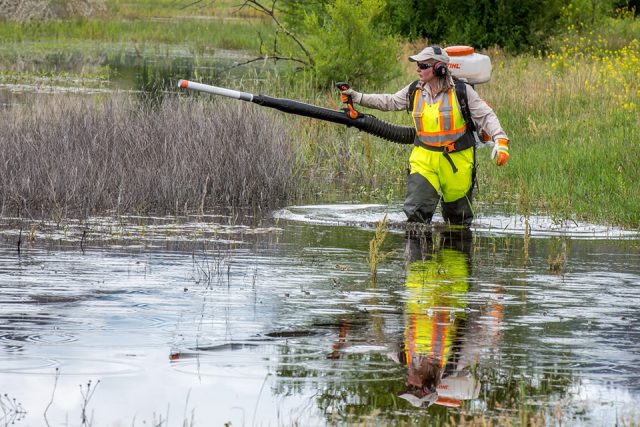
“It’s a fly by the seat of our pants,” kind of scenario she says. Staff are out actively assessing and treating sites and these change from year to year.
“It doesn’t always look the same every year like you’re on a property it may be that we’ve treated that site and it is three meters across, like three metres from the property line, but this year, it could be 12 metres from the property line and only one metre across.
“The pool can sort of shift around based on how high the groundwater table is, what the flooding looks like, how much water is available, and whatever is happening on the property.
“So it’s a matter of monitoring and treating what we find. We really haven’t settled into a routine where we have a solid understanding of what we’re going to be looking at this year.”
She says current efforts are focused on the “swampy pools” underneath the brush because the mosquitoes like “dank, inky, swampy water” and not fresh running water.
The RDOS Mosquito Control Program responds to property owners who contact the RDOS when they cannot effectively drain standing water from their own property. The areas of control include Electoral Area A, B, C, D, F, G and H as well as Summerland, Penticton, Oliver and Osoyoos.
For more information on the program or to obtain a copy of Mosquito Control Principles & Mosquito Control Policies or to report an infestation call the Regional District office at 250-490-4110 or email [email protected]. For general information see the program brochure.