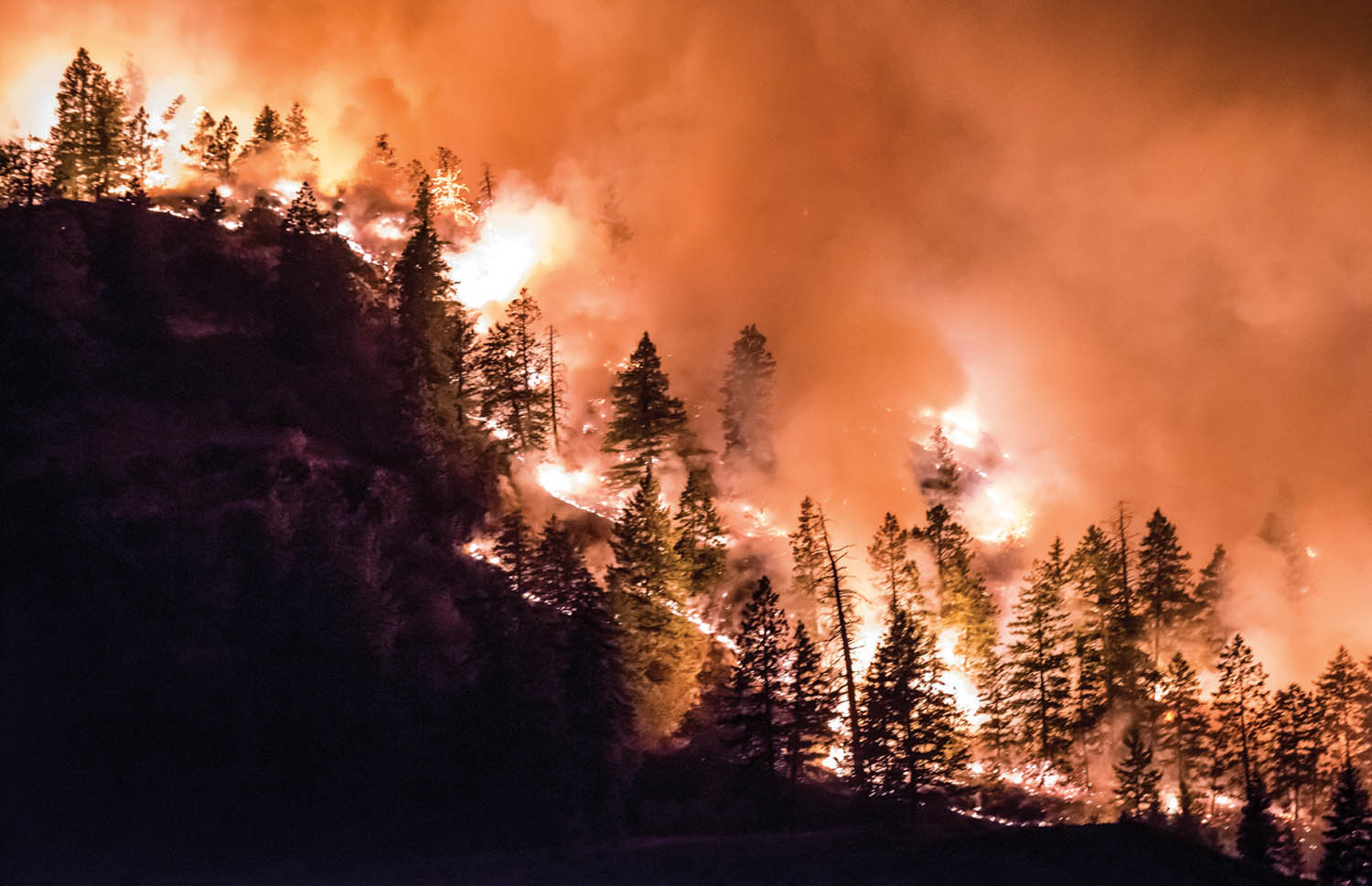
Trees burn as intense flames spread down the base of Mount Kobau just south of Testalinden Creek during one of the many dangerous wildfires that broke out in August. (Richard McGuire file photo)
The outbreak of numerous dangerous wildfires that destroyed homes and forces mass evacuations across the South Okanagan dominated the headlines in August.
For a few days, major wildfires broke out in every direction from Osoyoos as parched drought conditions left forests and grasslands tinder dry. To the north, south, east and west, separate fires raged, stretching firefighting resources, exhausting professionals and volunteers and driving hundreds of residents from their homes.
Closest to Osoyoos, the Testalinden Creek fire erupted on Mount Kobau, burning its way down the slopes almost to Highway 97 over a stretch extending roughly from Road 22 to Road 11.
The fire also swept down the other side of Mount Kobau, jumping Highway 3 between Spotted Lake and Richter Pass, burning its way into Kilpoola Estates just west of Osoyoos.
At least one home was lost there.
An evacuation order affecting about 100 homes was later downgraded to an evacuation alert, but residents at 125 homes were still warned to be ready to leave at a moment’s notice.
The wildfires started breaking out when the largest and most destructive fire started near Rock Creek – apparently with a tossed cigarette – and other fires broke out on Sidley Mountain to the east of Osoyoos and throughout Washington State just to the south.
For several hours, Highway 3 was closed in both directions from Osoyoos with the Testalinden Creek fire closing the road to Keremeos and the Sidley Mountain and Rock Creek fires closing the highway to traffic between Osoyoos and Midway.
Travellers were faced with notices on the Drive BC website advising that there were no local detours available.
The Rock Creek fire gained the most national media coverage as it swept through a campground with almost no warning, forcing people to flee on foot, many leaving trailers behind. More than 30 homes were destroyed, another 15 structures were burned to the ground and dozens were left homeless.
Several fires also broke out in Washington State, one when a plane crashed near the Oroville-Chesaw road, killing two people.
The Testalinden Creek fire spread over several days to cover an area estimated at 1,600 hectares and the Wilson’s Mountain fire reached 317 hectares. At least one structure was burned in each fire.
An Emergency Social Services Reception Centre was set up by the RDOS at the Oliver Community Centre. A second reception centre at the Sonora Community Centre in Osoyoos, but closed the following day.
The RDOS issued evacuation orders for 260 homes affected by the Wilson’s Mountain Fire and for 100 homes affected by the Testalinden Creek fire, including those west of Highway 97 and in Kilpoola Estates.
Oliver Mayor Ron Hovanes was choked with emotion as he thanked the firefighters and other volunteers for their efforts. Also speaking were RDOS Chair and Area A director Mark Pendergraft and Terry Schafer, Area C director, both looking worn out.
“I’ve lived here pretty much my whole life and I don’t think the town or the rural areas have ever been faced with something quite like this before,” Hovanes told reporters and a scattering of local residents. “The community really came together, the volunteers are really precious for the work they do for this community.”
Within two days, the fires were largely reduced to smouldering ground with minimal open flames, although areas of Mount Kobau were still burning.
Somebody illegally operating an unmanned aerial vehicle or drone over the fire at Testalinden Creek put aircraft at risk.
“Eight helicopters and five fixed-wing aircraft that were supporting ground crews were grounded and significantly impacted fire suppression operations,” B.C. Wildfire Services said in an information bulletin.
It wasn’t until much later in the day that the air operation was able to resume and by then some new areas were on fire.
Schafer said events like the fires showed what the community is made of.
B.C. Premier Christy Clark stopped in Oliver to personally thank firefighters for risking their safety to save the community from two dangerous wildfires.
Clark shook the hand of members of the Oliver Fire Department and their families during a quick visit to the Oliver Community Centre, where members of town council and emergency social services were gathered.
“Thanks for everyone coming together. It is times like this in B.C. that we know what we’re made of. We’re so lucky to have these volunteers,” said Clark.
In other news, federal election signs were springing up in South Okanagan-West Kootenay (SOWK) in what would be the longest election campaign since the time of Sir John A. Macdonald.
The 11-week campaign leading to an Oct. 19 election was launched in August when Prime Minister Stephen Harper visited Governor General David Johnston.
First to roll out local campaign signs was Conservative candidate Marshall Neufeld. His sign crews were busy in Penticton and Okanagan Falls in the first couple of days, with signs soon following in Osoyoos and the Kootenays.
Liberal candidate Connie Denesiuk said the lengthy election campaign means “the sea of signs is going to grow old very quickly.
“We’ve gone backwards during the Harper decade and we need to get Canada back on track economically,” Denesiuk said.
KEITH LACEY
Osoyoos Times
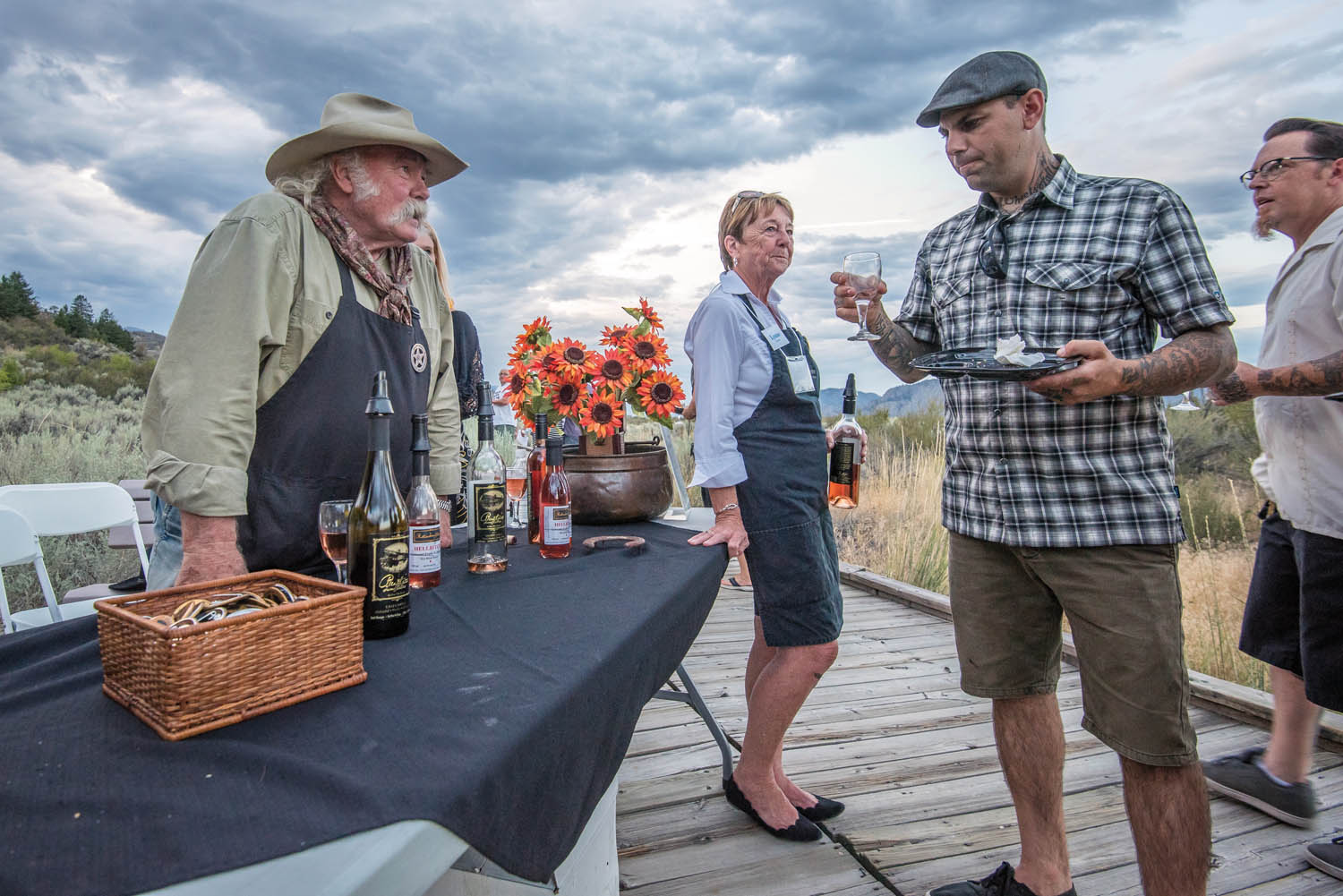
Bruce Fuller (left) of Rustico Farm and Cellars chats with guests as they sample wine on the boardwalk at the Osoyoos Desert Centre during Romancing the Desert last August. The event is a fundraiser for the Osoyoos Desert Society. (Richard McGuire file photo)

Three horses race side-by-side after leaving the gate at the first of two race days scheduled for Desert Park last August. The second date had to be cancelled due to the wildfire situation. (Richard McGuire file photo)