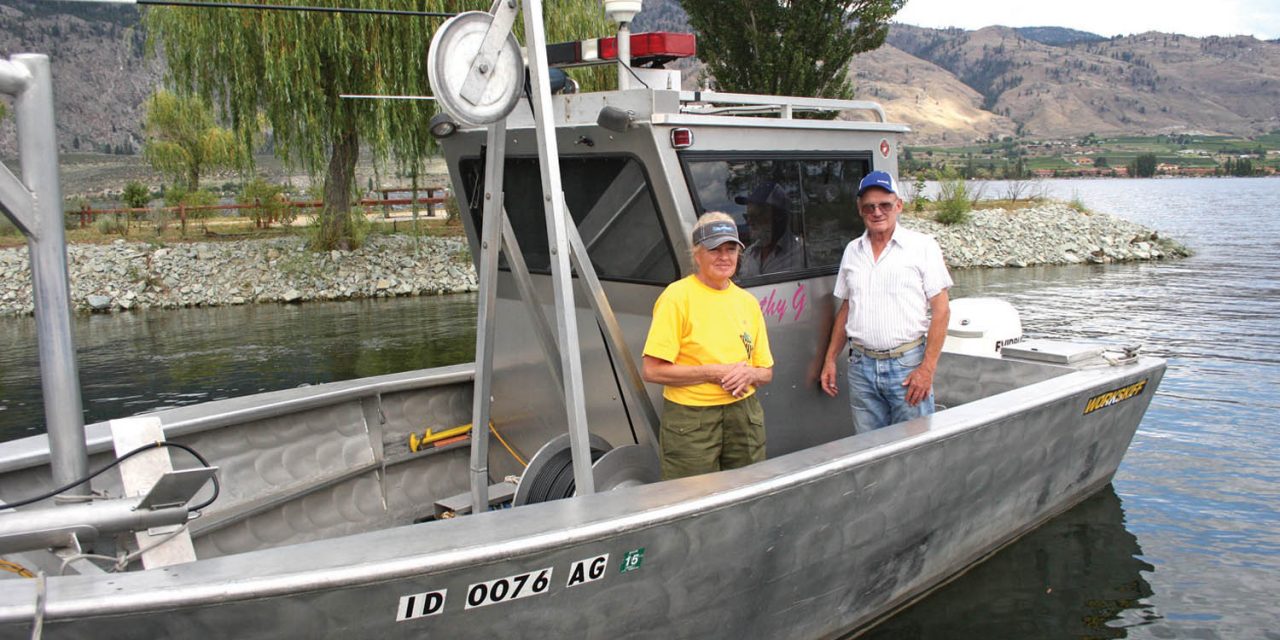
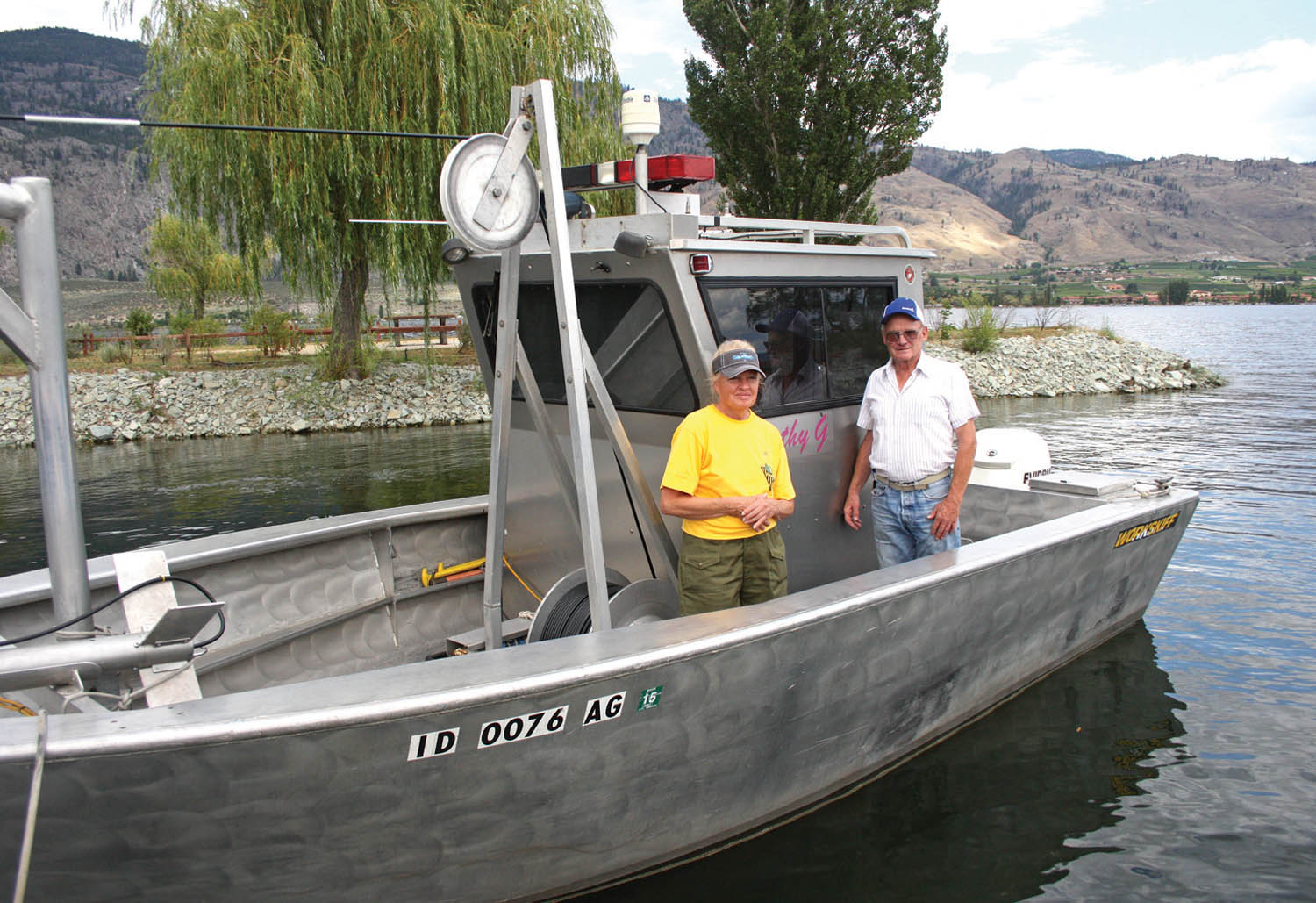
Gene and Sandy Ralston of Idaho, who have gained worldwide attention for their ability to find drowning victims using sophisticated sonar equipment, were invited to Osoyoos to look for a young man reported missing in Osoyoos Lake. They didn’t find the body during their first visit, but returned several weeks later and did find the man. (Keith Lacey file photo)
A manhunt for a repeat violent offender in the Oliver and Osoyoos area and a ban on fishing for sockeye salmon on Osoyoos Lake due to an extended drought made headlines in July.
The popular commercial and recreational salmon fishery operated by the Okanagan Nation Alliance (ONA) on Osoyoos Lake was cancelled in July.
That decision was made by ONA senior management after the provincial government announced all river and stream angling across large swaths of British Columbia would be shut down due to unprecedented drought conditions.
Responding to dry conditions, the provincial government announced a Level 3 drought rating for the Thompson, Nicola, Similkameen, Kettle and Skagit regions and had taken the additional action of suspending angling in streams and rivers throughout the South Okanagan due to ongoing low stream flows and warming water temperatures.
The ban went into effect in late July and would continue through Sept. 15.
Lake fishing will still be allowed, but the Okanagan Nation Alliance decided not to conduct its annual recreational and commercial fishery on Osoyoos Lake.
Richard Bussanich, fisheries biologist for the Okanagan Nation Alliance (ONA), confirmed the entire recreational and commercial fishery that traditionally takes place each summer on Osoyoos Lake would be cancelled due to serious drought conditions, which had already killed tens of thousands of sockeye salmon that traditionally travel from the United States towards Osoyoos Lake and South Okanagan tributaries.
“This is a good call … the situation is dire,” said Bussanich.
The extreme drought conditions led to near-record high water temperatures and limited oxygen supply for hundreds of thousands of sockeye salmon that were expected to make their way to Osoyoos Lake.
“The bottom line is that many fish have already been killed,” he said. “We were expecting as many as half a million at the mouth (Washington State tributaries) … and between 200,000 to 300,000 haven’t been accounted for.”
You could almost hear the collective sigh of relief across the South Okanagan in late July when it was announced that Ronald Teneycke had been captured.
The dangerous fugitive, who was roaming the backcountry of Oliver, was finally off the streets after an exhaustive and extended manhunt that lasted several days.
Fortunately, there were no casualties in the orchard in Cawston where the manhunt ended.
“We are thankful the arrest was made without any injuries to our officers, the general public, or Teneycke,” said RCMP spokesman Cpl. Dave Truman.
There were unconfirmed reports that the 53-year-old fugitive high-tailed it to the Similkameen after allegedly wounding an Oliver man during a confrontation on a forest service road to Mount Baldy.
The reported victim thought Teneycke was a hitchhiker and told him to get out of his vehicle when he discovered who his passenger was and was consequently assaulted with a weapon.
Tenecyke then stole the man’s pickup truck.
It was later confirmed an Oliver area man was wounded by a bullet fired by a rifle Teneycke was carrying and airlifted to hospital in Kelowna for treatment.
Sergeant Blaine Gervais from the Oliver RCMP thanked the public for many tips and reported sightings that led to Teneycke’s arrest.
Teneycke was suspected of robbing the Eastside Grocery in Oliver. The fugitive was able to evade capture for several days, putting a lot of residents on edge.
Teneycke remains in prison and his trial on numerous serious charges is expected to take place later in 2016.
Also in July, the investigation of a fire at Kobau Lanes bowling alley and Vengeance Fitness in Osoyoos was turned over to the RCMP, who later determined it was caused by arson.
Osoyoos Fire Chief Rick Jones said Osoyoos firefighters answered the call.
“The damage with smoke and water is extensive,” said Jones. “The Kobau Lanes is damaged by water. Vengeance is smoke and some fire.”
Jones said bowling lanes would be expensive to replace.
Neither business had reopened as of the end of December.
An Idaho couple who has gained worldwide attention for their commitment to recovering the bodies of drowning victims was called to Osoyoos by the family of a man reported missing in Osoyoos Lake.
Gene and Sandy Ralston made the long trip from southwestern Idaho to Osoyoos in July and spent several days using their sophisticated “side-scan sonar” to try and recover the body of the man reported missing on Osoyoos Lake after he fell off his jet ski in late June.
The Ralstons, along with longtime friend and deckhand John Zeman, have gained national and international recognition as they have travelled across North America and around the world helping grieving families to recover the bodies of drowning victims.
“We basically stay until we feel that all possible avenues have been exhausted,” said Gene Ralston, who has been married to Sandy since 1972.
Over the past decade, the Ralstons had recovered 98 bodies using what they call their “underwater robot”, which allows them to search in waters as deep as 850 feet.
The Ralstons were unsuccessful in finding the body in July, but returned several weeks later and were successful in recovering the man.
The Ralstons have given generously of their time for more than a decade as they spend between 100 to 200 days per year away from their home and family to conduct searches and offer training to search and rescue operators across the United States, Canada, Mexico and other countries around the world.
In an exclusive report from the Osoyoos Times, it was also revealed in July that planning was underway in early 2011 for a joint celebration of the signing of a national park agreement between Parks Canada, British Columbia and local First Nations – after the provincial cabinet secretly decided not to proceed with a park.
The agreement would lead to a new national park reserve in the South Okanagan-Lower Similkameen (SOLS), protecting an area of temperate grasslands that is unique in Canada and is a missing link in Parks Canada’s goal of representing each of Canada’s natural regions in its parks network.
Unaware the province had killed plans for a park, Parks Canada officials were mulling whether to hold an event on June, 21, 2011, National Aboriginal Day, or whether to hold it on July 15, 2011, British Columbia Parks Day.
Suddenly, as the result of the secret decision by the B.C. Liberal government’s cabinet, the planning came to a crashing halt. Parks Canada was left dangling for nearly a year before B.C. announced its decision not to proceed with the national park. The planning of the park announcement is just one detail contained in 126 pages of Parks Canada documents the Osoyoos Times obtained under federal Access to Information laws.
KEITH LACEY
Osoyoos Times
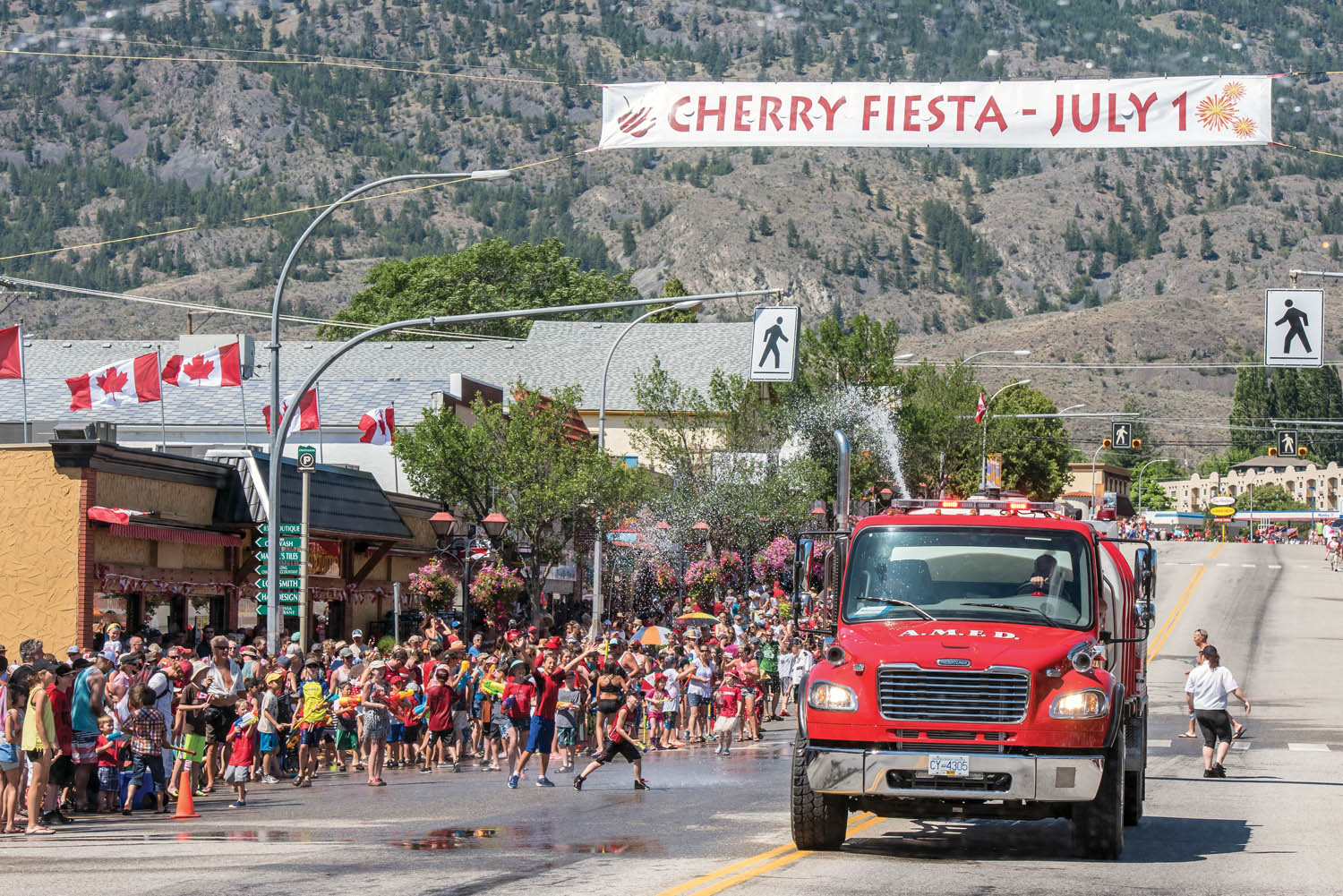
Anarchist Mountain firefighters made their way down Main Street past the attack zone for the water fight, which is in front of Osoyoos Home Hardware. The water fight is a popular highlight of Cherry Fiesta in July and gets underway just before the parade. (Richard McGuire photo)
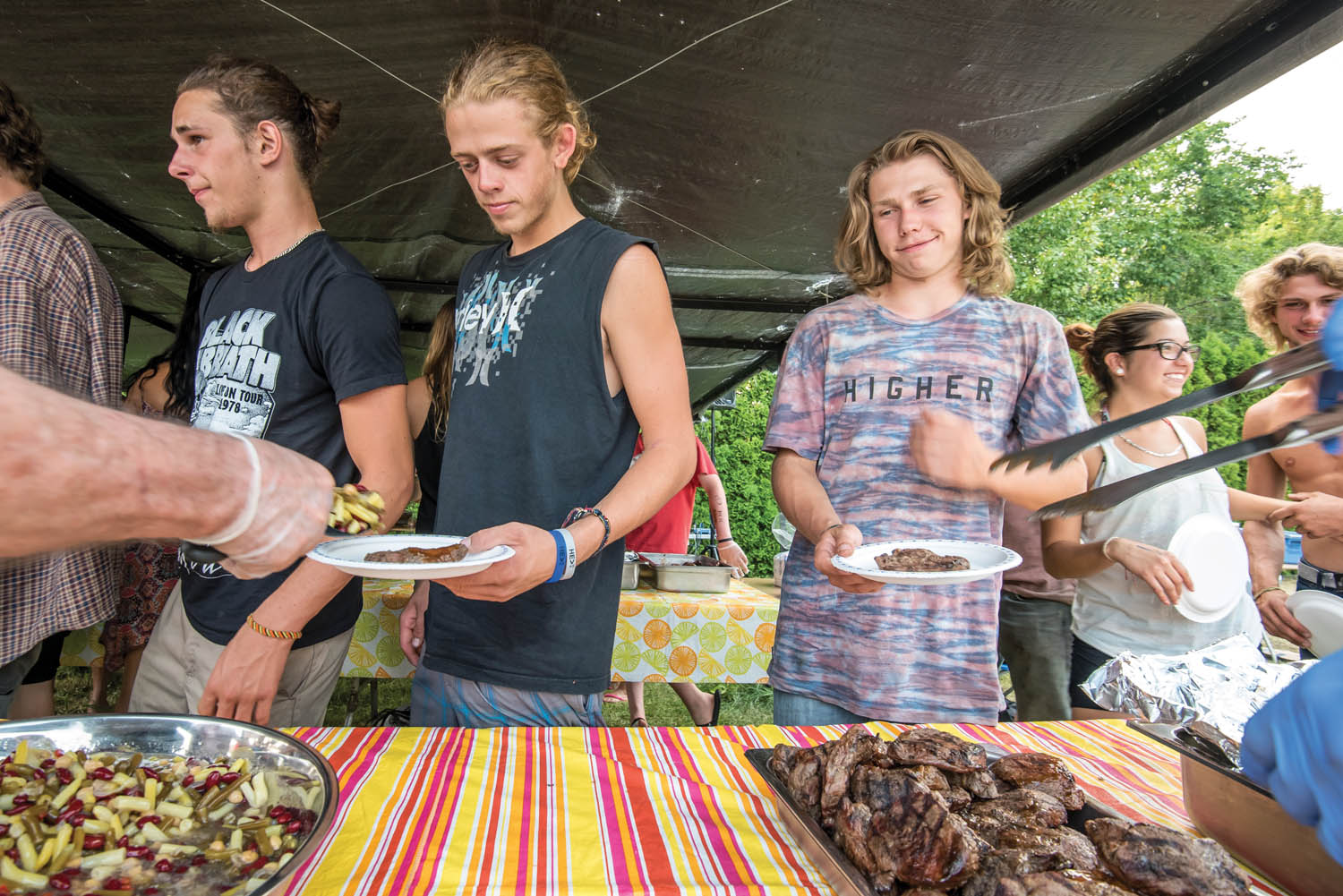
Osoyoos Baptist Church and Mountain Park Community Church from Abbotsford served steak and bean salad to a group of migrants from Ile d’Orléans near Quebec City. The church partners with a church in Abbotsford to provide meals to migrant workers and other transients each July. (Richard McGuire file photo)
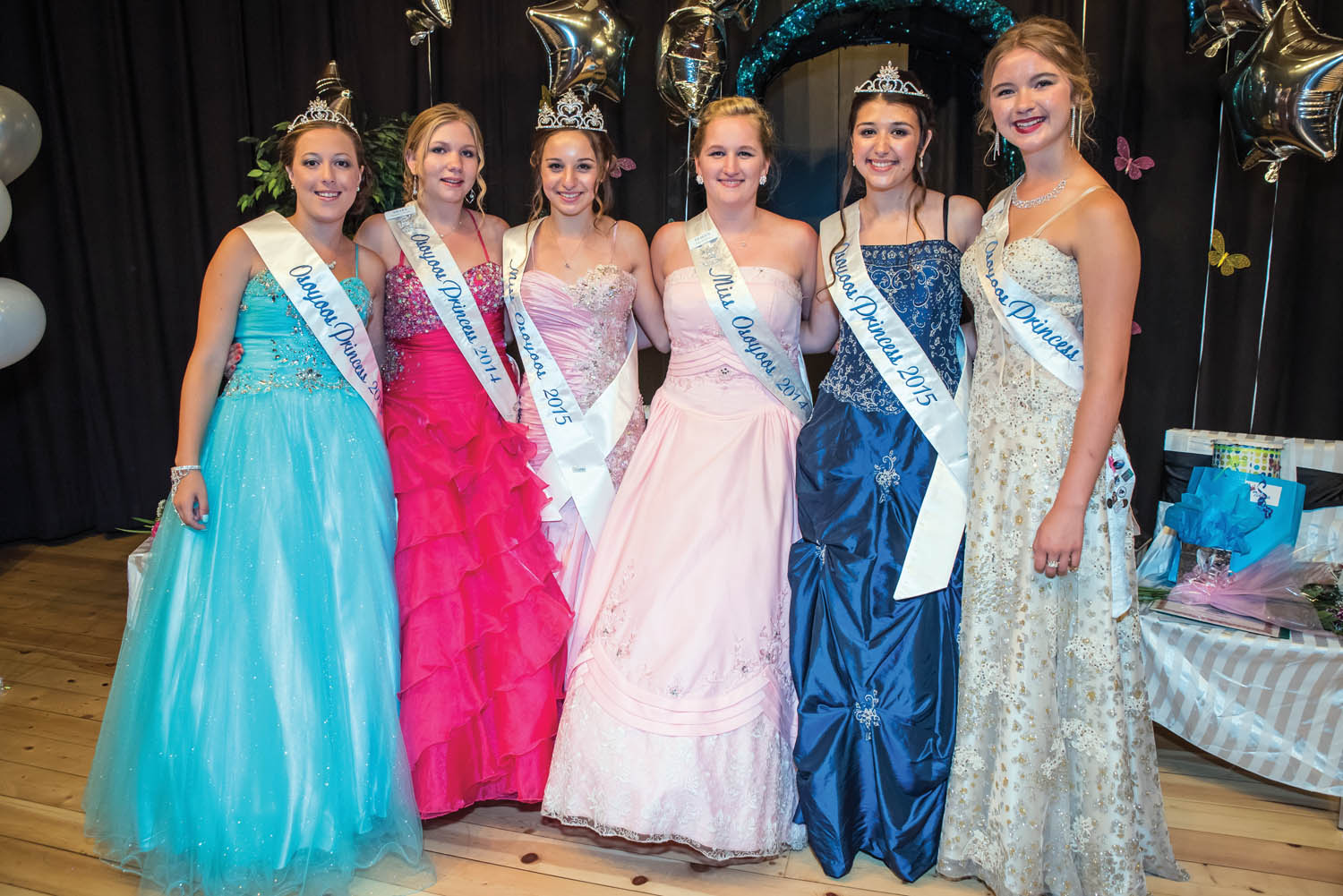
Incoming and outgoing Osoyoos Royalty pose for photos at a pageant at the beginning of July where the new Royalty were announced. From left are Princess Bailey Toepfer, former Princess Amara Leeson, Miss Osoyoos Emma Fernandes, former Miss Osoyoos Teagen Aspell, Princess Tianna Morgan and former Princess Ali Hutter. (Richard McGuire file photo)