The Osoyoos Lake Water Quality Society (OLWQS) has turned to the town for help after finding itself in desperate need of moorage for its water quality monitoring boat.
In a presentation to Osoyoos Town Council, OLWQS president Birgit Arnstein said the non-profit society was informed by Walnut Beach Resort, which had “generously provided safe moorage” for the last seven years, that it could no longer offer moorage or storage of its equipment.
The volunteer-driven society has been monitoring Osoyoos Lake since the early 1990s with the data collected going to the Ministry of Environment and Climate Change. The data is used to determine the health of the lake and evaluate what effects climate change may have on it.
“We have put out a wide public appeal for moorage and have approached many businesses and private homeowners with no success to date,” Arnstein said.
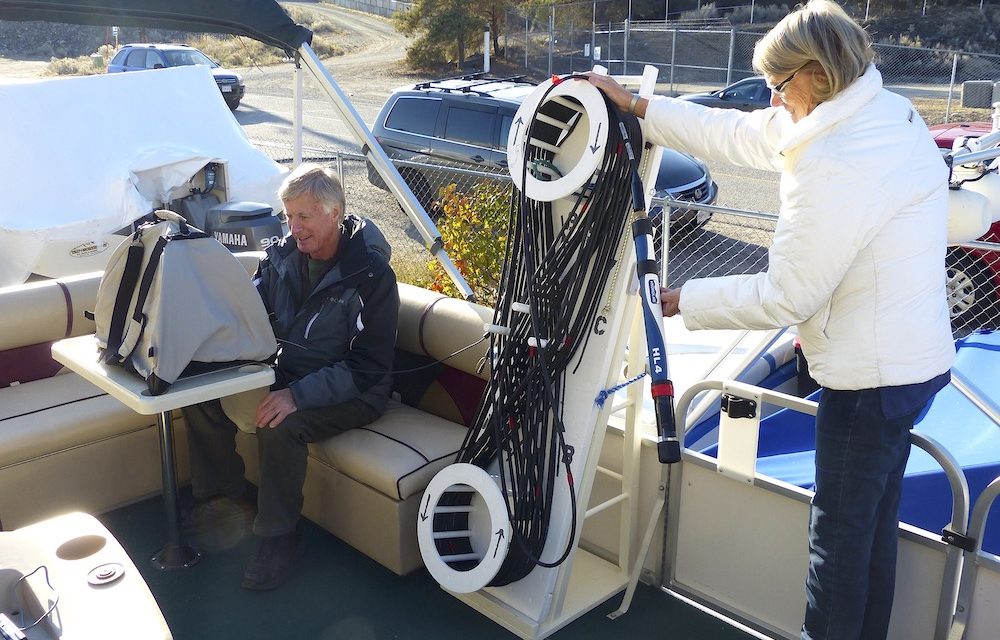
The society reviewed its options on what to do with its 19-foot aluminum pontoon boat and trailer, coming to the conclusion that the best option was to ask the town for assistance. “We are requesting moorage at the Town’s Desert Sunrise Marina for our boat from May to October,” Arnstein said.
“We understand the value of your work,” said Osoyoos Mayor Sue McKortoff. “Certainly the Okanagan Basin Water Board (OBWB) understands the value of what you’re doing and so does the International Osoyoos Lake Board of Control. McKortoff sits on both boards.
But she added that the 10 berths at the marina under town control (a further 10 belong to the Watermark Beach Resort) are in high demand. “I know we have a long waiting list of people wanting to take those spots,” the mayor said.
Arnstein acknowledged the high demand and waitlist, “but we would like to appeal to the Town to prioritize moorage for the OLWQS boat,” she said.
“Without safe, easily accessible moorage for our boat the important work of the Society would likely have to end. We recommend that the Town of Osoyoos consider our request so the continuity of lake monitoring and resultant lake management may continue.”
Should a space in the Sunrise Marina not be possible, the Society has three possible contingencies. The first would see the boat with its trailer stored on land, possibly at the Town’s public works yard, and launched/returned every two weeks. This would require a competent driver with boat launching and retrieval experience and a truck capable of towing the boat.
The OLWQS said this would result in added costs, wear and tear as well as potential damage from the 22 trips through the course of the testing season rather than two at the beginning and end of the season.
The second option would be to attach the boat to a buoy on the lake. Amongst the challenges, this solution presents are finding a safe location for a buoy and gaining permission for its placement following current federal and provincial regulations for mooring buoys.
This option would also require a dingy capable of carrying two people to take the captain to the boat along with the gas tank. A storage location for the dingy would also be required. In the absence of a dingy, the captain would have to wade out to the boat in the cool early morning and work in wet clothes for at least four hours.
Utilizing a private lakefront dock is the third option. Depending on the location this could bring with it potential damage from severe weather and waves generated by other powerboats as well as security issues, Arnstein said.
To ameliorate these issues a boat lift could be installed with an electric one costing up to $10,000 for a used one. Insurance costs would also go up to cover increased liability on an uncontrolled dock, Arnstein noted.
The pontoon boat is used to transport the Hydrolab 4 (sonde) which is connected to a computer and a long cable. The sonde is put into the lake, descending at two-metre intervals and provides data at various depths in four specific locations – two south of the bridge and two north of the bridge.
Among the bi-weekly data gathered is pH, temperature, dissolved oxygen, specific conductance, and water clarity using a Secchi disc (created in 1865 by Angelo Secchi, this disc is still the primary method for determining water clarity). In past years, the Society also participated in collecting water samples to test for veligers (larval forms of zebra and quagga mussels).
Town staff was asked to come back with a report on the status of the 10 berths belonging to the Town and the 10 belonging to Watermark in order to see what options are available.
Arnstein added: “We have very much appreciated the ongoing support the Town of Osoyoos has provided us through grants, winter storage of our boat at the public works yard, storage of printed matter, life jackets and other equipment in the Sonora Community Centre basement and enabling us to occasionally hold meetings in the Sonora Community Centre.”