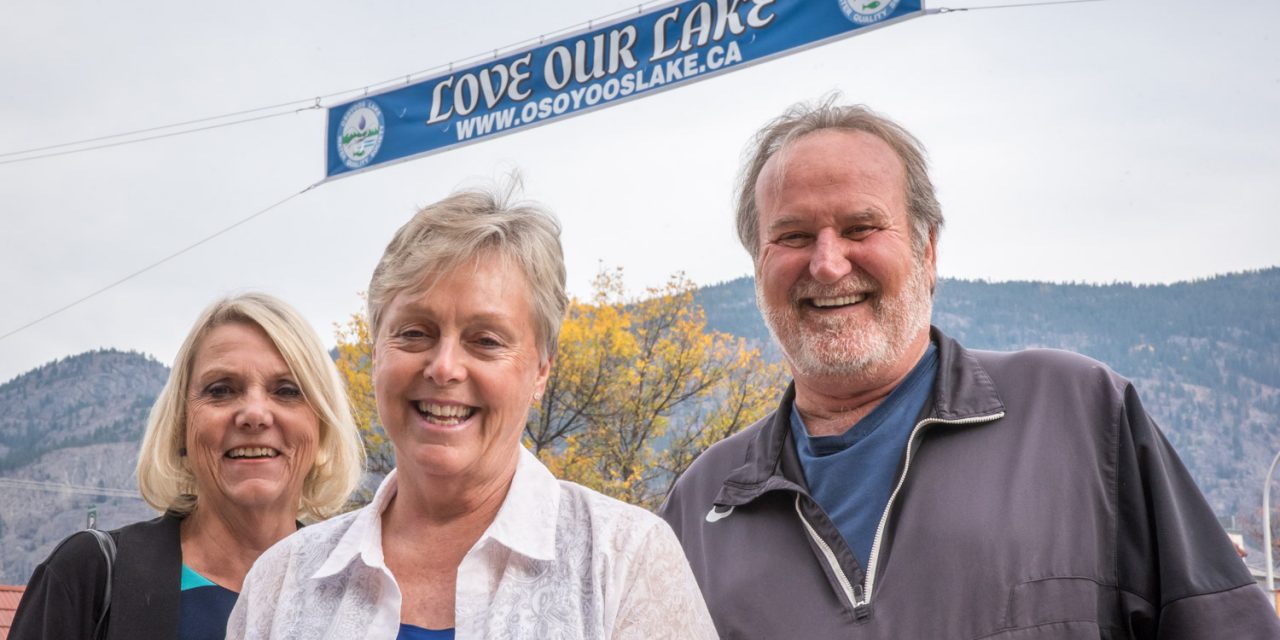
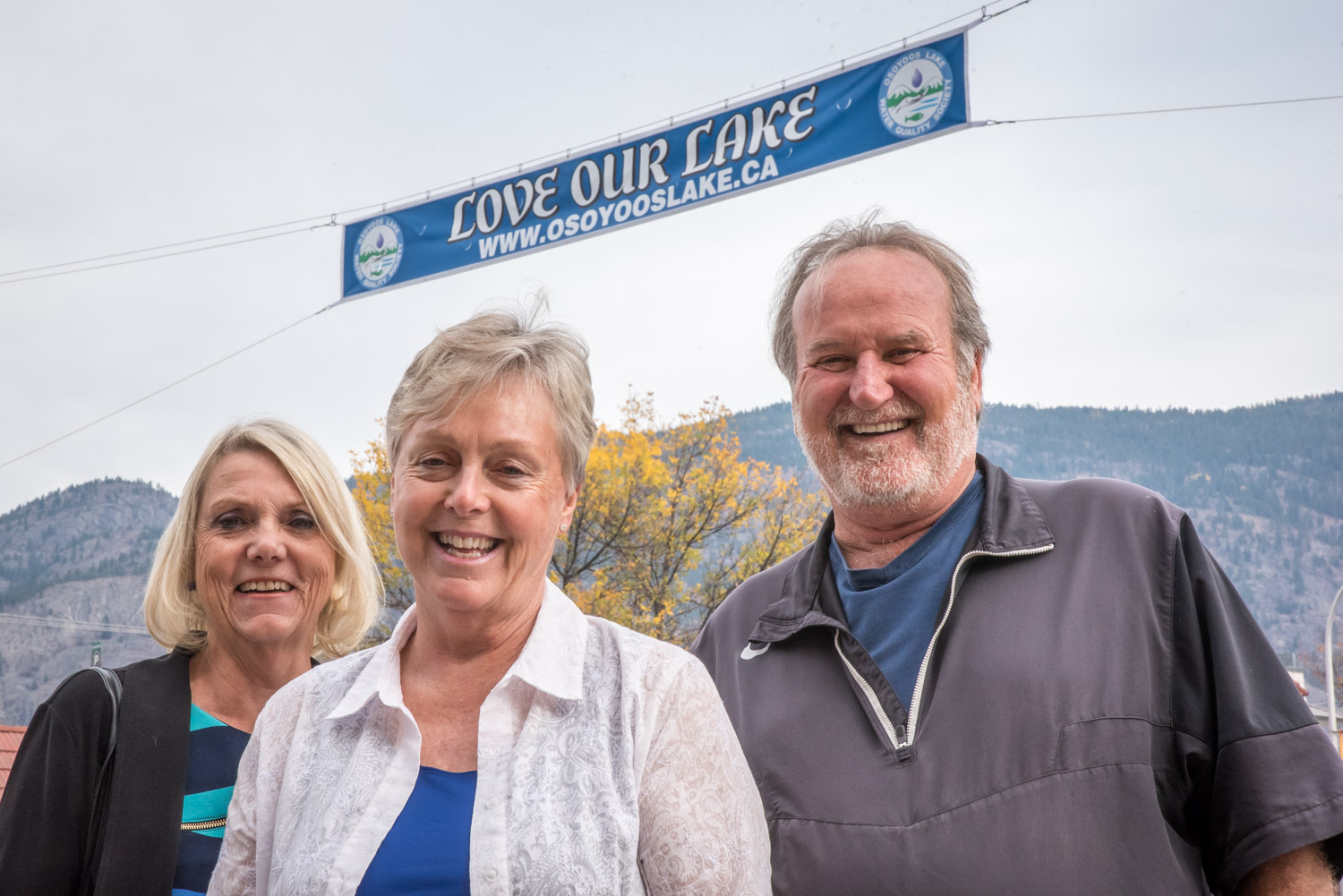
Osoyoos Mayor Sue McKortoff (centre) and former mayor Stu Wells, both organizers of the recent Osoyoos Lake Water Science Forum, are looking for solutions rather than doom-and-gloom defeatism ins response to concerns about climate change, drought and water quality raised by experts. Also pictured is Birgit Arnstein (left), president of the Osoyoos Lake Water Quality Society, a citizens’ group raising awareness about the lake and water quality issues. (Richard McGuire file photo)
The recent Osoyoos Lake Water Science Forum raised many frightening scenarios that could threaten our lake, water supply, fishing and agriculture.
But two local organizers of the event – Mayor Sue McKortoff and former mayor Stu Wells – are both looking for reasons to be optimistic.
“You can’t walk away from the science,” said Wells. “But hearing that we’re doomed, we’re all going to burn up and end up being white-skinned creatures living below the Earth’s surface – we don’t want to promote that.”
There is a danger, he said, that people become immobilized if they become too caught up in gloom. What is needed instead is leadership and action.
Some of that action, he said, may mean going out on a limb and considering ideas that might have been unthinkable before.
Take the Similkameen River, for example.
Currently the river has no dams above the aging, ineffective Enloe Dam in Washington. This means there is a burst of water down the river during the spring freshet, followed by a long season of very low water levels, said Wells.
Admitting he would never previously have considered it, Wells now floats the idea of dams on the Similkameen.
“That’s the furthest thing I ever thought would come from me,” he concedes. “Perhaps it is folly. But everyone has to rethink this.”
An earlier proposal to build a dam at Shanker’s Bend in Washington to replace the Enloe Dam would have been unacceptable, said Wells, because it would have flooded into Canada and taken away land as far as Cawston.
But operating in tandem with another dam near Princeton, proposed by FortisBC before being shelved, it might make sense for water supply, hydroelectricity and the environment, Wells said.
The two dams operating together would reduce the need to store large amounts of water above the Shanker’s Bend Dam, he added.
Wells knows the idea will be controversial with some environmentalists who want the Similkameen River to flow freely. But if climate change results in heavier flows and floods in the spring, and water shortages in the summer, it could make sense.
Experts speaking at the forum in Osoyoos pointed out that this year’s scenario is likely to be repeated as the impact of climate change increases in coming decades – precipitation in winter falling as rain instead of snow, early melting of snowpack and hotter, drier summers.
In some years during spring freshet, the flow of the Similkameen causes water to back up the Okanogan River at the Zosel Dam in Oroville, causing flooding on Osoyoos Lake.
Wells thinks if FortisBC could generate hydroelectricity near Princeton, it would be better for controlling climate change than generating electricity from fossil fuels such as natural gas.
“We have to move away from fossil fuels,” said Wells. “So now it’s sort of obvious that maybe the dams could work in co-ordination, much like the Columbia River Treaty dams … maybe the two dams together have the efficiency and the capacity to make it worthwhile.”
Wells also said he is alarmed by how few salmon returned this year through Osoyoos Lake to spawn. Estimates vary, he said, but some say they were as low as 7,500 fish, even if other estimates put the figure higher.
If these trends continue as climate change progresses, the extensive work of the Okanagan River Restoration Initiative (ORRI) north of Oliver could be for nothing, he said.
When river water temperatures rise, it causes what biologists refer to as a “thermal barrier,” stopping salmon from migrating upriver, because they can’t survive in warmer water.
Future revisions to the Columbia River Treaty may have to look more closely at salmon migration and synchronization of water releases on the Okanagan River to assist salmon migration, Wells said.
McKortoff also found herself looking for solutions as an alternative to becoming mired in gloom.
She was particularly alarmed by the impact of climate change, but also by the threat to Osoyoos Lake and other Okanagan waterways posed by invasive zebra and quagga mussels.
McKortoff said she was impressed by an argument she heard on the radio that the threat of climate change doesn’t need to be doom and gloom, but it can be reduced by investing in wind and solar power.
“I thought that really is something that we could push more,” she said. “Certainly solar power in Osoyoos. You don’t even need to have sun to get solar power. We’ve started that a little bit and there are people that are using solar power. I think good for them. We should probably encourage it more. We can’t be doom and gloom about everything. I think that we have to have a positive outlook.”
Nonetheless, McKortoff is very worried about the threat posed by invasive zebra and quagga mussels, which have now spread to some waterways in western North America.
They are difficult to detect when they are at the larva stage and some boats have even made it through cleaning and inspection without all the mussels being eliminated or detected, she said.
“The lake is the lifeblood of our community,” McKortoff said. “All it takes is one or two people that don’t pay attention to it or say ‘to hell with it, I’m not going to listen to what best practices are,’ and that spoils it for everybody.”
She noted that the Regional District of Okanagan-Similkameen (RDOS) and the Okanagan Basin Water Board (OBWB) have both been lobbying the provincial government to take more preventive action.
McKortoff noted that invasive mussels can be transported from infected waterways by means other than motorboats. Even canoes, kayaks or wetsuits, she said, can spread them.
One invasive species, albeit less destructive than mussels, is Eurasian milfoil, a weed that has been on Osoyoos Lake since the 1970s.
McKortoff pointed to the different approaches taken to controlling this on the Canadian and American ends of the lake.
In Canada, the OBWB has been doing summer and winter cutting and harvesting of this aquatic weed, which the Americans don’t like, because the cut weeds often drift down to their end of the lake.
The U.S. approach has been to use chemicals, which aren’t considered appropriate in Canada and raise concerns about the quality of drinking water obtained from the lake, she said.
McKortoff notes that invasive mussels weren’t very much on the radar at the last water forum held in 2011.
In four years, when the next water science forum occurs, there may be another issue that’s front and centre. That’s why it’s good to have these forums periodically, she said.
RICHARD McGUIRE
Osoyoos Times