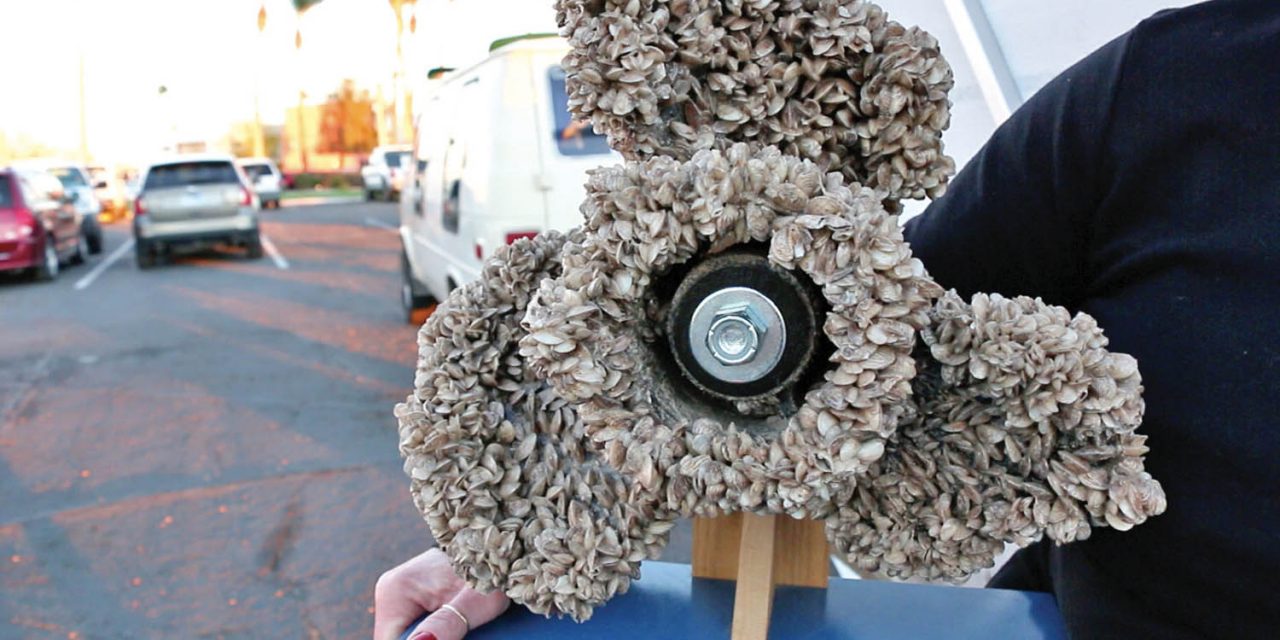

Quagga mussels encrust a boat propeller in this shot from the short film Mussel Threat. The Okanagan Basin Waterboard (OBWB) is warning that if the province fails to take adequate measures to stop mussels from invading Okanagan waters, local taxpayers must not be on the hook for an estimated $43 million annually to mitigate the problem. (Photo supplied)
You can’t put toothpaste back in the tube and you can’t get rid of invasive mussels once they get established in a lake.
That lesson has been underlined recently by the failure of the Manitoba government to stop the spread of zebra mussels by dumping liquid potash into Lake Winnipeg, which became infested in 2013.
Okanagan filmmaker Brynne Morrice last week appealed in an open letter to B.C. Environment Minister Mary Polak to heed the message from Manitoba.
“This is not unexpected news, but it is an urgent reminder of the danger that B.C. faces,” Morrice told the minister, citing statements this month by University of Winnipeg biologist Eva Pip that the situation on Lake Winnipeg is an irreversible disaster.
Critics accuse the Manitoba government of being complacent and doing too little, too late, to ward off the threat of invasive mussels.
Recent reports say that boaters and the public have found significant numbers of zebra mussels on boats, beaches and infrastructure in Lake Winnipeg.
Lake Winnipeg has not yet reached the mussel density of the Great Lakes, where clusters of mussels are often metres thick and the shells, like shards of glass, make it dangerous to walk on beaches with bare feet.
Morrice, who made a short film last spring called Mussel Threat, acknowledges that the B.C. government is doing more than the government of Manitoba did, but he still doesn’t think it’s nearly enough.
“I don’t think they are taking the warnings seriously enough,” said Morrice. “They continue to slough off the warnings of everyone who has been engaged in this issue for years. They are quite stubbornly sticking to the strategy of ‘roving’ inspection teams, when anyone who has some experience in this area agrees that permanent border stations are an absolute necessity.”
Morrice wrote to B.C. Premier Christy Clark in June telling her that the province’s program announced in March to spend $1.3 million over three years on detection and education was insufficient.
“In 25 years, in hundreds of lakes and rivers across North America, it has been proven again and again that eradication does not exist,” Morrice told the premier. “Zebra and quagga mussels, once in a lake or river, cannot be stopped.”
Clark’s office referred Morrice’s letter to Environment Minister Polak for response, and Polak reiterated the province’s strategy of using mobile inspection stations rather than permanent stations at entry points into the province.
She also said that co-ordinated efforts to establish a “perimeter defence” with other jurisdictions in Western Canada and the Columbia Basin are a key component of the province’s strategy.
Polak acknowledges that “if these mussel species become established in a large open water system, they will be impossible to eradicate.”
Morrice insists that what the B.C. government is doing to prevent an infestation here is still not enough.
“Until such time as this perimeter defence is fully in place, you must have an unbroken wall at our border,” Morrice told the minister.
Trying to intercept infested boats after they have already entered B.C. “is illogical and irresponsible,” he said.
Polak’s letter, he said, contains no new information.
Morrice says he knows of only one case where a jurisdiction successfully eradicated mussels. In that case, it was a very small lake, more of a pond, and they drained the lake and let the bottom freeze over the winter.
“Clearly this is not something we could do with 99.9 per cent of lakes in B.C.,” he said.
RICHARD McGUIRE
Osoyoos Times