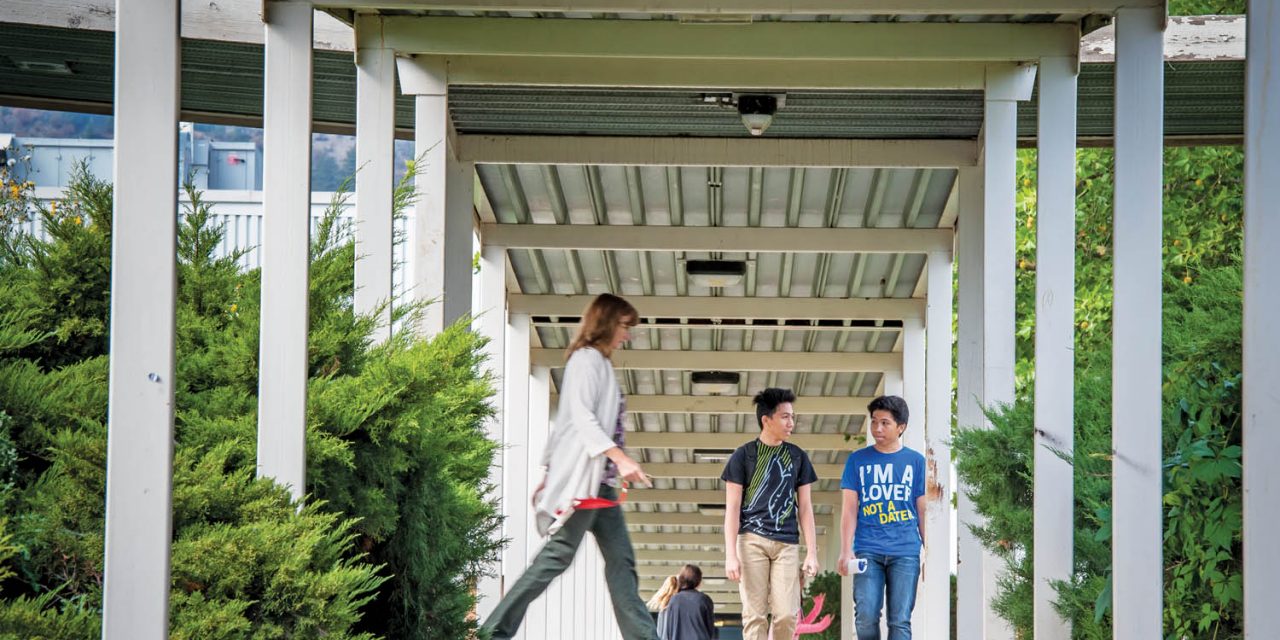
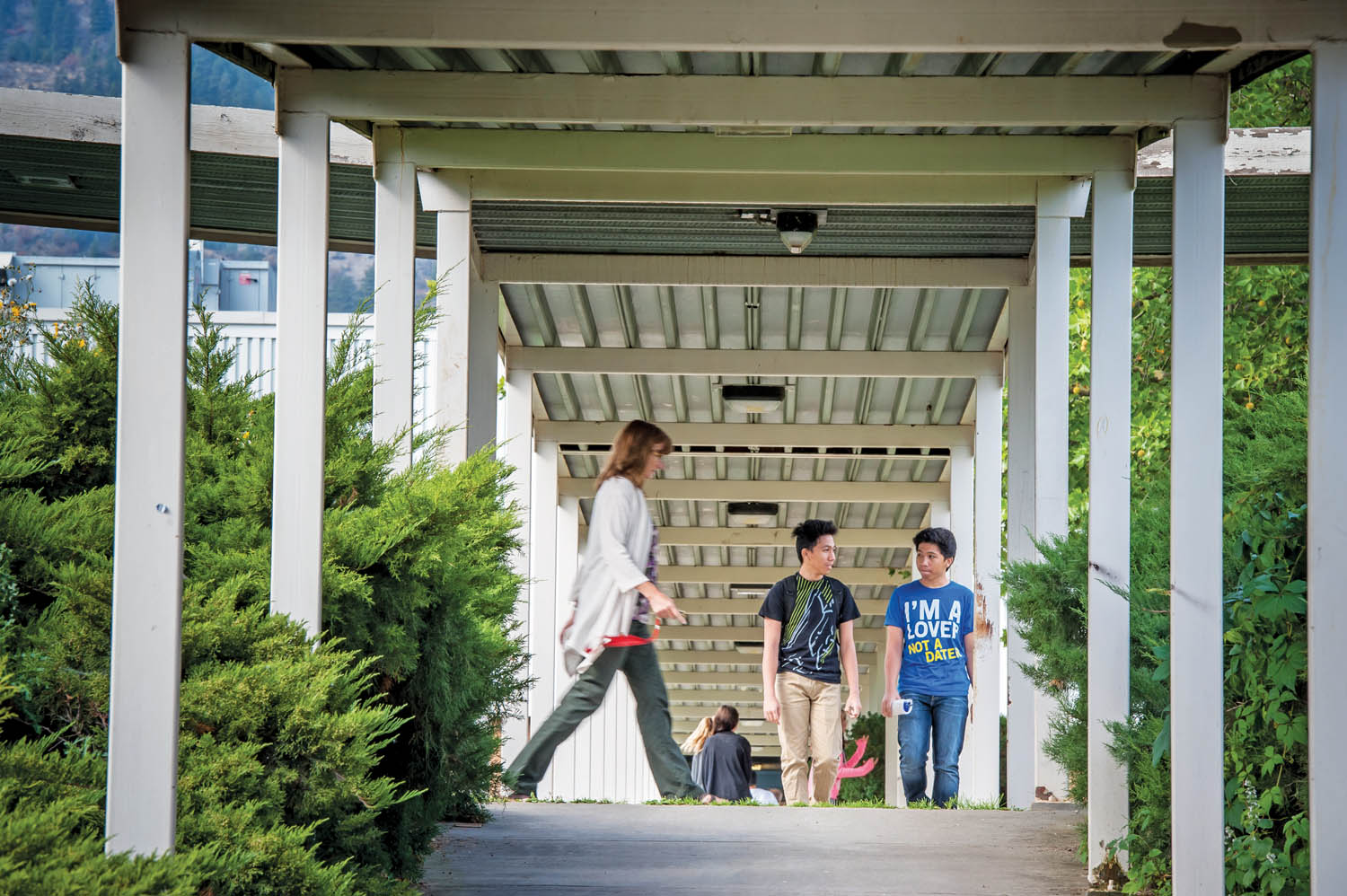
Students walk between classes at Osoyoos Secondary School in this file photo. School District 53 is again considering closing OSS and busing students to Oliver. (Richard McGuire file photo)
Underfunding of schools by the B.C. Liberal provincial government is at the root of school closures, say teachers and the NDP opposition.
“There’s been far too many school closures over the last decade under the B.C. Liberals,” said NDP Education Critic Rob Fleming in an interview last week. “The government is pushing even more aggressively now to close more schools, so it doesn’t seem to matter whether enrolment is decreasing or increasing, government is pushing for school closures.”
The board of School District 53 voted on Jan. 13 to begin public consultations on closing either Osoyoos Secondary School (OSS) or Osoyoos Elementary School (OSE).
The consultations are a necessary step before a school can be closed.
A tally of closures since 2002 compiled as of September by the B.C. Teachers’ Federation puts the number at 240 across the province.
Sylvia Slater, president of the B.C. Teachers’ Federation local representing schools in Osoyoos and Oliver, said the union is not taking a position on the specific proposed closures. Nonetheless, she said the union is concerned about provincial underfunding of education.
“It continues to be a problem of provincial funding,” she said. “That has been our position and will continue to be our position. Because of the lack of funding, it puts school districts around the province, not just in our district, in a very difficult position in having to make these kinds of decisions.”
Natasha Schroeter, an OSS teacher and staff representative with the union, also blames provincial government funding and said she has some sympathy for the situation the school board faces as a result.
“I’m a parent as well, so I wear two hats,” said Schroeter. “Parents are mobilizing to try to do something and come up with some alternative solutions. I’ve been telling them that you can’t displace your anger. These people (trustees) were elected to these positions and they are given X amount of money to work with. So they are in as awkward a position as the rest of us are.”
Until the B.C. Liberals came to power in 2001, there were very few school closures because the provincial funding formula included financial recognition of schools and provided an incentive to boards to keep them open.
That all changed in 2002 when the new government brought in a funding formula that greatly reduced the incentive to keep schools open. Instead, funding was shifted to an enrolment-based system, with school districts receiving most of their funding on a per-student basis.
At the same time, school enrolments, which peaked across the province in 1997, were going into a steady decline, meaning the funding districts received didn’t keep pace with costs.
“Given the previous formula’s disincentive to close schools and the resulting accumulation of considerable empty space, the new funding formula not only removed that disincentive, but provided an opportunity for boards to make a choice between keeping facilities open or supporting expanding programs,” said a 2007 report on school closures done by consultant Dick Chambers for the B.C. School Trustees Association.
Schroeter points out that school districts had to absorb extra costs of wage settlements recently, but they didn’t receive extra funding from the province to cover these.
“School boards had to fund that out of their existing funding, so that cost isn’t taken care of,” said Schroeter. “So the boards are stuck.”
She compares it to a situation where someone has $100 a week to spend on groceries, but is told they need to buy cauliflower, even though it isn’t in the budget.
“You have to buy it,” she said.
Fleming points out that B.C. has gone from having the second-best provincially funded school system to the ninth in Canada.
B.C. spends less per student than any province other than Prince Edward Island, according to 2010-11 figures from Statistics Canada, the most recent posted.
Nonetheless, B.C.’s spending is only marginally lower than Saskatchewan, Nova Scotia, Quebec and New Brunswick.
“The government said it was going to fully fund the cost of the teachers’ settlement,” Fleming said. “They broke that promise. They downloaded literally hundreds of millions of dollars in cost pressures onto school districts. That is what’s forcing districts to look at school closures.”
Fleming points to a report on Budget 2016 consultations released in November by the all-party Select Standing Committee on Finance and Government Services.
It calls for better funding of Kindergarten to Grade 12 schools.
“The recommendations presented to the committee from organizations and individuals across the province suggest current funding levels and assistance are inadequate, which is causing significant operation and program delivery problems in schools throughout B.C.,” the report concludes.
It calls on the Ministry of Education to review the funding formula to ensure the sector is properly supported.
“So far (Premier) Christy Clark’s government has completely ignored that recommendation,” said Fleming. “They are ignoring their own backbench and bipartisan committee of the legislature.”
Fleming said that school closures are disruptive to both communities and families.
The largest expense school districts face is human resources rather than buildings, he said.
“So in many ways the so-called savings are very small while the disruption can be huge,” Fleming said.
OSS Teacher Peter Gajda is critical of the decision to look at closing a school before exploring other options.
“I think for a lot of people, and certainly for me as a teacher, closing a school needs to be your last-worst option,” he said. “The only option you have left. I don’t think we’ve really explored all the options… When they talk about a $530,000 shortfall in a $24 million budget, that’s 2.2 per cent, there must be some low-hanging fruit we can still look at.”
Gajda points out that in his 11 years with the district, there has been the same number of administrators despite declining enrolment.
The school district contracted out sex education when this is something that teachers could do, he added.
A new network leaders program is also something that could be cut, he suggested.
“I know we’re big on spirals of inquiry and a lot of things like that, but when you’re talking about closing the school versus having a program that we could be doing on our Wednesday inquiry time once a month, and we’re already doing it there, there are some cost savings to be had,” Gajda said.
He’s frustrated as both a teacher and member of the community that Osoyoos is being asked to carry the brunt of declining enrolment without considering such options as a nine-day or four-day timetable.
“The ultimate blame needs to lie at the feet of the government who have been underfunding education for a long time in my opinion,” Gajda said. “I’m not sure a lot of people recognize that the government is not just funding public education, but they throw money into private education. Our tax dollars are going to a select few students who are going to private schools and parents who choose to go that route.”
The funding of private schools, which began in 1977 under the Social Credit government of Bill Bennett, has been growing ever since.
This province now has the highest percentage of private schools in Canada.
“Funding for independent schools is increasing at a much faster rate than public schools’ funding,” says the B.C. Teachers’ Federation in 2012 report on education spending. “Between 2005-06 and 2010-11, public school funding increased by 13 per cent while funding for independent schools increased by 34 per cent.”
At the time of that report, there were 347 independent schools in B.C., the majority provincially funded at 50 per cent of what public schools receive.
Gajda also points out that OSS has been moving forward with a plan to introduce open timetables next fall. This, he said, makes more courses available to students, allows them to take additional courses and better uses school resources.
It also addresses concerns of the school board that the school doesn’t offer enough courses and also addresses declining enrolment, he added.
That’s because students taking more than eight courses count as more than one full-time equivalent.
If a student can learn the work in less time, for example spending 60 hours to complete a course instead of 100 hours, it frees up time for them to do other things, said Gajda.
It also solves the problem of conflicts when classes for different subjects are scheduled at the same time.
“I think the big frustration is not having the opportunity for everybody in the community and schools in the system to sit down and say, ‘here’s the problem, let’s solve it,’” said Gajda. “We’re asking kids to be better problem solvers. That’s one big goal of the new curriculum. We want them to think outside the box and we want them to do project-based learning. Maybe the adults can do that too.”
RICHARD McGUIRE
Osoyoos Times