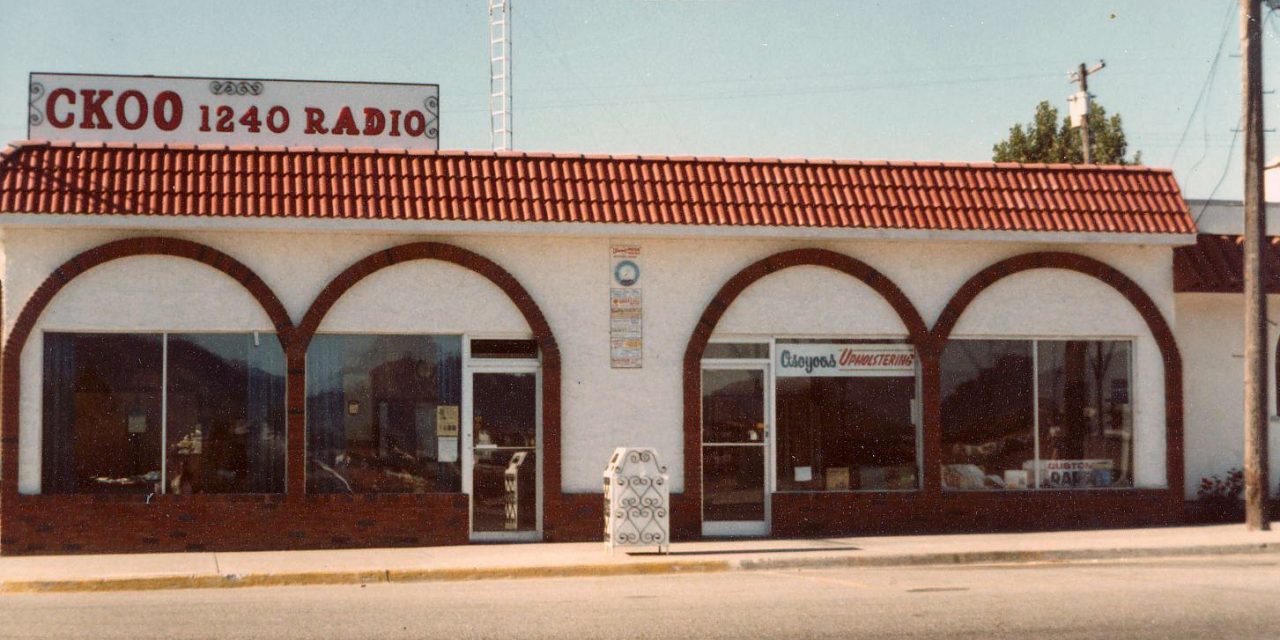

In the 1980s, Osoyoos was swept up in a movement to give the town a Spanish look and market Osoyoos as the “Spanish Capital of Canada.” One of the buildings adopting the theme with white stucco, red brick and tile roof facades was the home of CKOO 1240 Radio and Osoyoos Upholstering at 8901 Main Street, the present location of KH Craig Chartered Professional Accountant. This 1980s photo is from Penny Lamere. (Osoyoos and District Museum and Archives)
Back in the 1970s, it was a craze among tourism marketing types to represent communities as being from another part of the world.
Some of those international themed communities remain to this day.
Kimberley, B.C. and Leavenworth, WA were marketed as Bavarian.
Winthrop, WA was marketed as a town from the Old West.
For some reason, Osoyoos decided to become the “Spanish Capital of Canada,” even though there were probably many more Portuguese than Spaniards here.
The ostensible reason for the new discovery of Spanish heritage was that our dry climate and rocky terrain resembled parts of Spain – not the parts with palm trees and Mediterranean coast, mind you.
A Spanish Development Society was formed in 1974 and it used a combination of persuasion and moral pressure to convince business owners to redecorate building facades to fit the Iberian theme.
Old-timer Ruth Schiller, who thought the idea was stupid, recalls laughing in one man’s face when he talked up the idea. And she had a dust-up with former Osoyoos Times publisher Stan Stodola, a strong supporter of the theme, that caused her to cancel her subscription for a year.
The “Spanish” buildings had white stucco, arches with bricks, and red tile roof facades. Some used wrought iron balconies and black wood trim.
The town hall was one of the buildings that adopted the theme in 1975.
There was even a “Don Carlos” logo with a flamenco dancer.
Finally – thankfully for some – the Spanish Development Society disbanded in 2006.
By then, Osoyoos had been adopting a new marketing fad, pitching the town as a distant misplaced pocket of the Sonoran Desert located in Mexico and the U.S. Southwest.
The whitewashed stucco was replaced with earthy tones of simulated adobe, and fake wooden roof beams were added.
RICHARD McGUIRE
Osoyoos Times