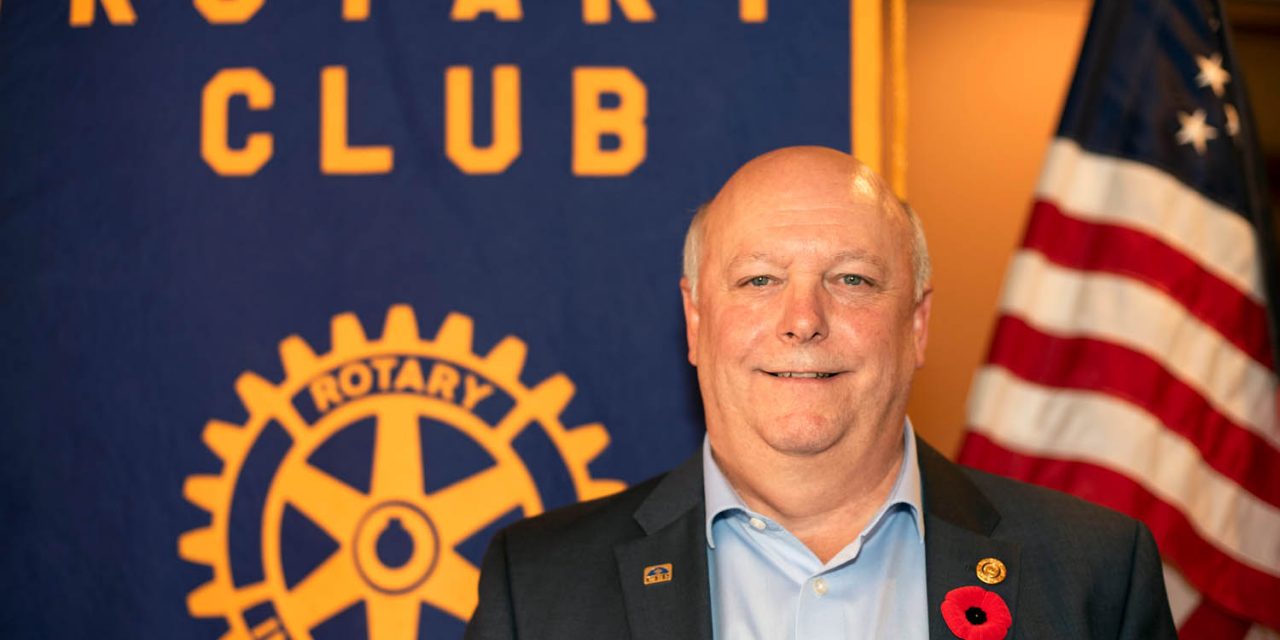

Financial planner Doug Matthews was the guest speaker at the Osoyoos Rotary Club last thursday. His presentation, entitled Death And Taxes Part Two, was a continuation of previous guest Brian Harvey’s presentation. Matthews spoke about estate planning, cost-cutting measures that can be taken and the various ways to avoid probate fees.
Financial planner Doug Matthews picked up where a previous speaker left off when he spoke recently about estate planning and wills at the Rotary Club of Osoyoos.
Local lawyer Brian Harvey spoke to the Rotarians in October about the pitfalls of dying without a will. Matthews, a Rotarian, talked about ways to avoid probate.
“Think of me as a quarterback when it comes to various financial planning needs,” he said.
Matthews explained that there are several costs and fees associated with having a will.
These fees could include executor or executrix fees, legal and accounting fees and probate fees.
Probate is the process wherein the courts verify that a will is valid. In British Columbia, when an estate is valued at $25,000 to $50,000 the probate fee is 0.6 per cent. In cases where the estate has a value of $50,000 or more, the fee is 1.4 per cent.
He explained that there are ways to save costs and prevent having to pay probate fees. One of these ways is to place assets into a trust, rather than having a will. When assets are placed into a trust for beneficiaries, those assets are managed by a trustee and are considered as being outside of the will. Therefore, there are no probate fees.
“Avoid the will, avoid the estate and you’re avoiding some of these costs,” Matthews said.
Another benefit to not having a will is privacy. All probated wills are public record. The reason for this is because anyone who is entitled to challenge a will must be able to know its details.
“How does someone know if they can challenge the will if they don’t know what the will is?” Matthews said.
He also mentioned other ways of avoiding or lowering the cost of probate fees.
By listing a beneficiary to one’s Registered Retirement Savings Plan (RRSP) and Registered Retirement Income Fund (RRIF), “that bypasses your probate…it goes straight to the beneficiaries,” he said.
Pension benefits left to a surviving spouse bypass probate, as do assets in a joint account. Assets from a life insurance contract with a beneficiary does not factor into the value of an estate.
Matthews said that many people try to avoid probate by having investments through joint ownership. This type of ownership is called Joint With Rights Of Survivorship.
An advantage to this is that these investments will not be part of the estate and will therefore avoid probate costs. However, it is not a guarantee that joint ownership will avoid creditors or challenges to the will.
A disadvantage to joint ownership of investments is that there is the potential for the creditors of the other owner to access the investments.
He gave an example of having joint investments with a child. If that child is sued and held liable, the creditors can now go after their assets, which may include the joint investments.
Matthews ended his presentation by noting that where second marriages and blended families are involved, “you definitely want to be doing some good estate planning in that area.”
At the end of his presentation, Matthews asked the members if they had any questions. Rotary President Jeff Duguid asked Jim King, who was working the projector, to go back to the first slide.
“Spend all your money,” Duguid read aloud. “There you go. It’s the best advice we all can have,” he said.
MICHELE WEISZ
Osoyoos Times