Neha Chollangi
Special to the Times-Chronicle
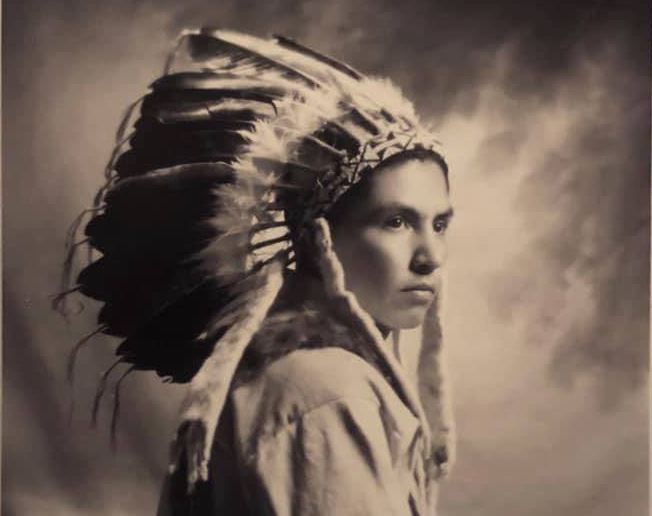
On the wall of Taylor Baptiste’s art studio at home, there hangs a photograph of her grandfather, Okanagan artist Francis Jim Baptiste. He is pictured wearing his headdress with arrow beading on the front, that had been missing since his passing in 1988. An artist herself, Taylor often looks at this picture for inspiration in her own practice, occasionally wondering where this headdress could possibly be.
Curious to solve this mystery, Taylor, a student at Emily Carr University of Art and Design, made a post on Facebook last month asking anyone with information about the headdress to get in touch with her.
“It could be anywhere; could be in someone’s attic, it could’ve been passed on to someone’s child. The possibilities are really endless to where it could’ve been, but I’ve seen crazier things happen on social media of people finding relatives or other family heirlooms, so I thought why not put it out there. Somebody out there must know where it is,” said Taylor.
Since her post, she’s received a sea of messages from people. Some saying that the post made them research about Francis and his art. Another message was from someone in Creston, B.C. who has a piece of artwork by Francis, but didn’t even know it was done by him prior to seeing the post. Taylor had never seen this work before which was a painting of three deer — a mother, father, and their fawn.
A great deal of Francis’ art was based off his life experiences and living on the Osoyoos Indian Band reserve. “There was a lot of sagebrush, deer, birds and everything that you would naturally see in the Okanagan,” said Taylor, who explained that his artwork allowed her to connect with him, as well as her land and culture.
Francis was born in 1920 and given the name “Sis-Hu-Lk,” which he used to sign his art. He went to the Inkameep day school where he started his lifelong pursuit of art from a young age. Francis later studied art at the Institute of American Indian Arts in Santa Fe, New Mexico. He went on to exhibit his work throughout Canada, the United States and Europe. A great deal of his artwork is stored in the B.C. Archives, the Nk’Mip Desert Cultural Centre, the Osoyoos Museum, and the Oliver Archives. He also notably made the first Canadian art piece that was purchased for Buckingham Palace’s King Edward and Queen Alexandra Memorial Collection.
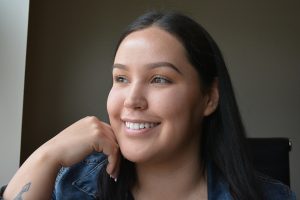
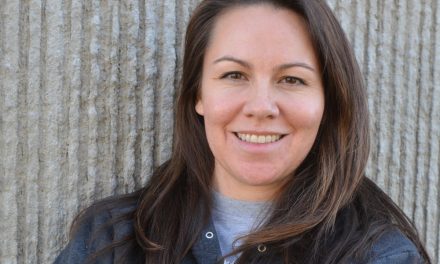
Local artist Taylor Baptiste has been looking high and low for the lost headdress of her grandfather, Francis Jim Baptiste. It’s like a Nancy Drew mystery that she needs to solve.
(File photo)
Hearing these stories about her grandfather, and seeing his “mesmerizing” artwork is what inspired Taylor to pursue art herself. Although she never had a chance to meet him, she found a connection with him through his drawings and paintings. “When I was younger in elementary school, I would try to recreate some of his paintings, and then through that, started to do my own.”
When tracing back to Francis’ early beginning in art, the story of the Inkameep day school comes up. The interesting part of the day school (and there are many) is that there was never supposed to be an art program. The chief of the Osoyoos Indian Band at the time, Chief Baptiste George, wanted to have the children go to a school on reserve to keep them connected to their community, instead of sending them off to residential schools. This, of course, wasn’t common. He had to send a request to the Department of Indian Affairs for a day school to be built in the community. When this was approved months later, the school was set up using the OIB’s own funds in 1915.
The topics that were meant to be taught included reading, writing and arithmetic, or the three R’s.
Anthony Walsh, originally from Scotland and England, moved to the Okanagan region and started teaching at the Inkameep day school around 1931. It didn’t take long for him to see that these children had a natural artistic talent.
Once his students began to trust him, they started to share their drawings and even made plays of Okanagan stories. A passage from the book Nk’Mip Chronicles: Art from the Inkameep Day School, recounts how children at the school taught Walsh many things including how to observe nature and how to listen. In return, he showed students how to express themselves and their culture through art.
“He just incorporated art within the schooling, and they started to share the culture that was at Osoyoos Indian Band,” said Charlotte Stringam, manager at the Nk’Mip Desert Cultural Centre. “He loved the children, he loved the community, and he was loved by the community.”
In 1934, Anthony helped his students at the Inkameep day school make an illustrated booklet, “The Tale of Nativity.” Francis was asked to create pen and ink drawings for this project. A few years later, these illustrations were exhibited at the Royal Drawing Society in England, where Francis was awarded a bronze star.
Sadly, after Anthony left the school in 1942, his predecessor did not have the same encouraging attitude towards art. Stringam said, “The new teacher that came in, just took a lot of stuff and burned it. So, it was lucky that Anthony Walsh did protect some of that artwork, and it got put underneath a bed, and later it came out.”
During the time, with a great deal of cultural repression and assimilation, much of the artwork made by students was hidden by Walsh and only resurfaced years later.
Dr. Andrea Walsh (no relation to Anthony), a visual anthropologist at the University of Victoria, started to research children’s art at residential schools and day schools two decades ago. In this process, she found her way to the Okanagan region to look for these children’s artwork.
“The hair on my arms just stood on end when I saw these drawings, they’re so powerful,” said Andrea. Although it’s been 20 years since she first started engaging with the subject, this “sustained conversation through art” is still ongoing for her.
Last year, Andrea curated an exhibit at the Museum of Vancouver titled There is Truth Here: Creativity and Resilience in Children’s Art from Indian Residential and Day Schools.
The exhibit showed rare artworks that were made by students who went to Inkameep day school, as well as a few residential schools in B.C. and Manitoba.
“The work that was at Inkameep fits into that larger category of starting to recognize children, not as numbers but as individual people with creative and intellectual lives that were living as part of that residential and day school era,” said Andrea. “It’s absolutely impossible to access those children’s lives otherwise, and this artwork gives us an incredible sense of who these people were.”
Although we often tend to downplay children’s knowledge, Andrea said that seeing history through the experiences and creative work of children is very important. It can take a black and white, detached view of history and instead allow for a conversation that “forces us to recognize the humanity of these kids,” while seeing how “these drawings and all their colour are ever present.”
The Nk’Mip Desert Cultural Centre in Osoyoos also has an exhibit for Inkameep day school that showcases student art done in the 1930s. It has art pieces done by Francis as well as other children who attended the school. Their work ranges from pencil sketches of animals to illustration of rodeos in the plateau region, to large murals depicting life in the Okanagan, said Stringam.
“We have many artists from the Osoyoos Indian Band. I think that that’s part of our lifestyle to be passed down,” Stringam said. “And within [the Baptiste] family, it was a very big part of their life.”
Taylor is currently in her first foundational year at art school, after which she will be channeling into a bachelor of fine arts. She is primarily interested in illustration, painting with acrylic while working with Indigenous materials like buckskin, raw hide and wood—taking inspiration from her grandfather’s practice of painting on buckskin and leather.
“People like Taylor are really inspiring to me,” Andrea said. “She is taking up this quest to understand the history, and to bring back things like a headdress, which are the physical ties to real people that can inspire the nation in terms of the Osoyoos community. But they can also educate those people who come to the desert heritage centre to understand what are my obligations on this land, that is Syilx territory? What are the things that I should know about being a good guest, and understanding the laws, protocols, the goals that are set down by the Okanagan nation?” Andrea urges people to have these discussions.
Taylor said that if she finds the headdress, she would first like to speak to the people who have it and find out how it got to them, then see how to bring it back to OIB to be protected. “It would just be so special if we could like bring it back to keep it preserved for the family and then just as well with the rest of his artwork so that the story can go on.”
If you have any information regarding Francis Baptiste’s headdress, you can email Taylor Baptiste at [email protected].