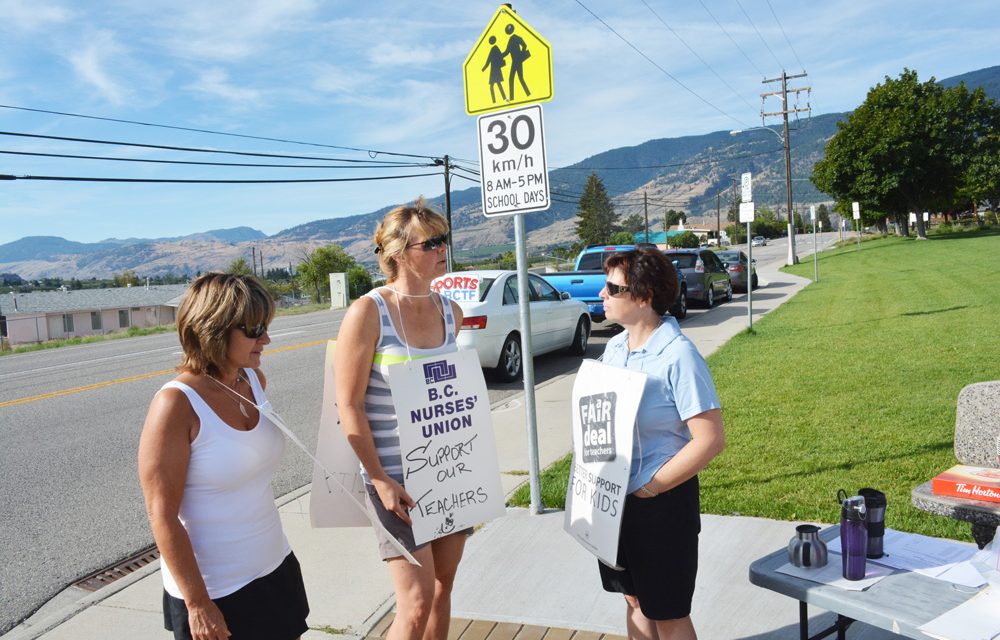
A glimmer of hope that students would be back in school this week was dashed when the provincial government rejected a binding arbitration deal by teachers.
BC Teachers’ Federation (BCTF) president Jim Iker said they will hold a province-wide vote (planned for Wednesday) to end the strike if the government agreed to binding arbitration. (This means a third party would make a decision on the dispute and both parties would have to abide by it.)
Iker said this is the quickest and most effective way to end the dispute and get teachers and students back to class.
But Education Minister Peter Fassbender agreed with the British Columbia Public School Employers Association to reject the proposal.
“After due diligence and further investigation, it became very clear that it was another empty effort to give parents and teachers a false hope that there is a simple way to resolve the dispute,” Fassbender said.
He noted the BCTF made it clear that they would insist on several preconditions – preconditions that would “tilt the entire process in the BCTF’s favour.”
Fassbender said teachers need to get into the affordability zone on wages and benefits so work can begin on negotiating class size and composition.
“This dispute needs to be settled at the bargaining table and I invite them again to lift their pickets while the parties work towards mediating an end to this dispute.”
The BCTF proposes to refer the unresolved items including salary, signing bonus, dental, pregnancy leave top-up and preparation time to binding arbitration.
Items currently before the Court of Appeal and/or those items related to class size, class composition and staffing ratios are removed from the bargaining table and remain before the courts.
Iker said teachers have given up a lot and all British Columbians owe them their gratitude.
“Throughout this dispute, BC teachers have led the way in trying to reach a fair deal that gives our students more support. We have made moves, proposed creative ideas, and taken job action only when absolutely necessary. In return, the government has put up road blocks.”
Iker said a new fund is needed to improve student learning conditions, noting that the government’s current Learning Improvement Fund does not meet those needs.
“Everyone knows our schools are underfunded. We must take action now.”
Iker said new money is necessary for pupils with special needs, those learning English, and those who just need some more one-on-one time.
With no back-to-school deal in sight, parents are urged to continue making alternate plans for their children.
“WedeeplyregretthattherehasnotyetbeenaresolutiontotheprovinciallabourdisputewiththeBC Teachers’Federation,” said local Superintendent of Schools Bev Young.
But the board remains hopeful, she pointed out.
Meanwhile,some parents have been calling about accessingthe$40fromtheprovincial governmenttoassist withchildcareforstudentsundertheageof13.
TheMinistryof Educationhasestablishedawebsitewith parentinformationathttp://bcparentinfo.ca/ Thissite containsalinktoregisterforthe.Ministry ofFinance’s temporaryeducation·supportforparents.
Theapplicationformasksforthestudent’s PersonalEducationNumber (PEN), whichcantypicallybefoundonareportcard.
For anyonewithoutInternetaccess,youcancall 877-387-3332toapplyforthedailystipend.
Forregularupdatesand information,check the board’s websiteatwww.sd53.bc.ca.
“We lookforwardtoatimeinthenearfuture whenwecanwelcomeallstaff, studentsandparentsbackto a newschoolyear,” Young said.
In the meantime, many parents in Oliver and Osoyoos are feeling powerless.
“There is huge frustration. We feel like our hands are tied,” said Cory-Lee Mills, chair of the Parents Advisory Council (PAC) for Oliver Elementary School.
She stated that writing letters has not made a difference, so local PACs got together and met with members of the teachers’ union, asking them for specific information about their demands.
“They listened well and said they would put something together for us.”
Mills said parents are not taking sides in this dispute.
The stay-at-home mother has noticed a different, “heightened” energy in her children when they are not in school.
“The kids are frustrated and nervous. My daughter is in tears because she’s afraid of falling behind (in school).”
Mills worries about how high school students are feeling, especially those behind in math. “Every day makes a difference.”
Mills noted that a lot of parents have purchased curriculum books for their children in order to keep them busy academically.
“The biggest thing is to keep them reading . . . keep their brain active.”
Mills is keeping her kids busy by having them do projects that involve research. She also has them play board games to expose them to mathematics.
She acknowledged that keeping children off electronics can be a challenge, but during homework she only allows her kids to use the computer for research purposes.
After playing the role of educator at home, Mills has a deeper respect for what teachers do in the classroom.
“The first day I tried teaching my kids, I was in tears (because of the frustration).”
Mills admitted that she wouldn’t have the patience to be a full-time teacher.
Sylvia Slater, president of the South Okanagan Similkameen Teachers’ Union, stressed that teachers want to be back in class.
“We are not getting strike pay but we believe so strongly in the public education system, one that’s equal for all its students. We are prepared to put our own financial situations in jeopardy. We have the courage and commitment to do it.”
Slater said the government needs to increase the funding to public education immediately.
She noted the government’s Learning Improvement Fund (purported to be $375 million) addresses some class size and composition concerns. But the reality is that amount is spread over five years ($75 million per year) for the whole province, she pointed out.
“Quite simply, it’s not enough money to address all of the challenges and complexities teachers face in the classroom.”
However, the provincial government says it will not increase taxes in order to meet the teachers’ demands.

Lyonel Doherty
Oliver Chronicle