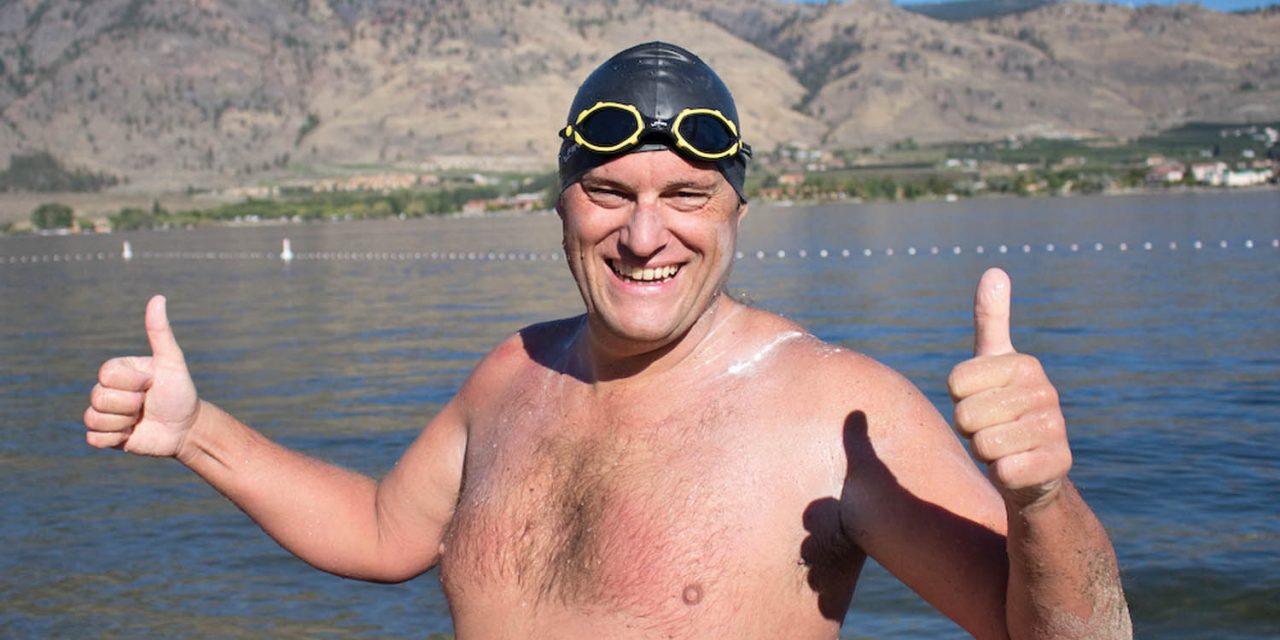
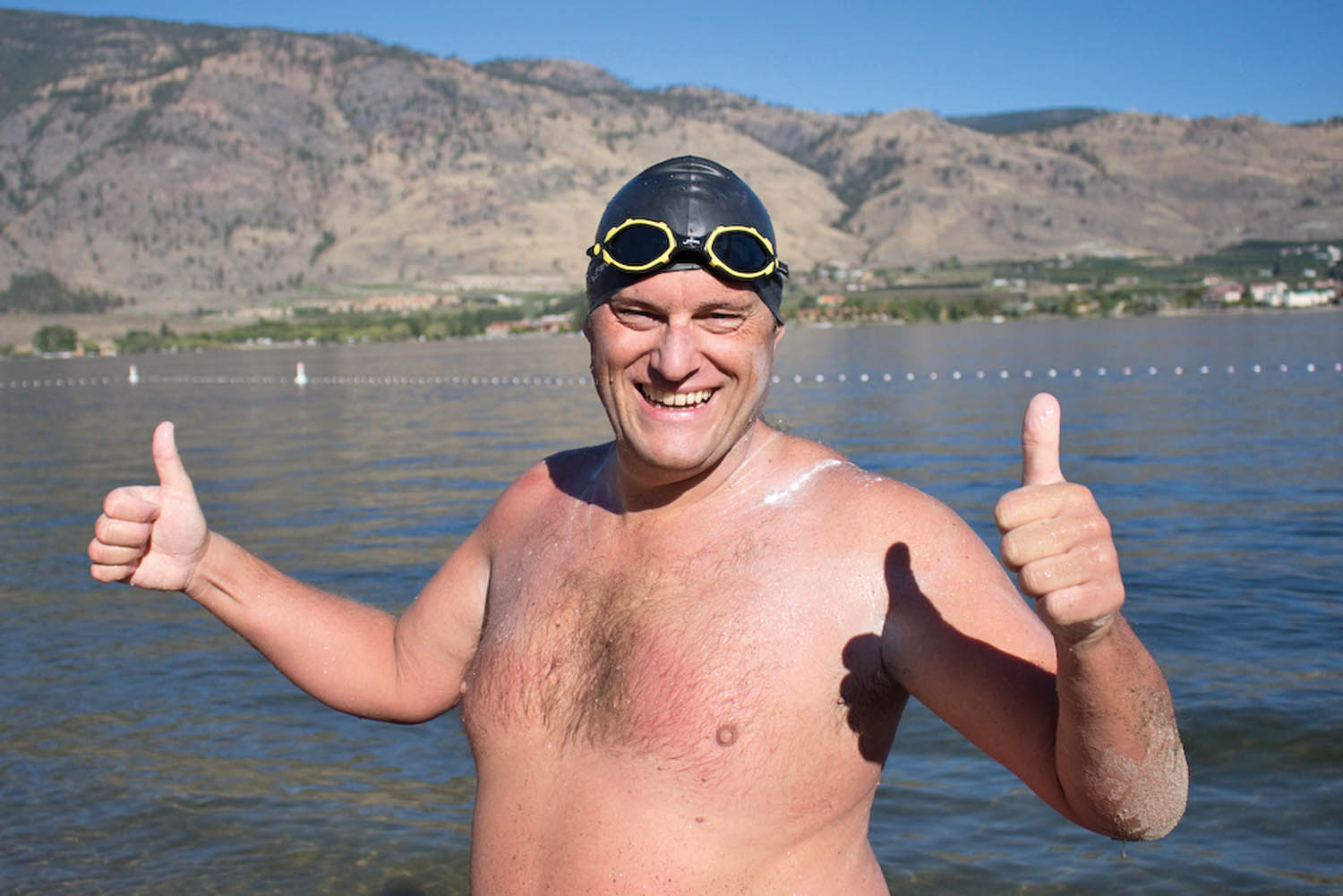
Paul Duffield gives a thumbs up after arriving at Gyro Beach in Osoyoos five and three quarter hours after he left Veterans’ Memorial Park in Oroville. His challenges included navigating border formalities and swimming past Haynes Point Provincial Park when arthritis in his hands gave him pain. (Angelique Duffield photo)
When Paul Duffield first came up with the idea 18 months ago to swim from Oroville to Osoyoos, he had no idea what he would need to do to cross the border legally.
The U.S. border officials he spoke to when he headed down to Omak that day also weren’t sure. It was a request they’d never encountered before.
When Duffield completed his swim earlier this month, swimming from Veterans’ Memorial Park in Oroville to Gyro Park in Osoyoos, his success was as much due to the groundwork he did with border officials as it was to his own swimming stamina.
Duffield, 45, from West Kelowna, set out at 10:38 a.m. from Oroville on Saturday, Sept. 6. The water was still warm, at 21 degrees Celsius, and he had been in training for a number of months.
He completed the 11.5 km swim, arriving at Gyro Beach at 4:23 p.m., a time of roughly five hours and 45 minutes.
Duffield, who suffers from arthritis in his hands, said he was in considerable pain when he rounded the end of Haynes Point Provincial Park. Nonetheless, his swimming muscles held up.
“For the briefest of seconds, I considered stepping out of the lake because of the pain,” Duffield said. “That was definitely the low point of the day, but the high point was getting over that little blip and carrying on swimming, and then, of course, stepping out onto the beach. My wife (Angelique) was waiting at the finish line.”
Duffield has endured other challenging swims, but until now, none have involved crossing international borders.
In December 2012, he did a winter swim on Okanagan Lake.
“That was two days before Christmas and the water temperature was 4.3 degrees Celsius,” he said. “I swam for over a mile and that allowed me to gain membership to the International Ice Swimming Association. I was the first Canadian swimmer to complete such a swim and I’m still the only person to have done a swim like that.”
His winter swim lasted about 37 minutes, but took many months of training.
“It wasn’t just a case of walking down to the beach and jumping in and giving it a go,” said Duffield. “It was probably four months of cold acclimatization and learning about hypothermia and medical checks before we went ahead with that.”
The training for this month’s Osoyoos Lake swim also required gradual build-up of distance and endurance, but his new challenge was arranging to swim across an international boundary.
In his research for the swim, Duffield has found no reference to anyone ever having done it before.
U.S. border officials told him to contact an official in Seattle. Duffield wrote to him, but never heard back.
In frustration, he decided that if the swim was going to happen, he should fire out as many letters to as many people as possible in the hopes that someone could steer him in the right direction.
“I wrote to people like the mayors of both communities,” he said. “Politicians from both sides of the border, governors, senators. I even sent an email to the Canadian Prime Minister (Stephen Harper’s) office. I came up with a lot of dead ends and lots of people who said they can’t help, but good luck.”
Eventually, however, Alan Profili, Chief of Operations at the Port of Osoyoos for the Canada Border Services Agency (CBSA), contacted him.
Profili contacted him in August 2013 and acknowledged it was an “unusual request,” but agreed to help him make it happen.
“The CBSA down there have been awesome to help me put it together,” said Duffield.
Obviously Duffield couldn’t simply swim over the border with a passport tucked in his bathing trunks.
He had to submit a comprehensive plan of the day along with names of people in the two accompanying kayaks and full passport details for everyone to CBSA back in June for a pre-approval.
The American officials didn’t present any problems.
“I spoke to the U.S. authorities in Oroville and as far as the U.S. was concerned, as long as we entered the U.S. in the normal manner by driving over, it wasn’t necessarily a problem how we left the U.S.,” he said.
Duffield swam along the western shore of the lake, using landmarks to track his progress. He also wore a GPS tracker donated by sponsor Finis strapped to his goggles, not for navigating, but rather to record where and when he swam.
His last major challenge was going under the bridge below Main Street in Osoyoos.
“Boats were coming in both directions while we were going under the bridge,” he said. “Then I could see the ropes of the public beach and swimming area so the end was in sight. That last 400 or 500 metres was awesome.”
Stepping onto the beach was such a relief, he said.
Duffield doesn’t yet know where his next big swim will be.
“I’ll be getting the map book out for the winter, that’s for sure,” he said.
RICHARD McGUIRE
Osoyoos Times
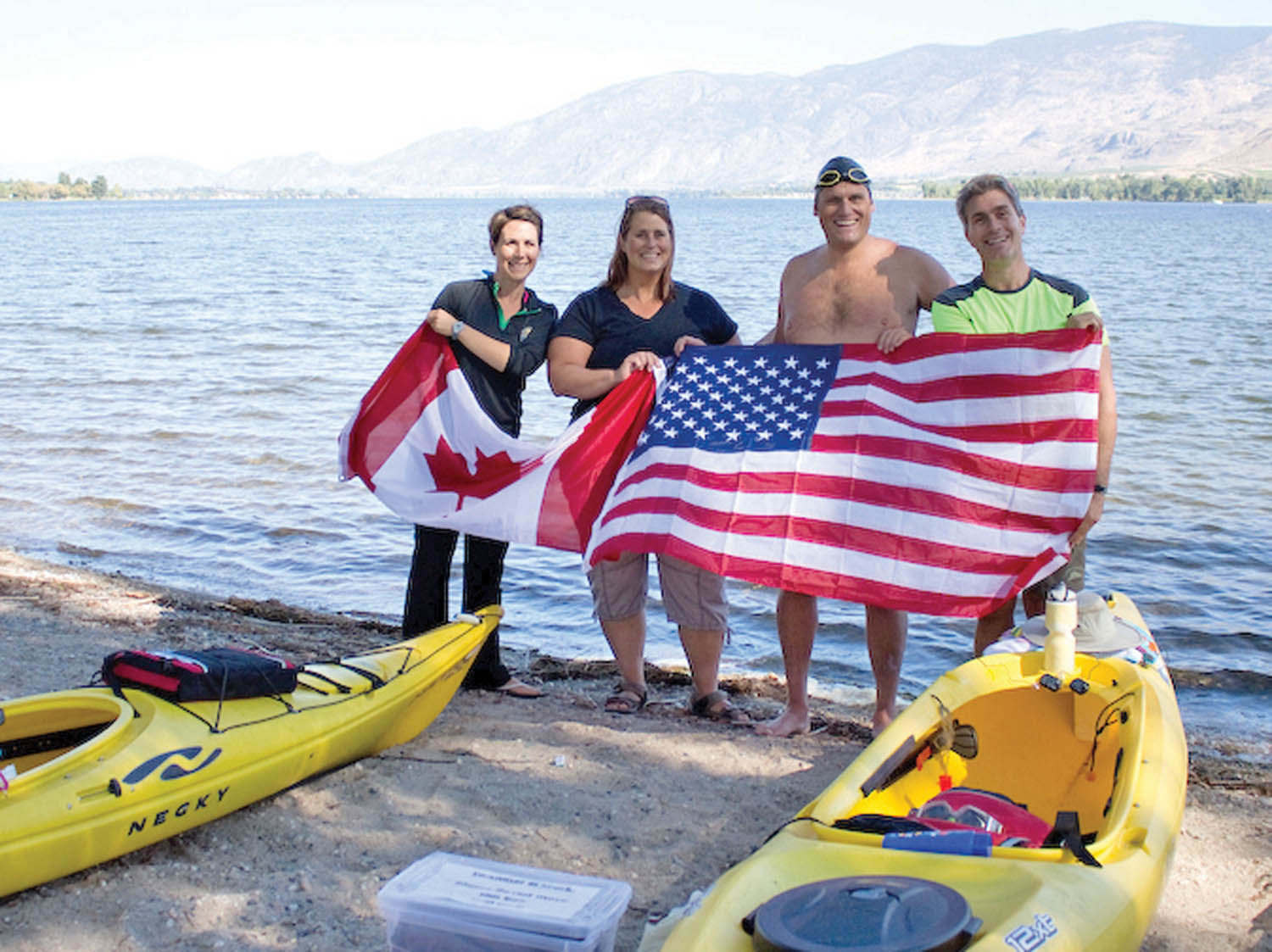
Swimmer Paul Duffield (second from right) was supported on his swim by kayakers Ashley Russo (left) and Phred Martin (right) and his wife Angelique Duffield. (Photo supplied)
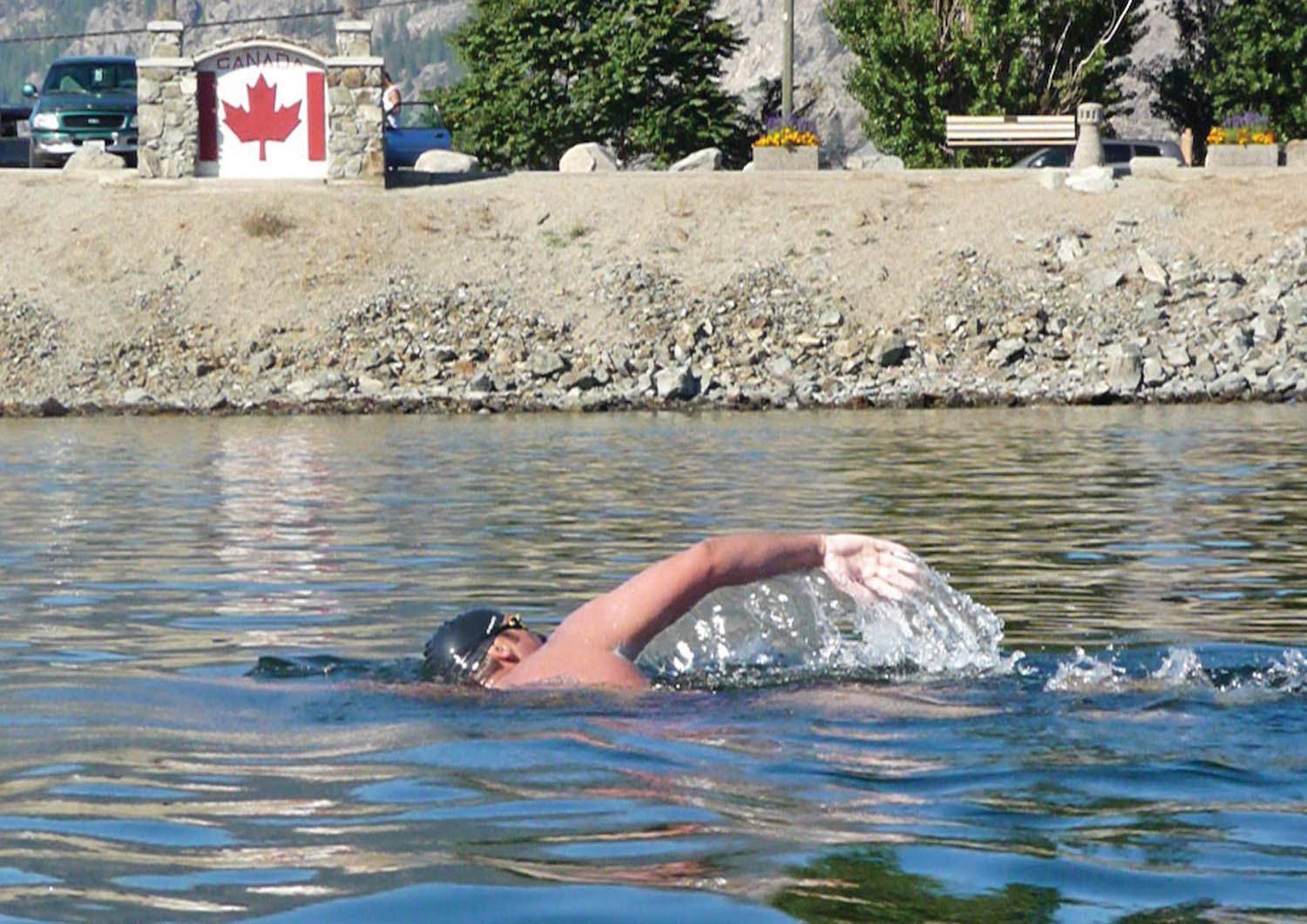
Paul Duffield swims on his way between Oroville and Osoyoos. (Photo supplied)
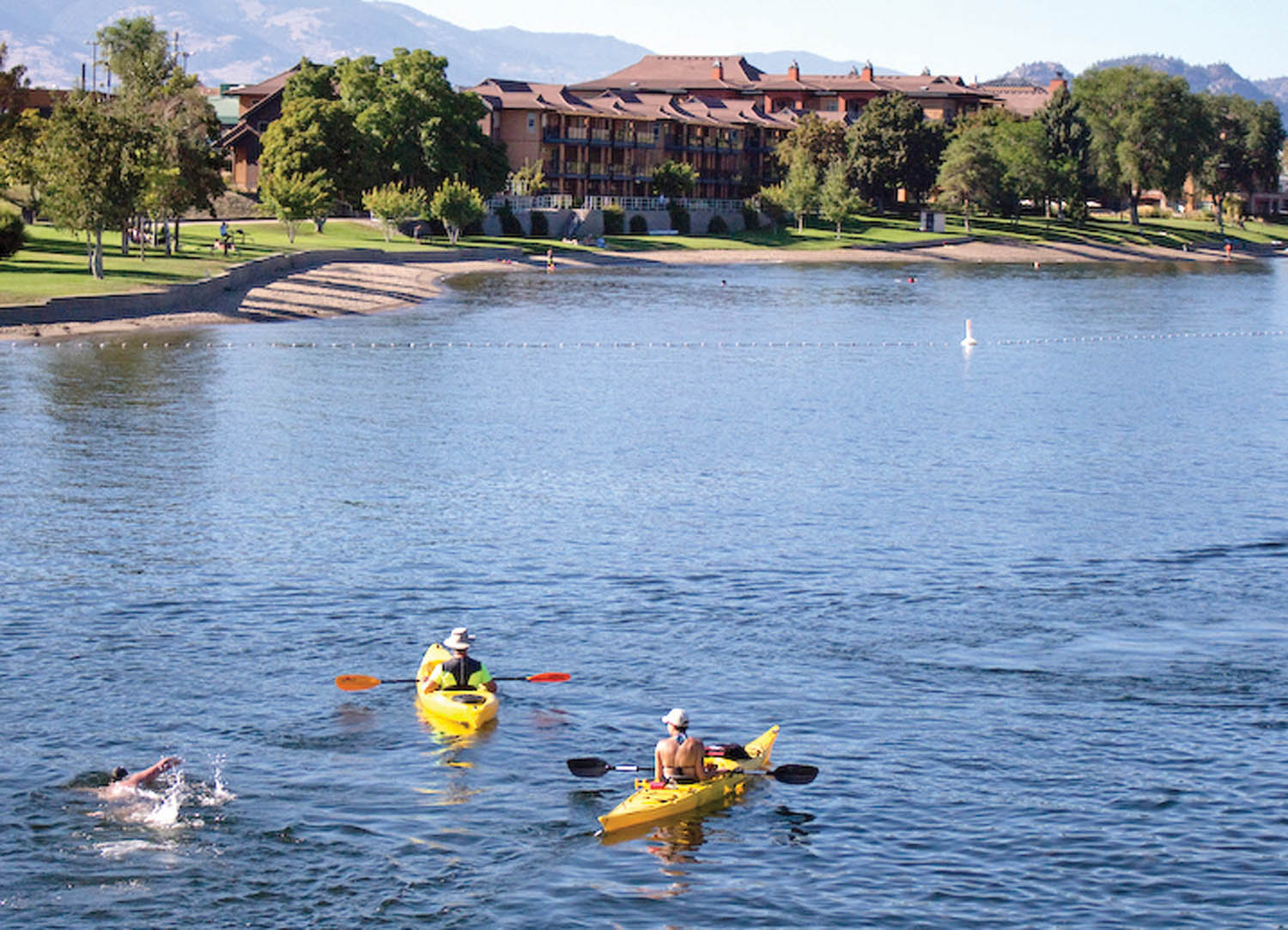
Duffield, accompanied by kayakers Ashley Russo and Phred Martin, completes the final lap to Gyro Park in Osoyoos. (Angelique Duffield photo)