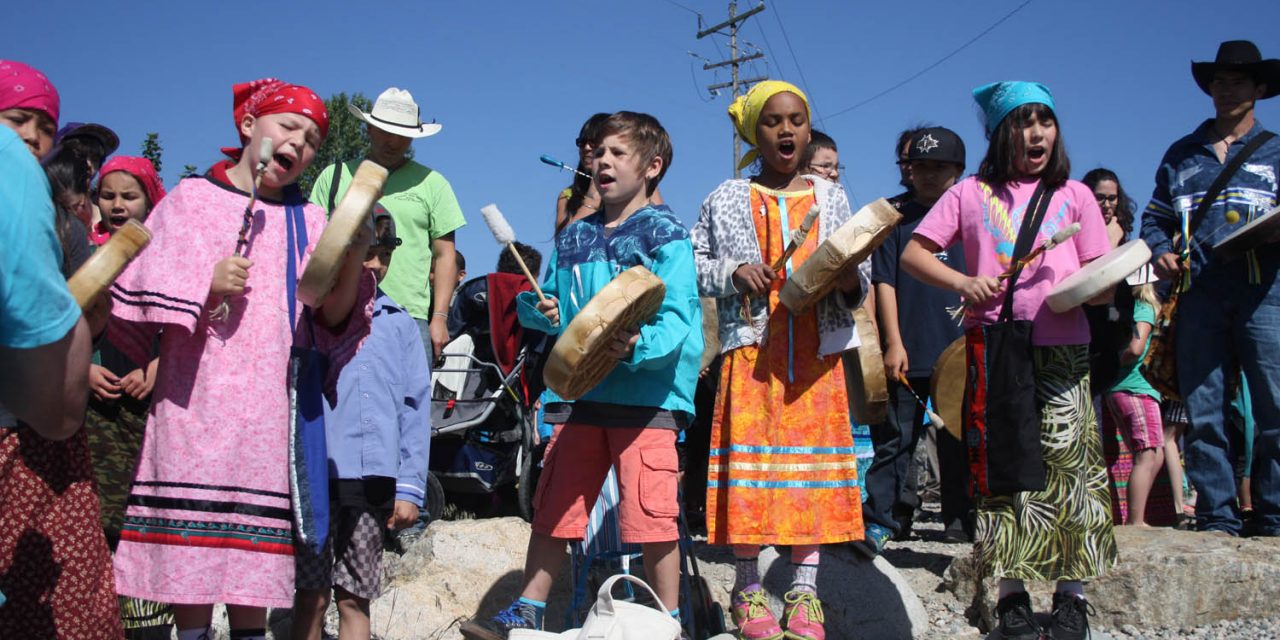
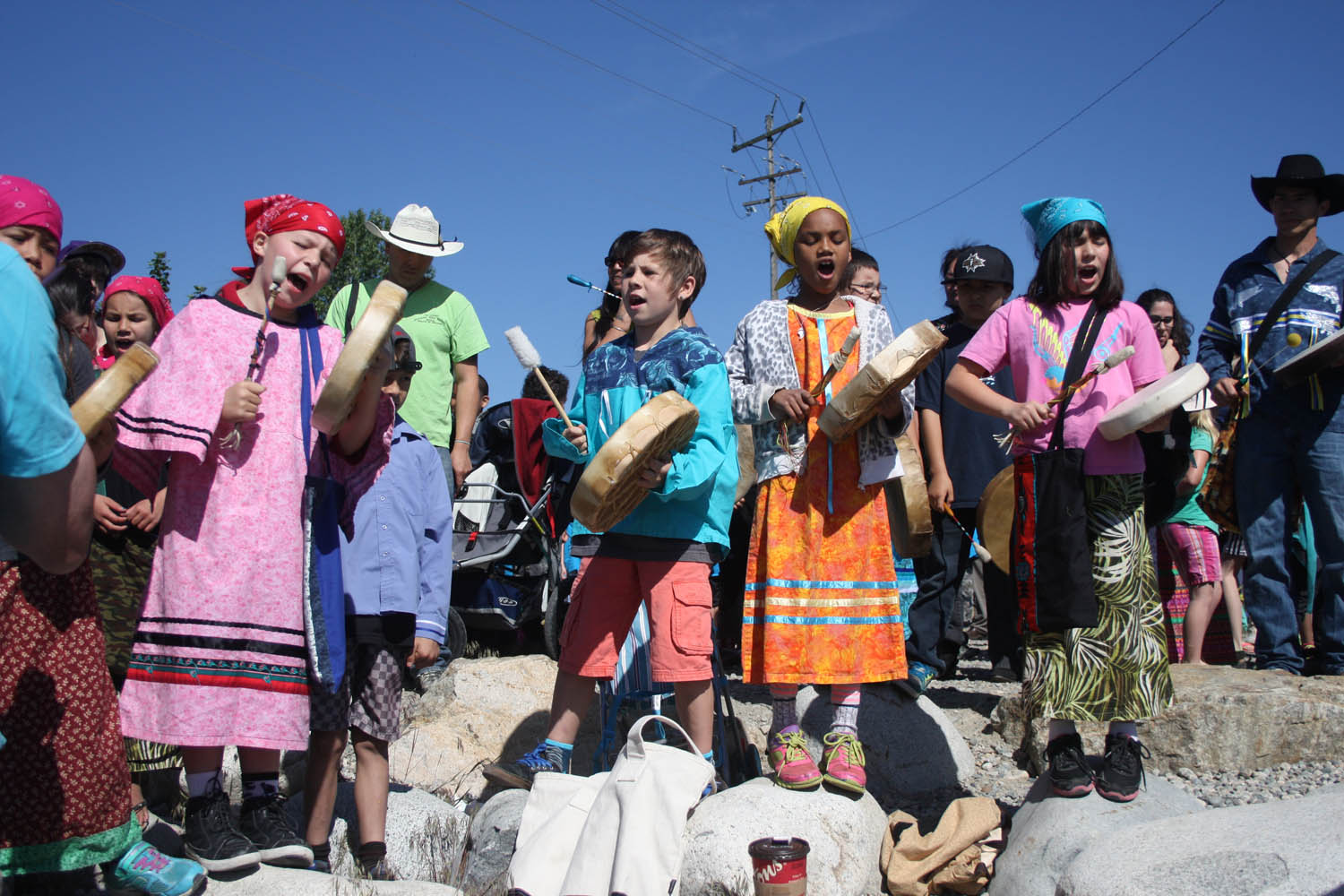
Children beat on drums at an Okanagan Nation Alliance ceremony to release salmon fry into the Okanagan River. (Keith Lacey photo)
When Jonathan Kruger – the Chief of the Penticton Indian Band (PIB) – was a child, he fondly remembers his parents and grandparents telling stories about how there were so many sockeye salmon in the Okanagan River that children could literally run across the river on the backs of the salmon.
Last Wednesday morning, school children from a dozen schools across the South Okanagan gathered on the shores of the Okanagan River as the Okanagan Nation Alliance (ONA) Fisheries Department released thousands of sockeye fry into the river.
These were the first sockeye fry produced from the Kt cpalk stim Hatchery that opened last fall on Penticton Indian Band (PIB) land last fall.
As part of the ONA sockeye education program, over 200 students from a dozen schools have been raising their own fry in classroom incubators over the winter. They gathered to release their “babies” into the river.
This provided an opportunity for youth to learn about the importance of sockeye salmon, while allowing First Nation youth to affirm their deep connection with this sacred species of fish and their return to the Okanagan Valley, said Kruger.
“I have been Chief of this band for seven years and this is one of my proudest days,” said Kruger. “It took a lot of hard work and planning to make this hatchery a reality, but it has opened and today we are releasing tens of thousands of fry produced at our hatchery.
“I’m very proud of the leadership in our band and I’m very proud of our elders who spearheaded the call many years ago to bring the sockeye salmon back to the Okanagan.
“I’ve spoken to many elders over these past few years and they passed on the stories I heard as a child about this river being so full of salmon that you could run across the river on the backs of the salmon. Those days will hopefully return once again.”
It has taken almost a decade of hard work and political advocacy between the ONA and provincial, federal and American tribal leadership to rebuild the sockeye run from the Columbia River to the South Okanagan, said Kruger.
One of the biggest and most important results from these collaborative efforts has been the Skaha Lake Reintroduction Program.
The ONA Fisheries Department has been directed to develop and implement the reintroduction program with input and guidance from the Columbia Okanagan Basin Technical Working Group, which represents provincial, federal and local agencies, said Kruger.
Kruger said more than 400,000 sockeye salmon fry will be released from the hatchery this year.
The short-term goal is to release as many as 1.6 million fry next year and the long-term goal is to release as many as five million annually in 2017 or 2018, he said.
The ONA fisheries department has, in a few short years, become the largest indigenous inland fishery in North America with a full-time staff of 35, most of them fish biologists, said Kruger.
The staff numbers increase to over 60 during peak season from spring to fall, he said.
“This is more than the fishery staff with the Ministry of Environment and Department of Fisheries and Oceans combined in our region,” he said proudly.
Having hundreds of children on hand to witness this historic moment has very significant meaning, said Kruger.
“We want the children to see the success of this program, become interested in why the sockeye salmon run is so important to our culture and the community at large,” said Kruger. “They are the ones who will carry this success into the future.”
Howie Wright, the program manager for the ONA Fishery Department, said negotiations to establish a fishery in the South Okanagan dates back to around 2002.
It was a thrilling day when the hatchery officially opened for business last August and even an better day on Wednesday when the first several thousand fry were released into the Okanagan River.
“It has been a very long time coming,” said Wright.
The goal is for hundreds of thousands of sockeye salmon fry to go from the Okanagan River into Skaha Lake and back towards Osoyoos Lake and back towards the Columbia River in the United States, said Wright.
By the summer of 2018, thousands of those fry will return to this area coming back from the Columbia River towards the South Okanagan and will weigh between two and four pounds, said Wright.
Currently, sockeye salmon can’t advance past the Okanagan Lake dam in Penticton, but negotiations continue between program partners to see that change over the next couple of years, said Wright.
“If they can get past the Okanagan Lake dam … they would get into Okanagan Lake, which is definitely part of our mandate,” he said. “That would feed the entire Okanagan system and bring salmon to the entire Okanagan Valley.
“Once they get into Okanagan Lake, they would just do their thing and we would have salmon populating the entire system across the Okanagan Valley.”
Wright said the large team of biologists will closely be monitoring the Okanagan River, Skaha Lake and Osoyoos Lake over the next few months to determine the proper number of fish that should be produced and released at the hatchery.
“We want to get the numbers right,” he said. “We don’t want to oversaturate the system, but we want a healthy supply for harvest. That will be a big focus for the rest of the year.”
KEITH LACEY
Osoyoos Times