As a June 1 deadline rapidly approached to register off-road vehicles (ORVs) to be used on Crown land, the province last week extended the deadline to Nov. 1.
The postponement provides additional time for off-road users to prepare for mandatory registration, the Ministry of Forests, Lands and Natural Resource Operations (FLNRO) said in a news release last Wednesday.
In a recent interview, before the government’s announcement, Norm Eady, vice president of the Osoyoos Wildlife Federation said some people were not aware of the requirement to register and many were confused by the rules. He wanted a grace period.
“I think probably 75 per cent of people are aware of the registration part,” he said. “It might even be 80 per cent. In our club, we pounded it out to everybody.”
Jeff Mohr, president of the Quad Riders Association of B.C., said the government’s extension was a good idea overall, even though most riders already knew about the June 1 deadline and many had already registered.
“It gives more people a chance to think and put things together and get their ducks in a row,” said Mohr. “I think that’s probably a very good thing, yes.”
FLNRO spokesperson Greig Bethel said the government is introducing the option of a sticker as an alternative to metal plates.
“The additional time is necessary to provide a sticker and develop supporting regulations,” he said.
The sticker will be the same size as plates, but it addresses a key request from off-road motorcycle and snowmobile groups, the government said.
Those who have already registered and obtained a plate will be able to exchange it for a sticker in the early fall if they wish.
ORV owners choosing a sticker are responsible for removing it if they sell the vehicle. This eliminates the possibility that a ticket issued to a new owner for an infraction could be sent to the previous owner instead.
Registration is done through ICBC and there is a one-time $48 fee for the registration and plate. It will be required for everyone operating an off-road vehicle on public lands, including Crown land. It is not required for vehicles operated only on private property.
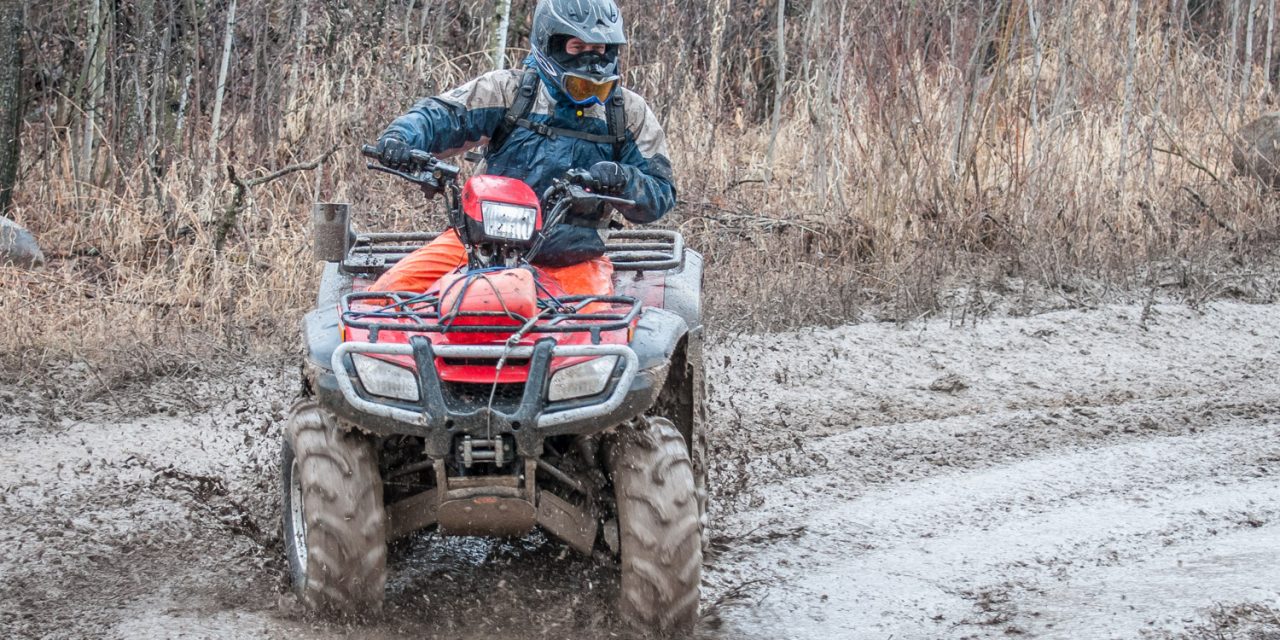
The requirement applies to snowmobiles, all-terrain vehicles (ATVs) or quads, off-road motorcycles and side-by-sides. Vehicles already licensed for use on the highway, such as jeeps, trucks and SUVs don’t require an additional license.
Eady doesn’t think the government has done a good enough job communicating the new rules, especially the insurance requirements. Nor does he think all ICBC insurance office staff are as informed as they should be.
“I know the onus is on you to know the law, but at the same time the onus is on the government to explain and have the law put out properly,” Eady said. “If they were really serious about making sure that they wanted to keep this a friendly environment, all it would take is a leaflet from the government to go into everybody’s mailbox.”
Both FLNRO and ICBC have extensive information on the new requirements on their websites. Visit www.for.gov.bc.ca/mof/orv/ and www.icbc.com/vehicle-registration/specialty-vehicles/Pages/Off-road-vehicles.aspx.
Registration requires paperwork such as bills of sale or transfer/tax forms showing proof of purchase. Specific requirements vary depending on whether the vehicle is new or used and whether it was purchased in B.C. or came from another province or the U.S. Details are available on the ICBC website.
Eady points out that even if people have older machines and have lost their paperwork, they can submit a declaration.
“It ended up costing them money because they had to go to a notary public and swear that, ‘I didn’t steal this machine off somebody’s backyard in Saskatchewan,’ but that’s a small inconvenience,” he said.
ICBC says that if you operate an ORV on or across highways, you are required to obtain ICBC’s Basic Insurance. If you operate on forest service roads, you need $200,000 in third party liability insurance.
On all other Crown land, liability insurance is voluntary, but is recommended.
Police may issue an operation permit, free of charge, as a condition of highway operation. Operation permits are not required for highway crossings controlled by a stop sign or traffic light or when loading and unloading an ORV from another vehicle in a parking lot, ICBC says.
Those who have registered or transferred their current snowmobile under the Motor Vehicle (all terrain) Act are eligible for a refund when they register under the ORV Act.
Eady doesn’t believe, as some have suggested, that the new legislation will help to recover stolen ORVs. That’s because when you replace the frame, you get a new serial number, and because many stolen vehicles are taken on joy rides until they are burned out and then they’re sold for parts.
He does, however, believe that the license plates will help to make irresponsible riders accountable.
“The license plate will open up an avenue to pursue the people that are breaking the laws and throwing hardship on the rest of us riders,” he said. “We as riders totally agree that this is a good thing and we hope that will assist us in not seeing further closures of areas like the West Bench.”
Mohr, of the Quad Riders Association of B.C., believes the province already provided considerable information about the new requirements.
Most people knew about the changes, though they may have had questions about the forms they need, when changes come into effect and what is compulsory and what is optional, he said.
He agrees with Eady that some ICBC brokers are better informed about the new rules than others.
Some brokers are making people believe that they require insurance if they are only using ORVs on Crown land, he said.
Mohr thinks there are mixed feelings among ORV users about the new requirements.
“I like to think the majority are very much in favour, because it is an opportunity to try and curtail some of the theft and identify the bad apples that are out there destroying the environment and giving us all a bad name,” said Mohr.
RICHARD McGUIRE
Osoyoos Times