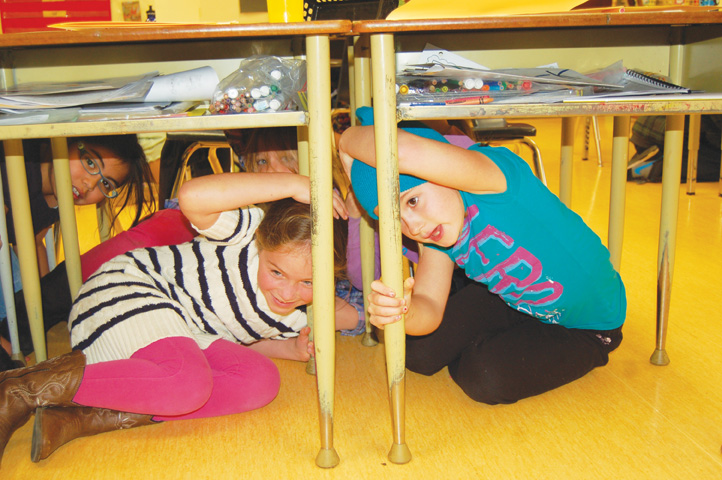

Jordyn Koteles (left) and Taya Loverin duck and cover during the earthquake drill at Oliver
Elementary School on October 17.
Lyonel Doherty photo
A strange rumbling (sound effects courtesy of Lori Martine) could be heard over the intercom at Oliver Elementary School.
Immediately every student ducked under his or her desk and held onto one of the legs.
Earthquake!
Pupils in Tammy Dionne’s Grade 2 class did a good job staying under cover for the two minutes during BC’s “ShakeOut” drill.
Even Minister of Justice Suzanne Anton in Vancouver dropped, covered and held on along with more than 690,000 British Columbians during the earthquake preparation drill on October 17.
Anton noted the risk of a catastrophic earthquake for coastal BC is very real and urged British Columbians not to be complacent.
Quick facts
– The Pacific Coast is the most earthquake-prone region of Canada.
– More than one thousand earthquakes rumble beneath the surface of BC every year – more than three a day on average.
– In the last 70 years, the offshore region to the west of Vancouver Island has had more than 100 earthquakes of magnitude five or greater.
-The Pacific plates are constantly moving relative to one another at speeds of about two to 10 centimetres a year (about how fast your fingernails grow). The plates can either slide past one another, collide, or move apart.
British Columbia is one of the few areas in the world where all three of these types of plate movements take place.
It is reported that a fault line runs through the Oliver area.
Elementary school principal Barton Tumlinson said schools are mandated to practice fire, earthquake and lock-down drills on a regular basis. So last week he used this instrument (provided by Martine) to emulate the sound of rumbling. He then instructed 318 pupils to get under their desks to protect themselves from falling objects.
Tumlinson said students would have time to react during a real earthquake because they practice being quick and efficient at getting in a safe position. By ducking under a desk, the children can protect themselves from objects falling from the ceiling or shelves falling over.
“While we have not seen an earthquake of this severity in the Okanagan, in the schools we practice the procedures that allow us to be as safe as possible.”
Tumlinson experienced a real earthquake in Oregon one time.
“The earthquake was very brief. Once we realized that we were experiencing an earthquake, it was over.”
Anton said practicing the duck-and-cover technique is a critical first step for families because it will help create a quicker and trained response when an actual earthquake occurs.
She also stressed it is important to look beyond the impacts of the initial earthquake and consider that, in the hours and days following a quake, it will be critical for families to be prepared with an emergency plan and emergency kit. She noted that families should be prepared to survive on their own for at least 72 hours.
Lyonel Doherty
Oliver Chronicle