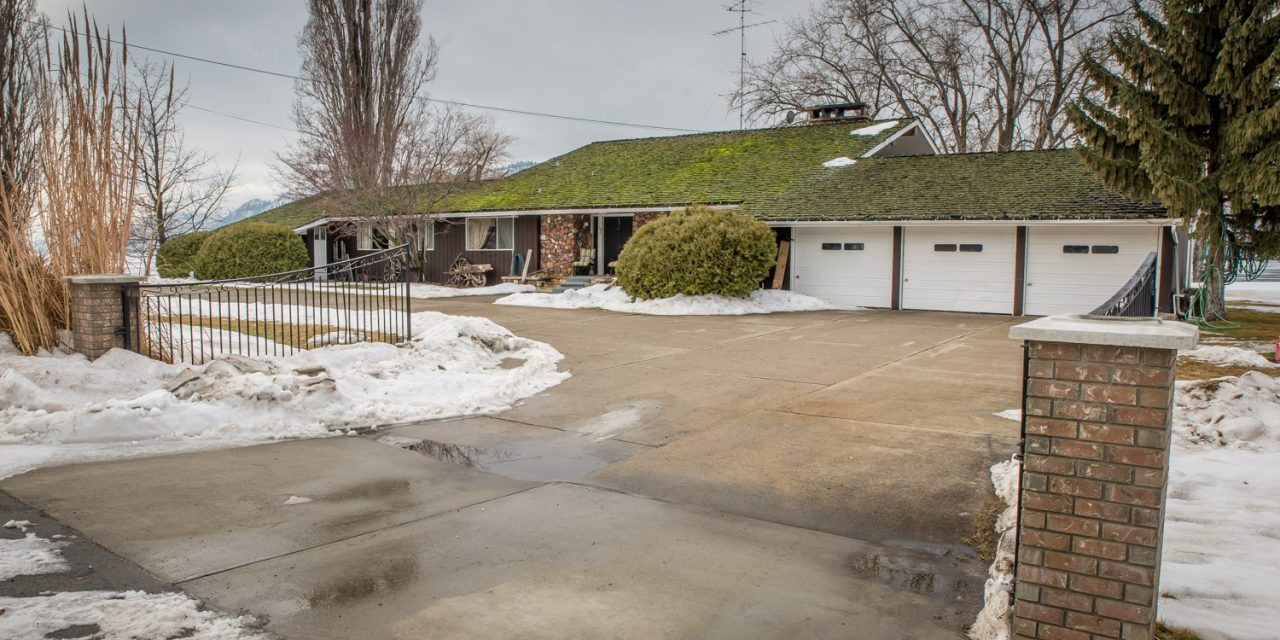
This 4,100 sq. ft. lakefront estate house on Lakeshore Drive on an acre of land with a peninsula of sandy shoreline was recently listed for more than $3.4 million. Its assessment was about an eighth of that amount. It’s classed as a farm. (Richard McGuire photo)
As Osoyoos homeowners mull over their assessment notices that reflect the market value of their homes, they may be surprised that some of their rural neighbours enjoy huge property tax breaks.
The assessment reductions are intended for farmers, but a number of rural estate properties receiving these benefits are no longer farmed.
Among the properties looked at by the Osoyoos Times were:
• A 4,100 sq. ft. lakefront estate home on Lakeshore Drive recently listed for more than $3.4 million, but only assessed at about $425,000;
• A residential one-acre lot with a large home across the road from Osoyoos Lake, assessed at just over $1,000 on the land for education tax purposes;
• A lakefront subdivision just north of Osoyoos with homes valued at $1 to $2 million on lots less than one acre where owners get a 50 per cent reduction on their land value because they are in the Agricultural Land Reserve (ALR)
Some of these tax breaks were brought to the attention of the Osoyoos Times by a resident of Area A (rural Osoyoos) in the Regional District of Okanagan-Similkameen (RDOS).
The resident agreed to be interviewed only if he wasn’t identified because he fears repercussions from owners of some of the homes he named.
“What bugs me is people put these great big mansions on farmland and they’re not really farming it,” said the resident, who we’ll call “Tom.”
“The property is assessed at a couple thousand bucks. It’s just not fair.”
Tom said he has no problem with those who actually are farming receiving a break on their land values, but he resents that these breaks are extended to others when the land isn’t farmed.
Asked how he reacted when he saw a home listed for $3.4 million, but only assessed at $425,000, Tom said, “I was flabbergasted.”
A real estate listing for the home describes it in glowing terms.
“This property is spectacular!” says the listing. “You own a peninsula of sandy shoreline on Canada’s warmest lake. The property is over an acre, with no neighbours, surrounded by the lake on two sides. Floor to ceiling windows that face the lake take advantage of the home’s perfect location, and extra large room sizes for all entertaining options.”
BC Assessment, the provincial agency that determines property values for tax purposes, puts the value of the home at $423,000 and the land at $3,706.
It considers the property to be farmland.
For purposes of the education tax and some other taxes, the value of the land is further discounted by 50 per cent to just $1,853.
Asked about this property and others in the same area, Tracy Wall, deputy assessor for the Thompson Okanagan Region with BC Assessment, said the properties “currently have farm class, so the value of the land does not reflect market value.”
BC Assessment conducts regular follow-up on all active farms to ensure they continue to meet the qualifications for farm class, she said.
“Our records show these properties are part of active farm operations,” Wall said.
The situation around Osoyoos hasn’t come near to matching that in the Lower Mainland, where speculation in rural properties to avoid taxes has set off alarm bells.
Recently the Globe and Mail reported on a 22,000 sq. ft. home in Richmond with five large suites, complete with Jacuzzis, on so-called “farmland.”
In September, Metro Vancouver released a report arguing that these tax breaks actually work to the detriment of agriculture and are unfair.
“When farm property tax policy inadvertently creates financial tax advantages for non-farm residential and commercial uses in the ALR, questions of equity among taxpayers emerge,” said the Vancouver report, which its authors say can apply to other areas of B.C.
“Reforming farm property tax policies may or may not increase total taxes collected by municipal governments, however, it will redistribute the tax burden more equitably,” the report said.
There are two separate provisions of provincial law that rural estate property owners use to gain tax advantages.
In the case of the $3.4 million home and some neighbouring properties, they benefit from Regulation 411/95 of the B.C. Assessment Act, which classifies the land as a farm and so assesses the property below market value.
For properties between 0.8 and four hectares, the farm operation should gross $2,500 annually, even if it’s just through the sale of Christmas trees or hay.
For “farms” less than 0.8 hectares, they need gross sales of $10,000.
There is also a provision to classify land as farmland if it is owned by a retired farmer.
Tom admits some of the local properties he points to may be owned by farmers who farm elsewhere, but he said these properties themselves aren’t farmed at all.
The second provision in B.C. law reduces the assessed value of land in the ALR by 50 per cent, even if it is subdivided as a residential lot and has no connection to farming.
This 50 per cent reduction applies for the purpose of education and hospital taxes, but provincial rural taxes are charged on the full value of the land.
It is under this provision that a group of lakefront estate homes on 87th Street north of Osoyoos get a break not enjoyed by some of their neighbours.
One half-acre property in this group, for example, has a house assessed at $481,000 and land assessed at $662,000 for a total assessment of $1,143,000.
But for purposes of education taxes and other taxes that use the same formula, the land is only assessed at 50 per cent – just $331,000.
Kim Grout, chief executive officer of the Agricultural Land Commission (ALC), points out that her agency has nothing to do with taxation.
It does, however, rule on subdivision applications for land in the ALR. Decisions are based on the benefits to agriculture.
Grout said she didn’t have enough information to know why the lakefront properties on 87th Street were allowed to be subdivided, but remain in the ALR and receive the tax benefits.
The ALR, she said, was put in place in 1974.
“Perhaps those lots were already existing at the time,” Grout said. “Decisions were made not to have leapfrogging of urban intrusion into ALR areas, so regardless of parcel size, contiguous areas of land were put in. There’s no requirement for that land to be removed just because someone feels like it’s too small to farm.”
Mark Pendergraft, who represents Area A on the board of the RDOS, says the system is unfair and he’s tried to have it changed, but the province has been unwilling.
“This is the case in only a handful of situations,” he said. “It’s not the norm. It is something that I have attempted to have corrected, but the province at the time seemed unwilling to go down that road, without any good rational explanation for it.”
He acknowledges that the province has made some effort to address properties that are improperly classed as agricultural, but he said there’s been no effort to address the situation of small properties receiving the ALR land assessment reduction.
“I’m still asking the province to continue to look at and correct it,” Pendergraft said. “My understanding is they were going to start with the bigger ones, because they were the most obvious.”
Pendergraft said he’d like to see property owners treated fairly across the board.
“It’s only a few people that probably are even aware of the situation,” he said. “Not a lot of people compare their assessments to their neighbours.”
When people have brought these concerns to his attention, he said he’s tried to work with them to get changes made, but they’ve often given up in frustration.
“I’ll keep working at it,” he said. “But it’s just something that I guess wasn’t high on the province’s priority list.”
RICHARD McGUIRE
Osoyoos Times
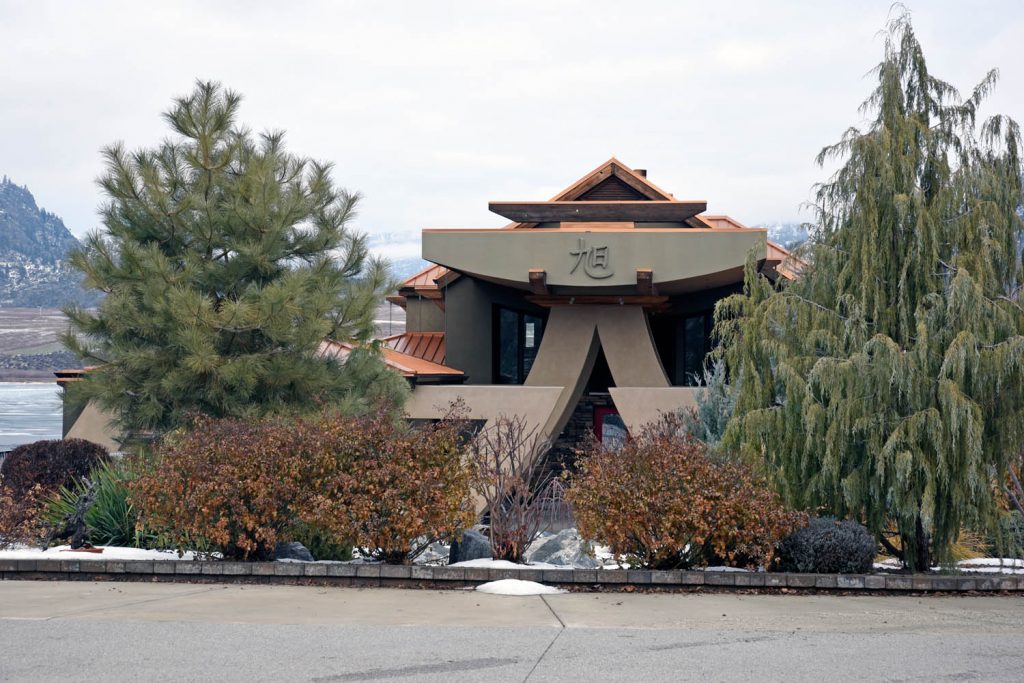
This $1,872,000 lakefront estate north of Osoyoos is assessed at market value for the house, but the assessment on the land is discounted by $329,000 or 50 per cent of its $658,000 market value for education and other taxes because this subdivision is in the agricultural land reserve. There was no apparent sign of farming on the half-acre lot. (Richard McGuire photo)