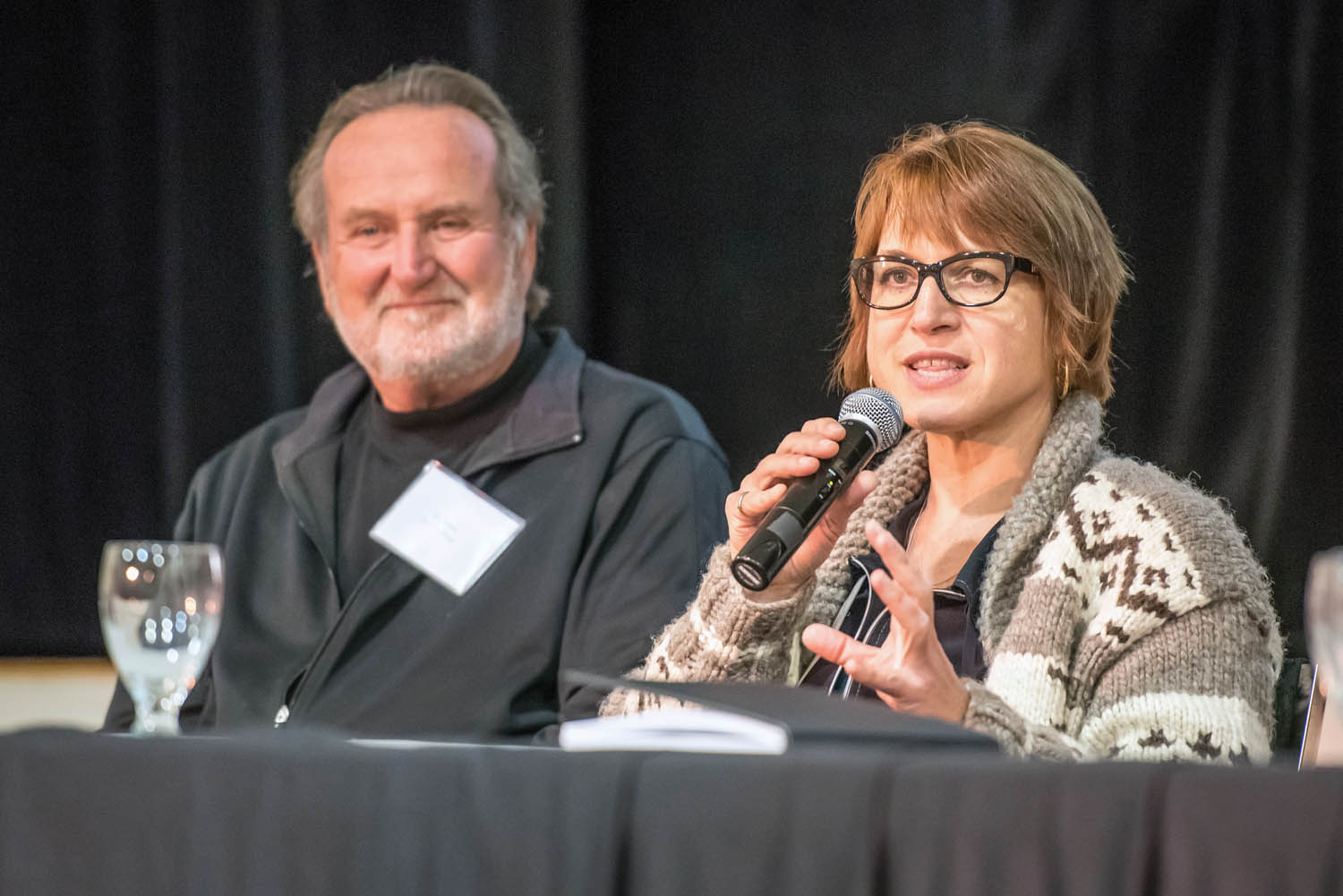
Anna Warwick Sears spoke last October at the Osoyoos Lake Water Science Forum. At left is former Osoyoos mayor Stu Wells, who co-chaired the forum. Sears says whether we see floods or drought this year will depend on timing of the melt and on June rains. (Richard McGuire file photo)
Snowfalls this winter mean the snowpack in local river basins is much higher this year than last, but the timing of the melt and June rains will determine whether we have floods or drought this year.
That’s the word from Anna Warwick Sears, executive director of the Okanagan Basin Water Board (OBWB).
January snow basin indices from the B.C. River Forecast Centre put the Similkameen at 143 per cent of normal and the Okanagan at 125 per cent of normal.
A year ago both basins were below normal.
Figures released Tuesday put the Similkameen at 103 per cent of normal as of Feb. 1 and the Okanagan at 122 per cent. January precipitation was above normal.
“The real thing this year is going to be when it melts,” said Sears, noting that last year warm spring temperatures caused the snow to melt early, contributing to the drought that followed.
June rains are a second key factor, she said. Normally June is one of the rainier months, but last year there was little rain in June, exacerbating an already dry situation.
“The thing that usually saves our bacon is getting a nice rainy June and we didn’t have that last year,” Sears said. “I haven’t heard anybody prognosticating on whether or not it’s going to be a dry June or a wet June. It’s the amount of rain in June that determines usually if it’s going to be drought year or not.”
Both Environment Canada and the National Oceanic and Atmospheric Administration (NOAA) in the U.S. predict the period from February to April will be warmer and drier than average.
“They are much better at predicting temperature than they are precipitation,” said Sears. “What we’re seeing all over the whole world is global warming is warming things up.”
El Niño also tends to bring warmer temperatures, she said referring to the cycle of warm ocean water that develops in the central and east-central equatorial Pacific Ocean, which influences weather in countries on the Pacific.
NOAA is forecasting a high likelihood of El Niño conditions persisting through the spring of 2016 and possibly into the summer.
Sears said rain that was expected to hit California this year came farther north, bringing more precipitation to the Pacific Northwest.
Meanwhile, “the blob,” an area of warm water in the northern Pacific has now dissipated. It was first detected in late 2013 and contributed to warm winters and low snowpacks in southern B.C. over the past two years.
The blob and a ridge of high pressure especially kept Vancouver Island and the Lower Mainland in drought last year, Sears said.
The OBWB plans to do more direct one-on-one work with water utilities and municipalities this year to look at where the gaps were in responding to last year’s drought.
A particular focus will be on communications, she said, but it will also involve planning.
Sears said she’s still waiting for the provincial government to release its drought response plan update.
By early February, nearly two thirds of the annual B.C. snowpack has typically accumulated, the B.C. River Forecast Centre said in its February bulletin.
The centre said the higher than normal snowpacks being observed in the Okanagan indicate the potential for elevated flood risk.
“We’re very engaged with the weather,” Sears said. “Whether it’s a wet year or a dry year, we are working on the one hand trying to help communities get their floodplain maps done and on the other hand trying to help communities and make sure they have their water conservation and drought plans in place. If it’s just a nice, calm, normal weather year, then everybody can be happy. But is sure doesn’t hurt getting this stuff done in advance.”
RICHARD McGUIRE
Osoyoos Times