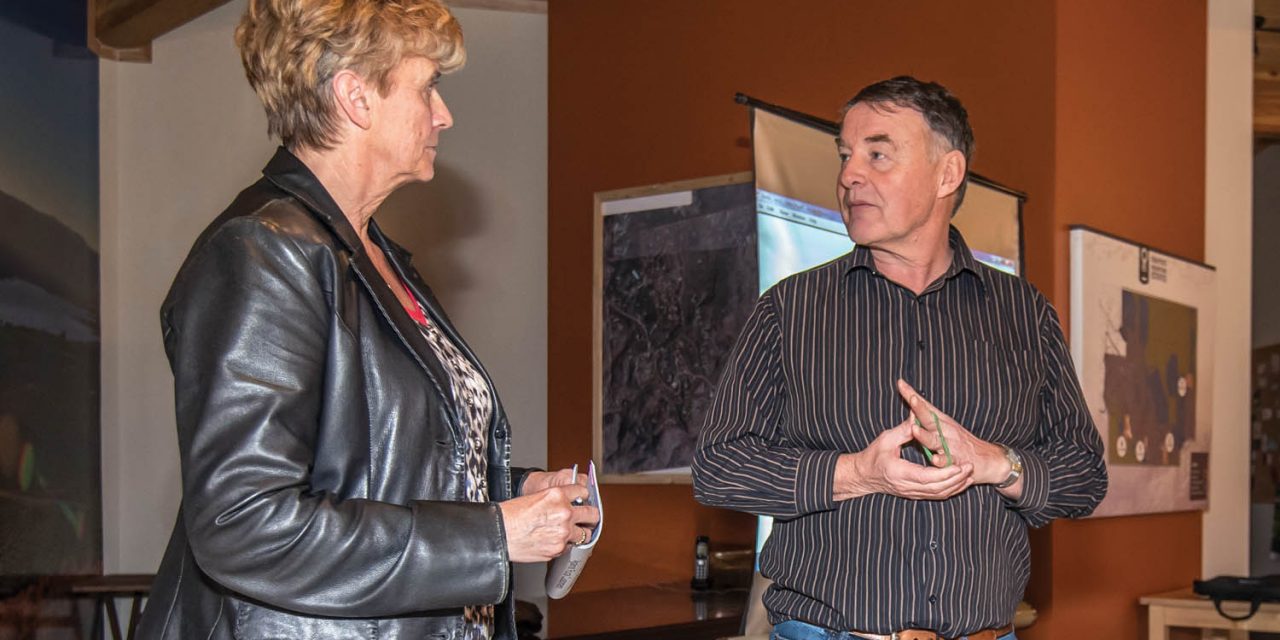

Members of the Anarchist Mountain community first raised concerns about two-tier electricity rates in a meeting with MLA Linda Larson late in 2014. Last July Bill Bennett, minister of energy and mines, posed five questions about the issue, but Nick Marty thinks he won’t get an answer until 2017. At right above is Mark McKenney, president of the Anarchist Mountain Community Society. (Richard McGuire file photo)
How long should it take for a provincial cabinet minister to get answers to five basic questions on two-tier electricity rates?
Nick Marty, an Anarchist Mountain resident who believes the rates charged by FortisBC and BC Hydro discriminate against rural people without access to natural gas, says taking well over a year is much too long.
“The questions are not that complicated,” said Marty, a retired federal official who spent much of his career working on energy conservation. “Quite frankly, if the request had come in when I was working in the government, I could have responded to it in a month.”
In July last year, Bill Bennett, B.C.’s Minister of Energy and Mines, asked the British Columbia Utilities Commission (BCUC) to answer five questions addressing issues raised by Marty about the Residential Conservation Rate (RCR).
Last week, Marty finally received notice that the two electricity monopolies have now been given a deadline of Aug. 5 to submit reports to the BCUC.
That’s not a deadline to answer the questions – just to provide initial reports.
That, Marty believes, could mean Bennett won’t get a response to his questions until sometime in 2017.
Meanwhile, electricity rates keep increasing. The second-tier rates that FortisBC customers without access to natural gas now pay for space and water heating are among the highest in Canada, Marty said.
Since Bennett posed his questions more than six months ago, the BCUC has been bogged down with the two utilities discussing the “methodology” by which the questions would be answered.
The two-tier rate system was claimed by the utilities to encourage electricity conservation because people are billed at a lower rate for the first 1,600 kilowatt hours (kWh) used in a bi-monthly billing period.
But Marty argues that most people with access to natural gas consume all or most of their electricity at the lower rate and so have a reduced incentive to conserve.
Those without access to gas, mainly rural customers, use much more power for space and water heating and so have little choice unless they switch to burning wood.
Marty says three quarters of his electricity is consumed at the higher rate, despite having geothermal heating and R-2000 insulation.
As of Jan. 1, FortisBC raised the second-tier rate to 15.2 cents per kWh, which Marty said is higher than rates charged in any other Canadian provinces with the exception of some time-of-use rates, which can be avoided with load shifting.
Prior to FortisBC adopting two-tier rates in 2012, the flat rate was 9.5 cents per kWh.
Asked if he thinks the process for answering the questions is a stalling tactic, Marty chooses his words carefully.
“I think that they are just in no hurry,” he said. “It’s not a priority for BCUC because all it’s going to reveal probably is negative information about their system. So they are in no hurry to get this report.”
The government isn’t pushing for the information any faster either, he said.
“It’s a way of deflecting any criticism for the next year and a half because they’ve got a response: ‘Oh, we’re looking into it,’” he said.
Did Marty experience this kind of tactic when he worked in government?
“Oh yes, all the time,” he responded.
Minister Bennett’s questions to the BCUC are:
- Do the residential inclining block rates cause cross-subsidy between customers with and without access to natural gas?
- What evidence is available about high bill impacts [greater than 10 percent as a result of the adoption of the residential inclining block rates] on low-income customers?
- What evidence is available about factors that lead to high-energy use and, therefore, bill impacts for customers without access to natural gas, including low-income customers?
- What is the potential for existing Demand-Side Management programs to mitigate these impacts?
- Within the current regulatory environment, what options are there for additional Demand-Side Management programs, including low-income programs?
RICHARD McGUIRE
Osoyoos Times