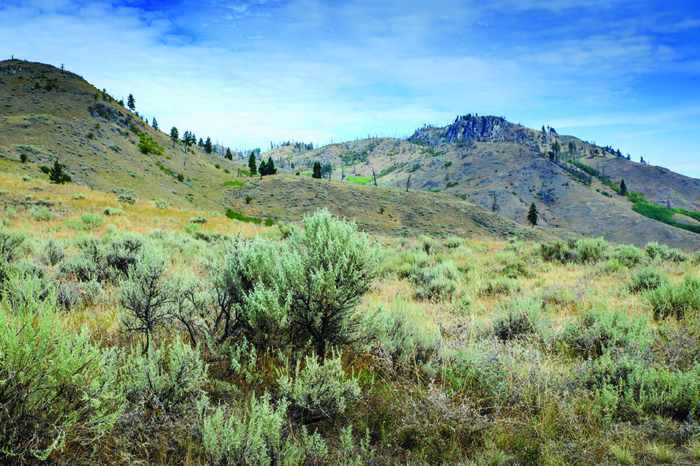

Jim Wyse believes that Mount Kobau should be included in the proposed national Park. Photo by Richard McGuire
Leaving Mount Kobau out of a proposed national park would be “just a crime,” says Jim Wyse, a conservationist and owner of Burrowing Owl Estate Winery.
As the October 31 deadline rapidly approaches for the public to comment on the province’s proposal for protecting land in the South Okanagan, Wyse has been taking his appeal to local organizations.
Early this month he delivered his pitch to the Rotary Club of Osoyoos. Recently, his presentation was delivered to the Oliver Tourism Association and Oliver Town council.
Wyse believes the region, especially Oliver, is missing a huge opportunity if the proposal outlined in a provincial government intentions paper is adopted.
The province is proposing a national park reserve in an area south of Highway 3 to the U.S. border that includes about 98 square kilometres of mainly endangered grasslands habitat.
A smaller area, about 68 sq. km in size, to the west of Vaseux Lake and including White Lake, would also become a national park reserve, separated by about 12 kilometres as the crow flies from the southern portion.
It’s the area in between, which includes the magnificent Mount Kobau, that has Wyse and fellow members of the South Okanagan-Similkameen National Park Network (SOSNPN) most concerned.
The province’s intentions paper, released on August 13 for public comment, would maintain this area, called Area 2, as a provincial conservancy, which in Wyse’s view offers it little protection.
It also doesn’t have the same cachet for attracting international tourism, he argues.
The largest of the three areas, at about 177 sq. km, the loss of this area as a national park would leave the national park reserve at just 166 sq. km – a far cry from the roughly 600 sq. km first proposed in 2006 and the smaller size of 284 sq. km proposed in 2010.
At the recent Rotary Club meeting in Osoyoos, Wyse’s comments were greeted with support by individual Rotarians, even though the club itself doesn’t take a position on such issues.
His presentation to the Oliver Tourism Association, delivered in his absence by Tony Munday, argued that with a provincial conservancy instead of a national park next to Oliver, the town is missing an opportunity.
The B.C. Ministry of Environment presented its intentions paper as an attempt to find common ground between diverse stakeholders, but it is not winning support among opponents of a national park either.
Hunters and off-road vehicle users are concerned about any curtailment of their activities.
Wyse argues, however, that the reduction of the park concept area to 284 sq. km in 2010, was a concession to hunters giving them continued access to the Snowy Protected Area south of Keremeos, which has higher-value game.
Although Wyse is a B.C. Liberal, he’s been critical of MLA Linda Larson, who is a staunch opponent of a national park reserve.
The government’s proposal to keep Area 2 as a provincial conservancy “was simply and purely a political accommodation for our good friend Linda,” he told the Rotarians. “I don’t think that’s an intelligent reason to do it. We believe there are so many reasons from the point of view of tourism to have the (Kobau) mountain included. Can you imagine the park without a mountain?”
Without Area 2, the national park will be fragmented, environmentally less effective and will likely be judged to be less than a “world class” tourist attraction, Wyse told the Oliver Tourism Association.
“This underachievement will be felt by all the local communities economically,” he said. “With Area 2 included, the park will definitely be a world class attraction and all the local communities, including Oliver, will benefit economically.”
Wyse noted that biologists are concerned about connectivity for endangered animals if the park is fragmented. He admitted, however, that he is not a biologist.
“My thrust is as a business person,” he said. “My interest and sincere concern is for the tourism that will not happen if we don’t get the full park. The small park won’t have the lustre that would come from having the whole thing nicely connected together.”
Wyse said he was impressed by a study of the economic impact of Parks Canada prepared for the federal agency by the Outspan Group and released in April 2011.
That study, which looked at the economic impact of national parks across Canada, found that among Canada’s 38 national parks, they created on average 862 direct and indirect jobs. B.C.’s six national parks created on average 772 direct and indirect full-time equivalent jobs.
Direct jobs refer to people employed by Parks Canada. The average per park in B.C. is 154 full-time equivalent jobs. Indirect jobs are those in related industries such as tourism, and in B.C. the average is 618 jobs per park.
The numbers vary depending on the size of the park and the number of visitors they receive.
Average annual spending per park in B.C. is $66 million, of which $8 million is direct spending by Parks Canada and $58 million is indirect spending, such as money spent in the area by tourists.
The proposed national park reserve area in the provincial government’s intentions paper is 166 sq. km, which would make it Canada’s seventh smallest national park, Wyse said.
If Area 2 were added to the national park area, it would be 343 sq. km, making it the 12th smallest national park in Canada.
Wyse noted that average annual spending by the province on a provincial park is just $35,000.
“That doesn’t even pay a full salary for a warden,” he said. “There’s very little money for protection. You can designate it all you want, but in our view the best protection by far is going to be a national park.”
By Richard McGuire