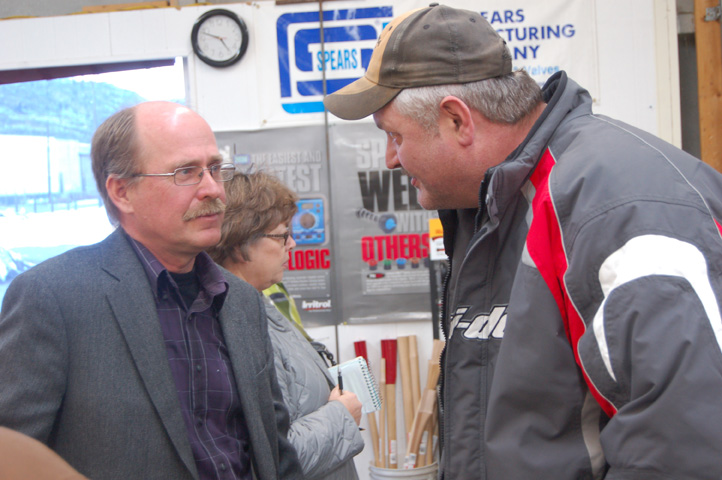

Greg Thorp, left, speaks with John Hofman from Integra Tire during a meeting of business owners on February 4 to discuss the regional district’s enforcement of sign regulations.
Lyonel Doherty photo
A meeting of property owners in Oliver has created solidarity in challenging the regional district’s sign regulations.
Several residents who attended the meeting at South Valley Sales on February 4 spoke out against the district’s enforcement plan.
The district has sent out letters to landowners along Highway 97 south regarding their contravention of the bylaw, which prohibits third-party signs and only permits one business sign per property. A height restriction (three metres) also applies.
The main reason behind the enforcement is driver safety; the fear is too many signs are distracting.
Greg Thorp from Riverside Greenhouse and Nursery said businesses are being advised to start altering what they’ve been doing for the past 100 years.
“I want to be able to put a sign on the road because I live (and work) in the hinterland. Signage is an important component to our business,” Thorp said.
He questioned if there is any evidence to suggest that more traffic accidents occur here (because of the signs) than anywhere else.
Carl Withler, regional agrologist for the Ministry of Agriculture, attended the meeting to offer support for farmers.
He admitted the sign enforcement issue “hit me out of the blue.”
Withler explained the regional district perceives the Highway 97 corridor as cluttered with signage, so the strategy is to clean it up. “Area C is first, then they will work towards Area A (rural Osoyoos),” he stated.
Withler said the bylaw has been around for a long time, but the district has not had the will to enforce it. When such a bylaw is not enforced, it remains unchecked, and when one person erects a sign, others do the same, he noted.
“There’s no magic wand to resolve this. Will you get it entirely your way? Probably not.”
But farmers can unite and start a dialogue with the powers that be, Withler said.
Road 9 nursery owner Lloyd Park has 10 third-party signs on his property, which he says were approved by the Ministry of Transportation.
“I’m helping my competitors. I’m not in the business to put people out of business. What am I hurting?”
The bylaw does not permit a property owner to erect a sign advertising someone else’s business.
Withler confirmed that the large billboard signs you see on the highway are on federal land, therefore, the BC highways act does not apply.
The proprietor of Peach Hill Farm Market in Osoyoos said they erect multiple signs along Highway 97 to make people aware of their fruit stand. He noted if drivers only see one sign at the last second, it could cause a traffic accident with people braking all of a sudden.
John Hofman from Integra Tire said he had a professional sign made for his business. It was erected (with permission) on private property on Road 6. The owner of the property received a letter from the regional district stating he must remove Hofman’s sign. Meanwhile, Hofman claims he received previous permission from the regional district to put it there.
“I get a lot of business from this sign on the corner,” Hofman said.
Oliver business owner Ron Ethier said people should have the right and freedom to erect third-party signs on their property. “Who are they to take away our freedom? Why must we always fight for our freedom?”
Ethier said signage brings tourism dollars to Oliver. “If I own a piece of land, why can’t I lease a corner of it for a sign?”
Withler pointed out that farmers are protected by legislation known as the Right to Farm Act in BC. This law offers farmers protection against claims from the public relating to noise, dust, etc. But Withler encouraged people at the meeting to focus on the sign bylaw itself by gathering a core group of people to communicate their key concerns to the regional district. “Stay organized. Stay rational,” he advised.
Thorp said their challenge is not a witch hunt. “We want to find a solution that works for everyone,” he said.
Regional district chair Mark Pendergraft said letters of enforcement will be going out to rural Osoyoos (Area A) property owners soon.
“I have not yet heard much on the sign issue locally, but am sure that there most definitely will be some calls on this.”
Pendergraft agreed there is a proliferation of signs in some areas along the highway in Osoyoos. “However, personally I do not find it all that distracting.”
But he noted the regional board, upon receiving a complaint, has to make a choice to either enforce the bylaw or not. In this case, the decision was made to enforce the regulations.
Andrew Stuckey, communications director for the regional district, said they sent out 80 letters in Area C, and plan to send out 80 letters in Area A during the second phase of the enforcement project. He noted that anyone who has a potentially contravening sign on the highway right-of-way or bordering the highway will be notified.
But the underlying issue is safety, he pointed out, adding this proliferation of signage has created “massive” driver distraction on Highway 97. In fact, this proliferation has resulted in drivers missing the regulatory signs that they should be seeing, Stuckey said.
He stated the third-party rule could be addressed by amending the bylaw at the board level. He said they don’t want to see a multitude of signs on a single property.
According to Stuckey, the majority of the public has responded favourably to this enforcement project. “The lion’s share of the feedback has been positive.” He said many people agree there are too many signs out there, and they want the RDOS to do something about it.
Lyonel Doherty
Oliver Chronicle