By Sebastian Kanally, Times Chronicle
FortisBC has been ordered to stop development of their proposed Public Safety Power Shutoff (PSPS) program, after myriad criticisms, and a grilling from the Regional District of the Okanagan-Similkameen (RDOS) Protective Services Committee.
Not only was the committee not happy with the plans of the energy provider that owns and operates 7,300 kilometres of power lines in the Southern Interior, they also moved to write a letter of complaint to FortisBC, the Ministry of Energy and Climate Solutions and the BC Utilities Commission.
A previous letter of complaint penned by the town of Princeton to the BC Utilities Commission forced them to order FortisBC to halt any more plans for the implementation of this program. This decision was made public on the evening of Monday May 12.
The controversial issue is the implementation of what FortisBC calls a “Public Safety Power Shutoff (PSPS) program. This program enables the company to proactively shut down sections of the electrical grid to reduce wildfire risk when conditions reach predefined thresholds.
The areas specifically targeted by this plan include the area around Princeton, Hedley and Keremeos/Cawston as well as Greenwood and Midway. Osoyoos, Oliver and Penticton appear to have not fallen within what FortisBC considers high risk areas.
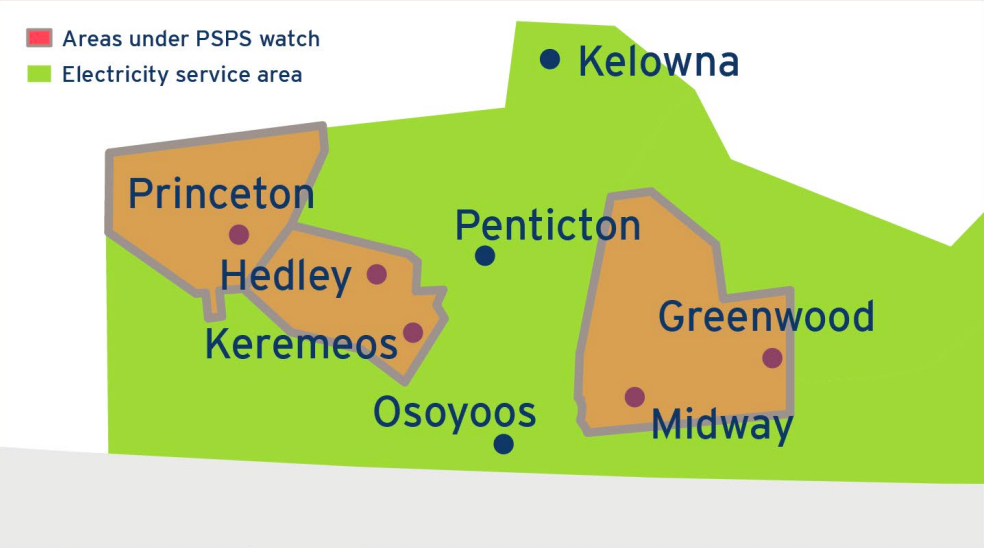
FortisBC service areas impacted by the proposed PSPS.
FortisBC intends to have this shutoff program as a “last case scenario”, to reduce the likelihood of wildfires caused by electrical infrastructure during extreme weather events.
If conditions are dry and windy – beyond certain thresholds – there could be risk for a tree falling on a powerline and creating a wildfire, as one example. They proposed this program as one solution to have in their back pocket.
The fact that FortisBC announced that they want to be able to shut off power to entire communities during extreme weather events did nothing short of cause a panic for people up and down the Southern Interior.
At the RDOS Protective Services Committee on May 8, Bob Coyne, director of area “H”, rural Princeton for example told FortisBC representatives that “you put out the press release a couple weeks ago, and you put absolute panic into a whole lot of people out here without a really good explanation about what’s going on.”
There were also references in the discussion to how much social media is buzzing about the proposed program.
Richard Barkwell, a Summerland councillor explained “this is a discussion that definitely needed to happen before it went to the public.”
Rob Maschek, project manager with FortisBC explained during their presentation of the plan to the RDOS that the PSPS program will be one of multiple methods they have for wildfire safety practices.
The new program is a “new precautionary measure where we proactively turn off power during periods of extreme wildfire risk. What we are looking at is very extreme wildfire index and very extreme wind events. We would only initiate a PSPS as a last resort and we do look to limit the scope, duration and frequency of these events.”
The timeline for the PSPS would go as follows:
- PSPS watch;
- PSPS warning;
- PSPS imminent;
- Outage begins;
- Outage updates;
- Power restored;
- Monitoring.
When Fortis mentioned the type of weather that could result in a PSPS event, they explained that there are four: low humidity, high winds, high temperature, dry vegetation.
While these decisions would be based on these four triggers hitting “certain thresholds”, it would ultimately be at the discretion of the upper management of FortisBC, and not based on consultation with people on the ground such as the RDOS Emergency Operations Centre (EOC).
Maschek pointed to taking the broader picture into account in their decisions, saying, “if taking the power down is going to create a greater hazard to the public under certain circumstances then leaving it on, that would be one of those risk management and waiting decisions that will be undertaken by the senior leadership in our organization.”
Spencer Coyne, Mayor of Princeton who was disgruntled with the whole plan, but took particular issue with this, explained that “this is not an us thing, this is a you thing, and we are going to have to fit into whatever you want us to deal with.
“That’s why everyone in our valley, the 10,000 plus people in our valley, are really upset. Because we are not part of this conversation.”
FortisBC said that the outages could last 72 hours and were suggesting people stock up on emergency supplies.
On the point of preparation Maschek explained that, “to help communities prepare for a PSPS event, we will provide advance notice, where possible, and provide updates throughout the outage.”
“We’ve identified communities within our electric service area at the highest risk of wildfire. While all of our customers should be prepared to be without power for at least 72 hours, we are encouraging these customers to be extra vigilant.”
The outages would not put the whole of the area into darkness all at once, but there would be significant populations impacted.
“There are multiple circuits in there so depending on the forecasted weather event, it may affect one line, it may affect multiple lines. There are 10 feeders in the PSPS areas we have identified as the highest risk, and one or multiple could be affected: we don’t know.”
Matt Taylor, director for area “D” Okanagan Falls expressed that the “scale of the number of people affected would be massive. This is a really big deal, I’m talking about the number of families, the number of homes.”
Richard Barkwell, a councillor of Summerland commented “I don’t know, it seems like the solution is worse than the problem.”
He went on to say that if FortisBC could clean up any potential trees that may fall on the lines “that’s all you can do.”
Multiple councillors commented on this fact and didn’t understand why FortisBC couldn’t focus more on cleaning up the trees and around the lines rather than implementing this program.
Coyne explained “looking at the powerlines, and between Allison Lake and Princeton, they are all going through the trees themselves. If you guys want to start somewhere, start there.
“The solution here is not equal to what you are proposing, go cut those trees down, go clean those brushes up. You go by my farm and you just about devastate every living thing, but then I drive by another area and the power lines are literally embedded in the trees. Like why that is allowed but not over there. There is a lot of work to be done here before you implement this.”
George Bush, director of area “G” Cawston asked why this kind of program is good for the South Okanagan but is not implemented in Kamloops or Lytton, or any other places in BC.
Maschek responded by saying “we took a look at our system and determined that the risk of us potentially starting a fire that could result in human loss is overwhelming.”
“Well, we don’t believe you,” Bush returned.