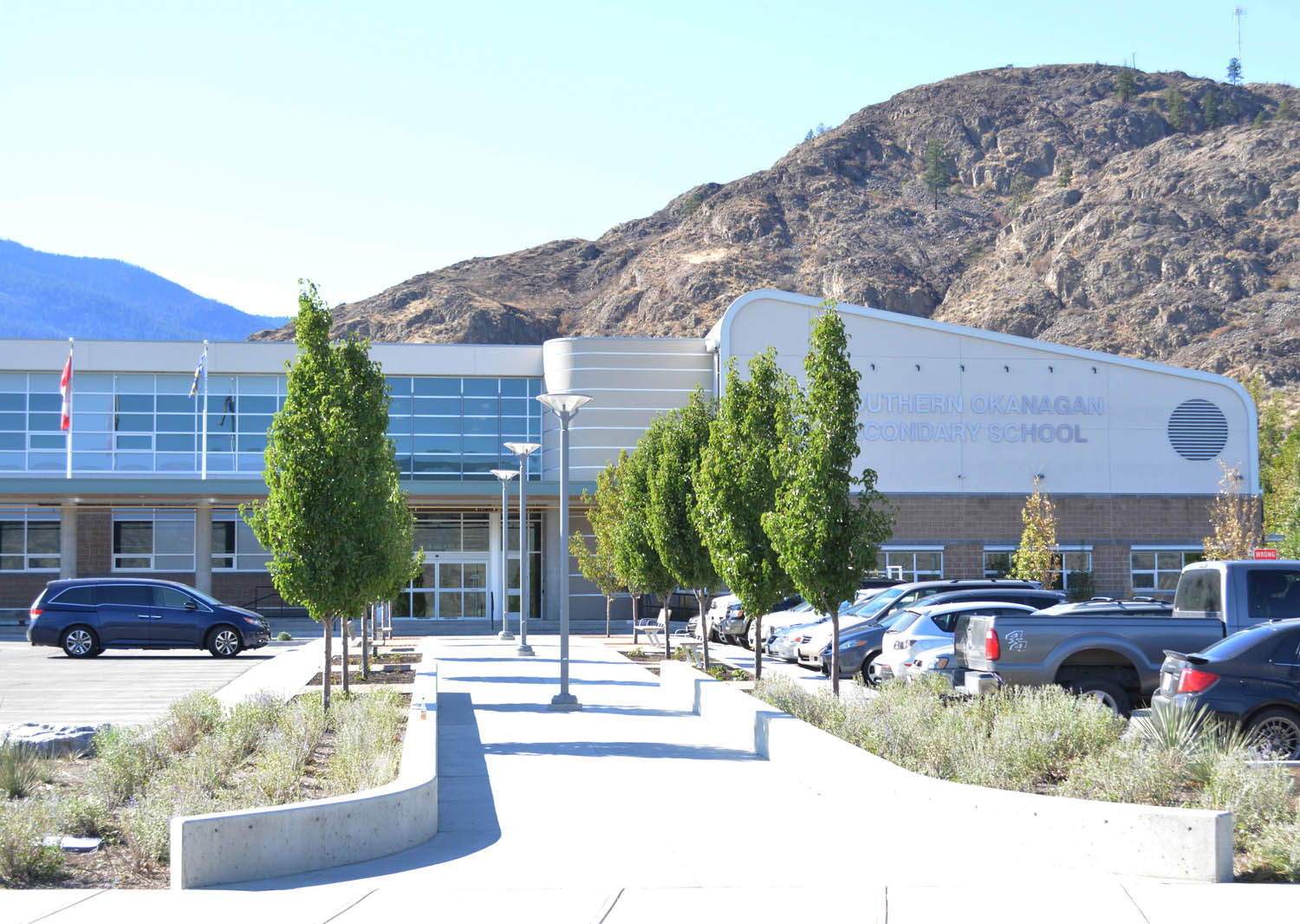
SOSS was rebuilt on original footprint based on 2005 enrolment, say SD 53 officials. (Lyonel Doherty photo)
There was no prior agreement to close Osoyoos Secondary School (OSS) when the Ministry of Education approved a 700-capacity high school in Oliver for fewer than 450 students, insists Bev Young, superintendent of School District 53.
Nonetheless, questions over the capacity of Southern Okanagan Secondary School (SOSS) in Oliver continue to be raised in the debate over potential closure of OSS.
When SOSS officially reopened in February 2014 following rebuilding after a devastating fire, the Ministry of Education stated in a news release that its capacity was 550 students.
Now, however, School District 53 and the ministry both agree the capacity is actually 700, which is 255 students more than SOSS’s 2015 enrolment of 445.
If capacity is 700, it would be large enough to accommodate all 230 OSS students, but if capacity were 550, then it would not be.
The sudden change in capacity is convenient if the school district had been wanting to close OSS, say critics, but why would the ministry agree to fund 255 spaces that aren’t needed if OSS remains open?
“By all appearances, the decision to close OSS was made at the same time as the decision to increase the size of OSS,” Osoyoos Mayor Sue McKortoff writes in a blunt letter to Marieze Tarr, chair of the school board. “This current situation ‘taints’ the concept of SD 53 providing transparent governance and consultation with the regional constituency. Regional consultation is needed to be carried out prior to the expansion of SOSS.”
Osoyoos resident Robin Stille, a former teacher who once taught at SOSS, posed some pointed questions about the capacity discrepancy in a 12-page letter and comments to the school board.
“Did the Ministry of Education agree to the extra capacity with the understanding that the school district would close OSS and bus its students to Oliver?” Stille asks, while wondering if trustees were aware of such arrangements.
“It’s very difficult to believe that the Ministry of Education would have approved additional renovations to the school to increase its capacity to 700 if the student enrolment at SOSS was only 483 at the time of the fire in 2011,” Stille wrote. “The Ministry of Education barely provides enough new construction money for existing populations.”
Asked why the ministry would agree to fund a capacity of 700 when enrolment was much lower, a Ministry of Education spokesperson issued a short emailed response.
“The ministry approved a 550-capacity building for SOSS in addition to the stand alone Tech Ed Building on site,” said the spokesperson. “The capacity was determined based on current and forecast enrolment at the time of project development in 2009.”
The Osoyoos Times asked Young if she could state unequivocally that there was no prior agreement or understanding between the school district and the ministry to close OSS in order to get extra capacity built at SOSS.
“There was no such agreement or understanding,” Young responded.
Young said the announcement of a capacity of 550 did not include the Tech Ed or Music buildings because these didn’t require renovations. The Tech Ed building, she said, includes a shop and three classroom spaces.
When the Osoyoos Times asked the ministry last month to clarify whether the capacity was 550 or 700, it took nearly a week for the ministry to clarify the issue and determine the capacity is 700.
Young acknowledged that SD 53 sent floor plans to the ministry recently as this question was being clarified.
“We sent them all the floor plans and they have reviewed all of our plans just recently and have confirmed the capacity at 700,” Young said.
Asked why the school district would require a 700 capacity unless it was planning to close OSS, Young said the process for determining capacity is complex.
“There is an onerous gathering of stats and information,” she said. “We can’t just pick the capacity. We can’t just choose.”
The ministry, she said, evaluates all the information with its capital planning branch rather than with the district.
In 2005 when the project started, the capacity was appropriate, she said.
“Then, when the fire destroyed the school in 2011, the ministry approved the rebuild on the same footprint,” she said. “It was a rebuild of 550, but it didn’t include the buildings that were already in place, which were the music building and the Tech Ed wing.”
Asked again why the school district needed SOSS to have a 700 capacity, Young replied: “I’m not sure how to answer that because that’s what was approved by the ministry. We certainly didn’t argue with them. I mean we didn’t know about future growth. Again, the ministry with capital planning, that’s what they approved for us when we rebuilt the school.”
Enrolment at SOSS in 2005, when the project started, was around 600, Young said.
Stille said she has no evidence to suggest the ministry agreed to the extra capacity at SOSS as a condition of closing OSS, but she wanted to raise the question.
She acknowledged that the ministry recently approved a capital project of $271,000 for a sawdust collection unit in the shop at OSS, which the school district listed in October 2015 as fourth on its list of high-priority projects.
Approving this project would not make sense if the ministry knew the board planned to close OSS.
Nonetheless, Stille notes that trustees themselves approved the expenditure at the Dec. 9 board meeting – the same meeting where the board announced it was calling a special meeting for Jan. 13 to discuss the updated facilities plan.
“How does the board office justify spending $271,000 on a school it plans to close?” Stille asks.
RICHARD McGUIRE
Osoyoos Times