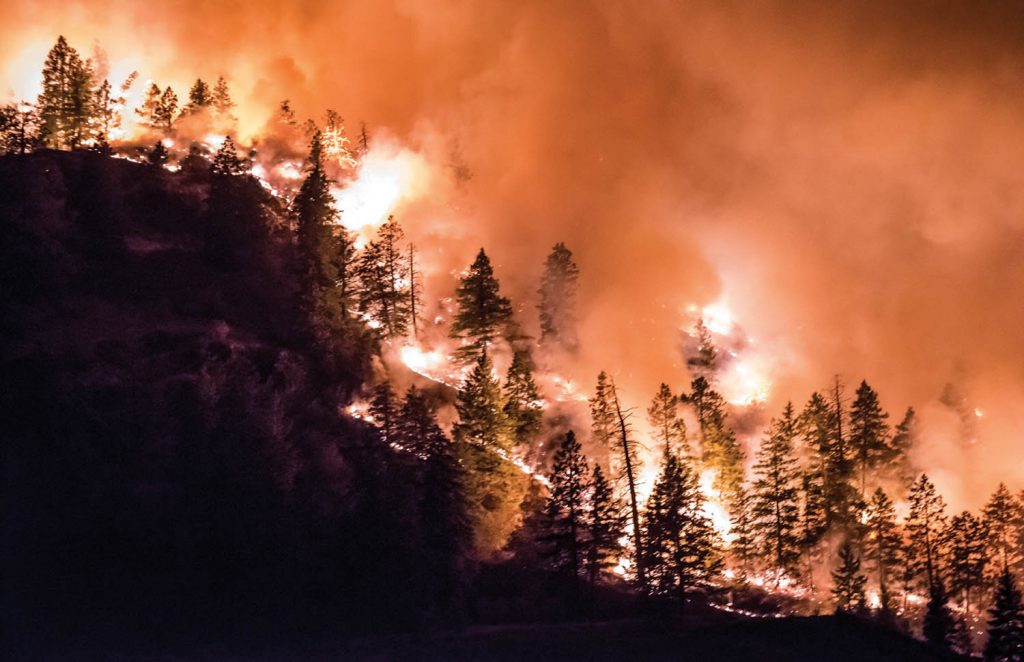
Two years ago, fires raged between Oliver and Osoyoos. In current conditions, it would only take one tossed cigarette butt or one illegal campfire to see a repeat. Most fires in Central B.C. have been human caused. (Richard McGuire file photo)
More than 14,000 B.C. residents have been evacuated from their homes (as of Tuesday morning) due to more than 230 wildfires that have broken out across the province, but Osoyoos and most parts of the South Okanagan have so far managed to avoid catastrophe.
The skies over Osoyoos, however, are thick with heavy smoke from more distant fires, including a large fire near Princeton.
In the area surrounding Osoyoos, the fire danger rating is currently classed as extreme, as it is throughout most of the Kamloops Fire Centre. Most of the rest of the region is classified as high.
Meanwhile, a ban on campfires and other types of open fire was imposed last Friday throughout the Kamloops Fire Centre, including Osoyoos, Oliver and surrounding areas.
The temporary ban at the provincial level came into effect at noon on Friday and will remain in effect until the public is notified otherwise.
The move was immediately followed by similar bans by the Regional District of Okanagan-Similkameen (RDOS), along with Osoyoos and Oliver.
Jody Lucius, fire information officer with the Kamloops Fire Centre, said the campfire ban is based on current environmental conditions, not on forecasts.
“It’s hard to predict how long campfire bans will last,” she said. “But they’ve been put out until we say otherwise, which will depend on weather over the summer.”
She said the regional fire centre has seen a high number of human caused fires this season and “very few” caused by nature.
“We’re asking public to be very cautious with anything that can cause a fire, especially ATVs and dirt bikes,” she said. “The more people can be aware and careful with the use of fire, the better off we all are.”
Osoyoos Fire Chief Rick Jones said with the current conditions, a wildfire in the South Okanagan could happen at any time – and it’s the human-caused fires that have him most concerned.
Before the ban came into effect, Jones said all campfires need to be completely extinguished before they’re abandoned.
“It has to be cold enough to put hands in ashes,” he said.
But even when campfires are permissible, the Town of Osoyoos keeps campfires banned year-round, which reduces the risk “quite a bit and keeps everybody safer,” Jones said.
Jones added the public could be doing a better job in terms of fire prevention, but he doesn’t feel like things have been getting worse year-over-year.
Bob Graham, Oliver Fire Chief, said the local area is very vulnerable right now.
“No campfires, no burning and no fireworks are allowed,” he said. “We’ve done everything we can do – all we can do is just wait for the next call.”
With more than 230 wildfires burning in other parts of the province causing hazy skies in the South Okanagan, Interior Health has issued air quality warnings, advising people with heart and lung conditions to know the symptoms of smoke exposure.
“If any symptoms are noted, affected individuals should take steps to reduce their exposure to smoke and if necessary see their physician,” the health authority noted.
The Ministry of Transportation and Infrastructure has issued a statement recommending that all British Columbians be prepared in case of a sudden evacuation order.
“In the event of an evacuation order, you must leave the area immediately,” states MOTI in a news release. “Local authorities will not ask you to leave without good reason, and failing to leave when asked to by officials puts yourself and others at risk.”
On Sunday, outgoing Premier Christy Clark announced $100 million would be spent in rebuilding efforts.
“Our first priority during this period of extreme wildfire activity in the interior has been to ensure the safety of all those directly impacted,” said Clark. “This included declaring a provincial state of emergency so that all possible tools are available to fight the fires and protect families and communities. The emergency and forestry crews have done exemplary work, conducting themselves in the professional manner we’ve come to expect from them.”
Category 2 and Category 3 open fires were already prohibited throughout the Kamloops Fire Centre before last Friday’s campfire ban was announced.
The ban covers campfires, burning of waste or other materials, stubble or grass fires of any size over any area, fireworks, sky lanterns, tiki torches, chimineas, burning barrels or burning cages.
Also prohibited are binary exploding targets and air curtain burners (forced air burning systems).
The prohibitions do not apply to cooking stoves that use gas, propane or briquettes or to a portable campfire apparatus with a CSA or ULC rating that uses briquettes, liquid or gaseous fuel – as long as the flame is less than 15 centimetres.
The provincial ban covers all B.C. parks, Crown lands and private lands, but doesn’t apply within the boundaries of a local government that has forest fire prevention bylaws and is served by a fire department.
At the same time, however, the RDOS implemented its own ban in conjunction with Osoyoos, Oliver and other municipalities contained in the RDOS.
The RDOS noted that motorized vehicles, particularly all-terrain vehicles and dirt bikes can produce a significant amount of heat from exhaust systems. This heat can be enough to spark a wildfire.
“Avoid operating any motorized vehicle in tall grass and vegetation when the weather is hot and dry,” the RDOS said in a news release. “Even operating a lawn mower in dry grass conditions can ignite a fire.”
Serious fines and possible jail sentences can be imposed on violators. If a fire is caused through recklessness or arson, the offender may also be required to pay firefighting costs.
To report a wildfire or open burning violation, call 1-800-663-5555 toll free or *5555 on a cellphone.
To make it easier to help those impacted by the wildfires, BC Liquor Stores have all began accepting donations on behalf of the Red Cross.
Cash donations to the Canadian Red Cross, which will be used during ongoing firefighting efforts across the province, are being accepted at the front desk of the Osoyoos Times’ office.
(With files from Richard McGuire)
DAN WALTON
Regional Reporter