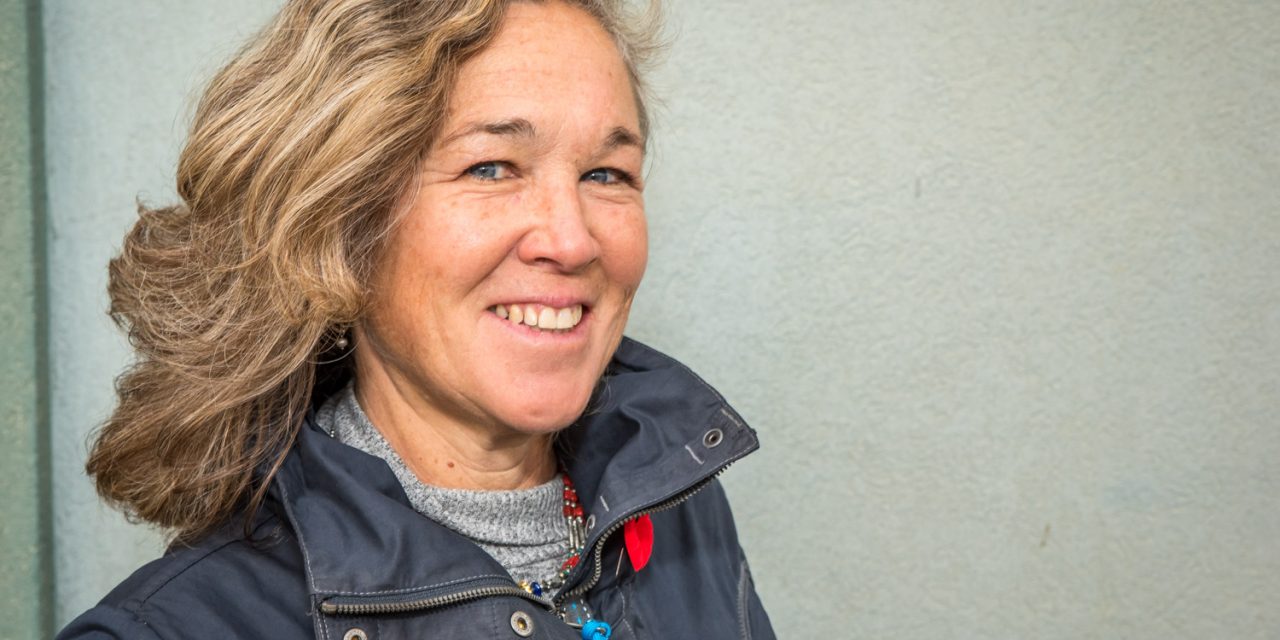
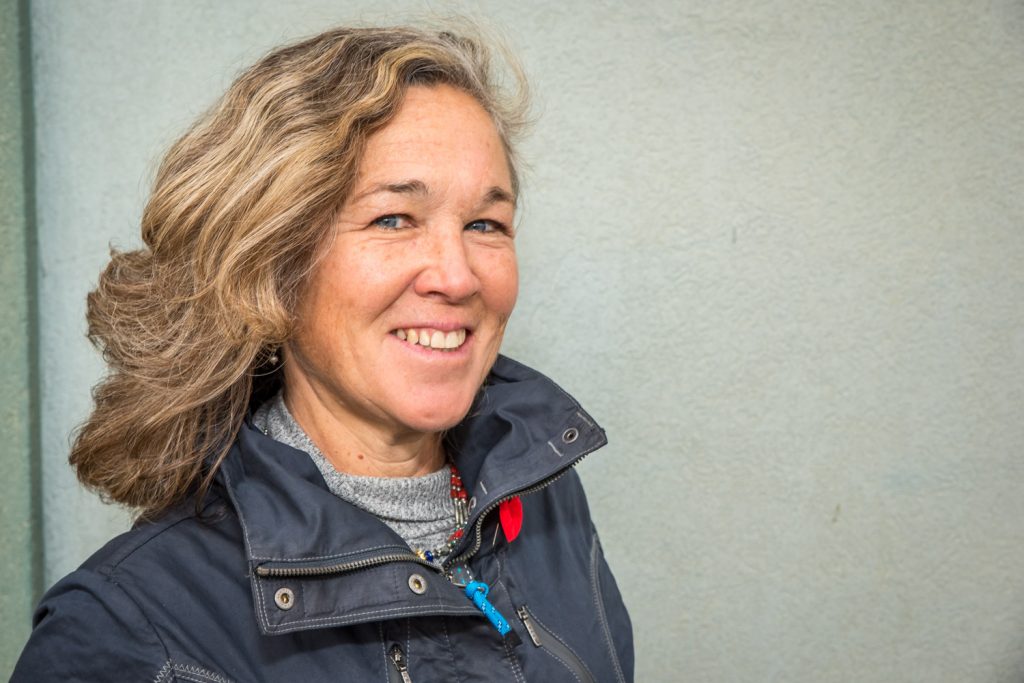
Colleen Ross, a Grand Forks first-term councillor, has been greenlighted by the provincial NDP to seek the party’s nomination. A candidate will be chosen in January to run for the party in next May’s election. (Richard McGuire photo)
It took two months for the provincial NDP to vet Grand Forks Councillor Colleen Ross to seek the party’s candidacy in Boundary-Similkameen, but the time spent may be a reflection of her extensive background.
Ross was recently given the green light to run for the nomination, which if she wins, would see her face off against MLA Linda Larson in the May 2017 provincial election.
Currently Osoyoos school advocate Brenda Dorosz is the only other potential nominee to be greenlighted, but Allan Patton, a former regional district director, also intends to run.
“I have a pretty deep history and I think it took them a while to dig in,” said Ross. “I was so impressed, because they found things on me that I had forgotten about.”
The vetting process is intended to weed out candidates who might be a future embarrassment to the party.
The party checked previous interviews she’d done on such diverse topics as the Canadian Wheat Board, migrant labour, the Leap Manifesto and a range of other topics.
Ahead of an interview last week, Ross provided the Osoyoos Times with a document titled “Short bio” that suggests she’s been busy for much of her 55 years.
She’s farmed more than 30 years in Australia and Canada, including the past four years at Grand Forks, where she grows certified organic crops and raises livestock.
She graduated from the University of Guelph, Ontario, with a diploma in agriculture and studied biosciences at the University of Tromso, Norway, focusing on the ethics of biotechnology.
And she’s worked around the globe on food sovereignty, social justice, fair labour laws, and women’s rights with a range of non-governmental organizations (NGOs) and civil society groups.
She’s also worked with federal and provincial NDP leaders and at other political levels on such issues as food sovereignty, labeling and control of genetically modified organisms (GMOs) and stopping the elimination of the Agricultural Land Reserve.
Ross said she was encouraged to play a public role by such people as former MP Alex Atamanenko, current MP Richard Cannings, former B.C. NDP cabinet minister Corky Evans, MLA Katrine Conroy and even by the late federal NDP leader Jack Layton.
Nonetheless, Ross said the decision to seek the nomination wasn’t an easy one.
“I’ve been struggling with it,” she said. “It’s a big decision. It’s not something you get all excited about and jump in in a naïve kind of way. I know enough about the system to realize that this is my life and I value the relationships I have in my life.”
Receiving the blessing of her three adult children, who live in Ontario and Quebec, as well as support from close friends, made her decision easier.
The nomination meeting is set for Jan. 15, but only people who were NDP members prior to mid-October are eligible to vote.
Like the other two potential candidates, Ross said she was busy selling memberships ahead of the cutoff date.
But only since being given the green light on Oct. 23 has she had access to party membership lists, which she’ll need for the next stage – convincing existing party members that she’d be the best nominee.
Ross said she’ll be emailing members to invite them to events in their communities and she’ll also follow up with a brochure and phone calls.
Her first event was Nov. 11 in Grand Forks, but there will be events in other communities such as Osoyoos and Oliver later in November or in early December.
She said she’s being strategic about the timing for contacting people because she knows people don’t want to hear from politicians just before Christmas.
Asked about what made her decide to run, Ross considers her answer.
“I can’t say there’s any one thing,” she said. “I have a deep sense of responsibility. I’m a person with a lot of energy. My friends say don’t give her a job to do unless you really, really want to get it done, because once I start doing it, I just do it and get it done in the most efficient and best way that I can.”
Her experience as a first-term municipal councillor and with numerous organizations has given her skills to be an effective MLA, she said.
These include building consensus, communicating, taking a leadership role, and working respectfully with people whose views are different from hers – including some people who have been misogynistic or had patriarchal ideas.
On council, she said, she’s learned to work with people she would not normally cross paths with, but whom she’s learned to enjoy.
“I had to learn not to be a jerk at times,” she said, explaining this means stepping outside her “bubble” and trying to listen to people whose interests and perspectives are different from her own.
“You have to be able to disagree in a respectful way,” she said, adding she will speak against a resolution she opposes, “but then when I’m the only one voting against it, to be able to move on.”
Asked what issues she’s been hearing about, Ross said employment is a key issue – especially as dependence on a resource-based economy diminishes.
“Although we continue to extract those resources, fewer and fewer jobs are remaining in the community that are associated with resource extraction,” she said, adding we need to be creative in finding ways to create new opportunities that will keep youth in local communities.
Boundary-Similkameen is a diverse constituency, Ross said, but many issues are universal.
“I could go to a village in India and they’re concerned about water, they’re concerned about land rights, they’re concerned about indigenous rights and concerned about transportation and communication,” she said.
Without mentioning MLA Larson by name, Ross said she’s been disappointed by current representation.
“I think it’s been disappointing, underachieving, underwhelming,” she said. “We know there’s an election in May and I’m seeing more activity… I’m hearing and seeing her a lot more. That’s just campaigning before the writ is dropped and I understand that’s the game.”
When the topic of education is raised, Ross stresses the importance to rural communities of keeping small schools open.
Then she makes a point of complimenting her rival for the nomination, Dorosz, who led the fight to keep Osoyoos Secondary School open.
“I really want to commend people like Brenda who did that work,” said Ross. I just applaud her and give her kudos for that work.”
Ross came to Osoyoos in March for the public hearing on closing local schools.
As the interview closes, she asks a reporter if he’d like to hear her views on the proposed national park reserve in the South Okanagan.
“I think we need to protect the land,” she said. “We have a bioregion here that is very delicate. We need to respect the needs of ranchers and even more so, we need to respect the wishes of First Nations communities. I want to respect the needs of land as well.”
Asked if this means she wants to see a national park as opposed to provincial protection, Ross makes her position more clear.
“I would like to see a national park with real measures in place to actually protect it,” she said.