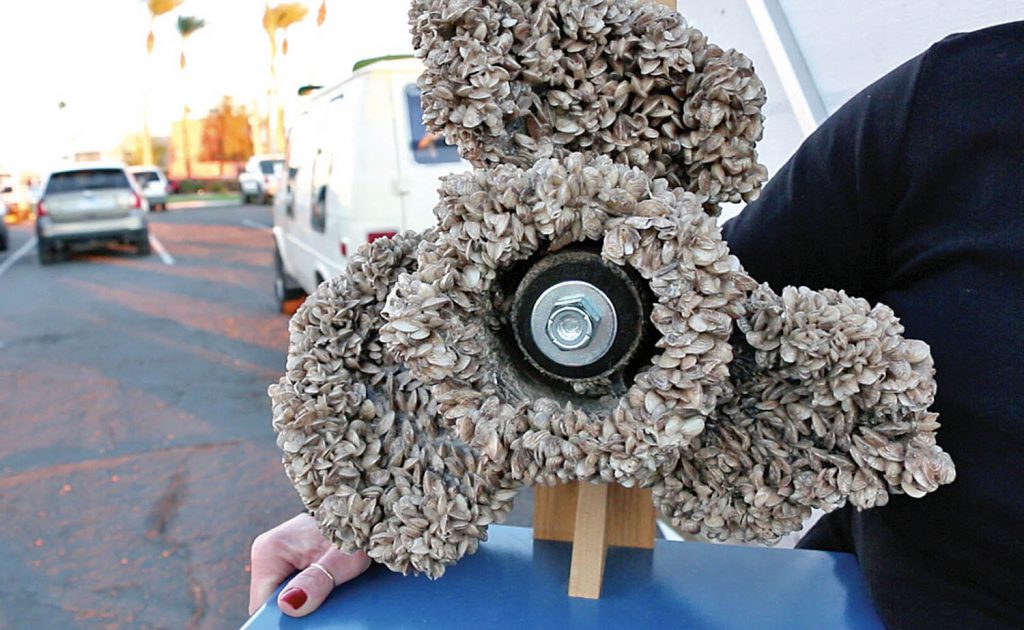
The provincial inspection program designed to ensure invasive mussels don’t land in B.C. lakes, rivers and streams intercepted 17 watercraft that were bringing adult invasive mussles into British Columbia this past boating season. More than 24,000 watercraft were inspected and 683 were identified as coming from a high-risk province or state. A news release didn’t say whether any of the mussels found on the 17 infected watercraft were still alive. (Supplied Photo).
An expanded invasive mussel inspection program this year intercepted 17 watercraft that were bringing adult invasive mussels into B.C.
The provincial program, which receives funding from the power utilities and Columbia Basin Trust, inspected a record 24,500 watercraft for invasive quagga and zebra mussels this boating season.
A total of 683 watercraft were identified as coming from a high-risk province or state, the B.C. Ministry of Environment said in a news release Thursday.
The news release didn’t say whether any of the mussels found on the 17 infected watercraft were still alive.
It did, however, say that 14 of the infected watercraft originated in Ontario. Of the other three, there was one each from Manitoba, Michigan and Nevada.
A Ministry of Environment spokesperson said there is no reliable field test to determine mussel viability, but the 17 boats were out of the water for fewer than 30 days, so the mussels could have been alive.
Crews at the inspection stations issued 92 decontamination orders, as well as 46 tickets and 36 warnings to motorists who failed to stop at the inspection stations as required by B.C. law.
Under the expanded program, there are eight permanent inspection stations at major entry points into B.C. from Alberta and the U.S.
These are staffed with 32 trained officers who inspect and can decontaminate watercraft as needed.
They also respond to boats flagged by the Canadian Border Services Agency (CBSA) and other Canadian and U.S. partner agencies.
The inspection stations closed on Oct. 10 after the Thanksgiving weekend.
At the station covering Osoyoos and Midway, 926 boats were inspected of which 98 were considered high risk as they were coming from states or provinces with mussel infestations.
Invasive zebra and quagga mussels heavily infest waterways in the eastern half of North America, including the Great Lakes.
Zebra mussels have spread as far west as Manitoba and both types of mussels, especially quagga, are now found in some waterways in the southwest United States.
Recreational boaters who fail to properly clean, drain and dry their boats after using them in infested waterways usually spread the mussels.
They encrust themselves onto any objects in the water, including water intakes, docks, boats and bridges.
They also leave razor-sharp shells on beaches and lake bottoms making it hazardous to go barefoot.
Invasive mussels have already caused billions of dollars in damage throughout North America and a 2013 study for the Okanagan Basin Water Board (OBWB) estimated that a mussel infestation in B.C. would cost $42 million a year to manage in the Okanagan Valley alone.
Richard McGuire
Osoyoos Times