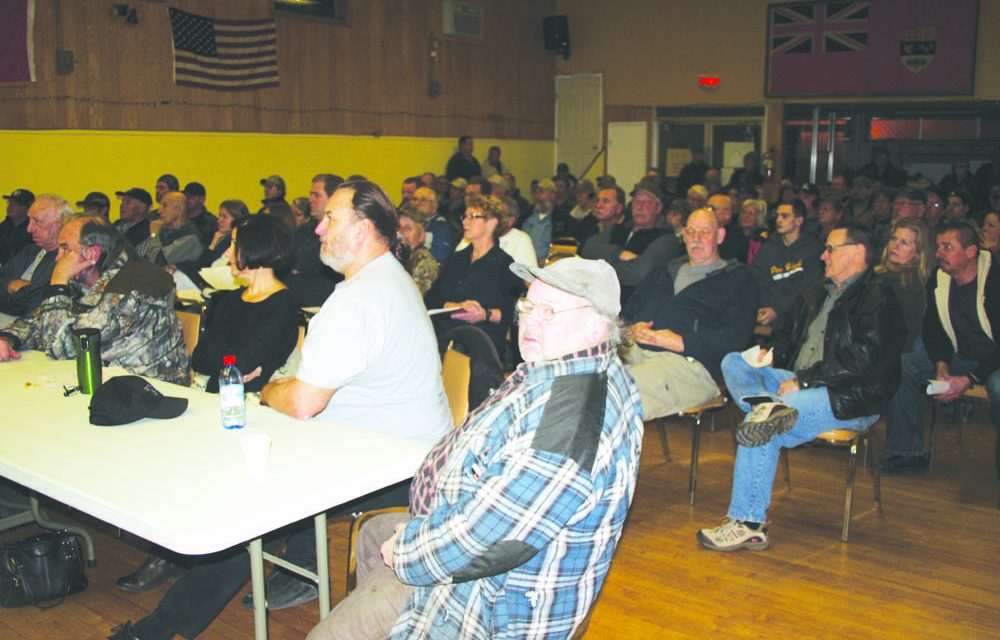
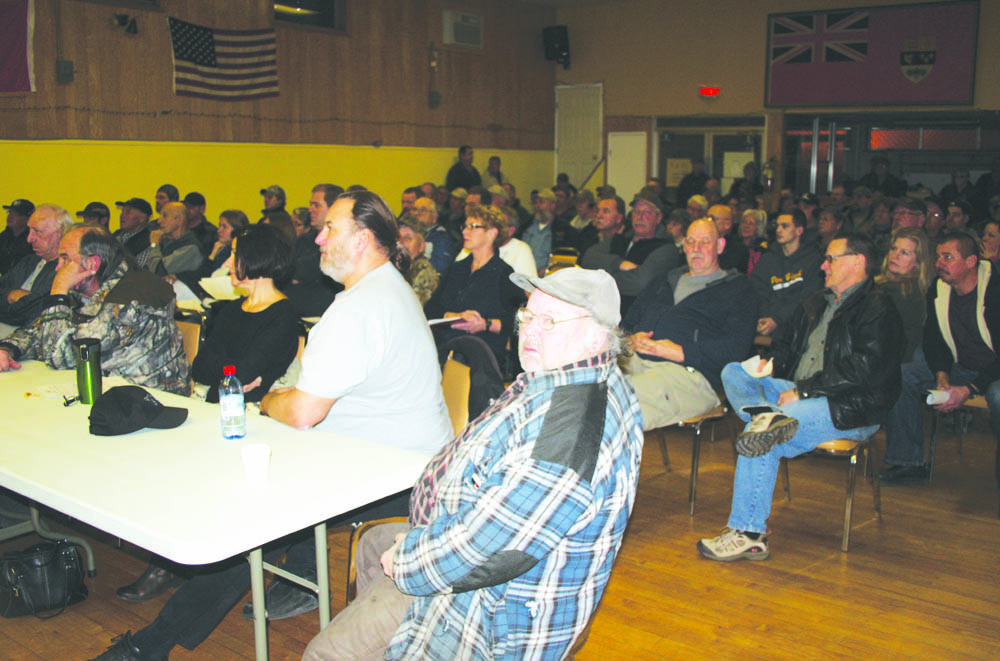
A packed house of more than 100 hunters showed up at the Royal Canadian Legion Branch 97 in Oliver on Sunday to listen to a presentation from directors with the B.C. Wildlife Federation about the unfairness of current hunting allocation policy for resident hunters across B.C.
Keith Lacey Photo
Hunters who reside in British Columbia are being victimized by one of the most unfair hunting allocation policies in North America, says the wildlife committee co-chair with the B.C. Wildlife Federation (BCWF).
Jesse Zeman said the provincial government has constantly changed the rules over the past 20 years making it more and more difficult for resident hunters to receive hunting permits, while allowing guide outfitters and hunters from other provinces and countries far easier access to this province’s treasured wildlife resources.
Speaking before a packed house of more than 100 avid hunters at the Royal Canadian Legion Branch 97 Sunday evening, Zeman pleaded with hunters to write their local MLA, Linda Larson, and to write letters to the editor of area newspapers to voice their displeasure with the current allocation system.
The BCWF has started a provincial petition asking resident hunters from all over British Columbia to sign up and voice their discontent with current policy and ensure their concerns are addressed in pending legislation.
Near the end of his presentation, Zeman and Ken Sword, a regional director with the BCWF, asked all those in attendance to attend a huge rally to protest the hunting allocation system in this province scheduled for West Kelowna on Saturday, Jan. 31.
Organizers are hoping that more than 5,000 hunters will attend the rally, which will run from the parking lot of the old Zellers building in downtown West Kelowna to the office of Premier and West Kelowna MP Christy Clark.
“We’re being treated as second-class citizens here in our own province,” said Zeman. “Things have to change.”
Across the province in the last couple of years, resident hunters have received 5,000 few hunting licenses, said Zeman.
The provincial Ministry of Forests, Lands and Natural Resource Operations has stated its intention to rewrite hunting allocation policy during the upcoming session of the legislature and it’s up to individual hunters and outdoor lovers to voice their concerns over the current legislation and ensure resident hunters are treated more fairly than they have been the past several years, said Zeman.
Steve Thompson, province’s Minister of Natural Resources, will have no choice but to change policy and legislation if enough hunters speak out, said Zeman.
The provincial government had good intentions to try and attract significant foreign dollars through its hunting allocation policies enacted 20 years ago, said Zeman.
However, the policies adopted over the past two decades now greatly favour the Guide Outfitters Association of British Columbia (GOABC) – and many of those outfitters are owned by non-Canadians who have been granted significant increases in permit allocations, while resident hunters have to deal with decreasing access, he said.
The reality is there are more hunters in B.C. than at any time in history – more than 102,000 were registered in 2014 – but their access to hunting permits is at near record lows, said Zeman.
Guide outfitters are able to take the permits they are allocated and to sell them to non-residents for guided hunts, said Zeman. Clients come from around the world, including other Canadian provinces. Under B.C. rules, anyone who doesn’t reside in B.C. needs to hire a guide in order to do any hunting.
Under the previous policy, the percentage of permits each group would receive was calculated each year, with each group getting a set minimum percentage of permits for each group.
Guide outfitters were only guaranteed 10 per cent of most big game hunts, with the exception of sheep and goats, for which they received 20 per cent. Because the new allocations start at 20 per cent, with the exception of antlerless elk, guide outfitters will get a bigger percentage of permits under the new rules, said Zeman.
The provincial government has continually allowed guide outfitters an increased share of the pie because those same outfitters “are continually crying about how they’re going broke,” said Zeman.
When guide outfitters are asked to show proof of their financial difficulties, most refuse to do so and resident hunters are forced to deal with reduced access to permits, he said.
“The resident share (of hunting permits) goes down is the common theme” over the past two decades, he said.
The GOABC claims that the annual fall hunt in this province generates more than $8.8 million in economic development, but those figures are greatly exaggerated and the BCWF believes a more accurate figure is closer to $3.7 million, said Zeman.
Those figures were derived by the GOABC for the period between 2002 and 2007, which were the most lucrative for the hunting industry in this province’s history, he said.
While guide outfitters may only get 10 per cent of allocation, the reality is they harvest 30 to 40 per cent of the majority of species that are hunted in British Columbia, said Zeman.
Hunting allocation policy for resident hunters in B.C. are among the worst in all of North America and this has to change, he said.
The only way the government will listen is if individual hunters work collectively to voice their displeasure and insist on policy change that puts the needs of resident hunters at the highest priority, he said.
“You are the voice of resident hunters, said Zeman. “As for the BCWF, this is the hill we will die on.”
Guide outfitters do bring in significant dollars into the provincial economy, but those numbers pale to the economic development created by resident hunters, said Zeman.
The “sad reality” is 67,000 resident hunters in British Columbia applied for hunting permits last year and more than 54,000 were refused, he said.
Katrine Conroy, MLA for Kootenay West, said the controversy over hunting allocation policy is one of the most controversial and contentious she has had to deal with during her political career.
“We are hearing from residents who are unhappy from across the province,” she said. “I’m here to tell you that you are making a difference and you have to continue to speak out.
“I encourage you to sign the petition and make sure your MLA knows how you feel about this issue. You have to let your voice be heard. There are thousands of hunters in this province and you have to have your voice heard.”
Zeman said this isn’t a scientific or economic issue, but “simply a political issue” and reiterated it’s up to hunters to have their voices heard and inform their local MLA about their displeasure with current policy and insist on change in favour of resident hunters.
For more information about the BCWF petition and upcoming rally in West Kelowna, visit www.bcwf.net.
KEITH LACEY
Osoyoos Times