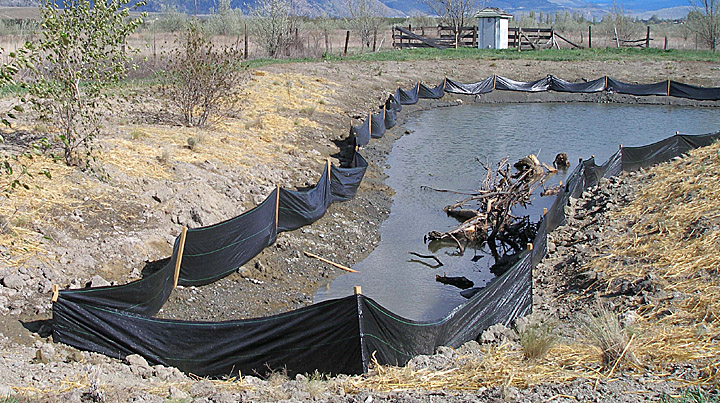
A new pond built by researchers from Ontario’s University of Waterloo and the B.C. Transportation Ministry. Researchers hope amphibians that live in the area where Hwy. 97 is being expanded will colonize the new wetland area. Photo submitted - Click on picture for larger image
OSOYOOS TIMES-May 19, 2010
By Paul Everest – Osoyoos Times
Researchers from Ontario’s University of Waterloo and the B.C. Transportation Ministry are working to give rare amphibians living near the site of the Hwy. 97 four-lane expansion project a helping hand.
Sara Ashpole, a researcher at the university, teamed up with ministry personnel last month to construct a new teardrop-shaped pond on ministry property near the intersection of the highway and Road 22.
She said the new wetland was built on April 13 south of an existing wetland near construction activities for the highway expansion project.
The new pond is 58 metres long and 26 metres wide.
Ashpole said she’s hoping amphibians such as tiger salamanders and Great Basin spadefoot toads, which live and breed in the old wetland area, will colonize the new wetland.
The tiger salamander is listed as endangered in B.C. and the Great Basin spadefoot toad is on the provincial blue list, meaning it is considered vulnerable to human activities.
Ashpole has also worked with Ducks Unlimited, which owns property neighbouring the ministry land where the highway expansion project is underway, to build other wetland areas in the hopes amphibians and other animals will live and breed in the new sites if the existing wetland near the intersection is disturbed.
She said that in the summer she has seen anywhere from two to 10 salamanders in the existing wetland area.
More than 262 native plants representing 14 species, including sand bar willow, prickly pear, sage and wood rose, were planted around the new pond on April 24 with the help of Oliver’s Sagebrush Nursery and some of the plants around the old wetland were transplanted to the new pond.
Ashpole also said silt fencing has been set up around the new pond to reduce any drift of pollutants, dust or other materials from the nearby construction activities.
The fence has holes in it for amphibians to pass through, she said, and it will also help to slow the flow of water into the wetland.
The fence will be removed in the fall.
The other good news, Ashpole said, is that she is working with the ministry to develop “eco-passages” or culverts under the highway so that amphibians and other animals can cross from the west side of Hwy. 97 to the wetlands.
Over the summer, other researchers from the university working under Ashpole’s direction will monitor the existing wetland, the newly constructed pond and the highway for amphibian-use.
They will also keep an eye on what impact highway construction may have on the wetlands and the local amphibian populations.
Ashpole said the researchers will be paying attention to mortality rates for animals on the road and her data will be used by the ministry in determining where the culverts will be located.
Brent Persello, an environmental services manager with the ministry, said “the ministry requires numerous culverts under the highway for drainage purposes.
“There is some flexibility around where they can be located,” he said in an email. “As a result, we try and orient them in locations where they can be beneficial for purposes other than drainage such as wildlife passage which minimizes any cost premium to the project.”
Ashpole said the plan is to have the culverts built at areas where clusters of animals, both dead and alive, are found on the highway using the researchers’ data.
Since researchers began working at the site on April 15, they have recorded 300 instances of frogs and salamanders crossing the highway, Ashpole said.
One researcher also spotted a painted turtle hatchling at the old wetland site on May 12.
The painted turtle is also on the blue list and Ashpole said roads and traffic are a “significant cause of turtle mortality and species decline.”
Anyone interested in getting involved with volunteer monitoring or anyone who has questions about the wetland can contact Ashpole at [email protected].
[email protected]