By Don Urquhart
Residents around Oliver reported hearing an explosion and/or feeling shaking Monday mid-afternoon in what was confirmed to be a 3.1 magnitude earthquake.
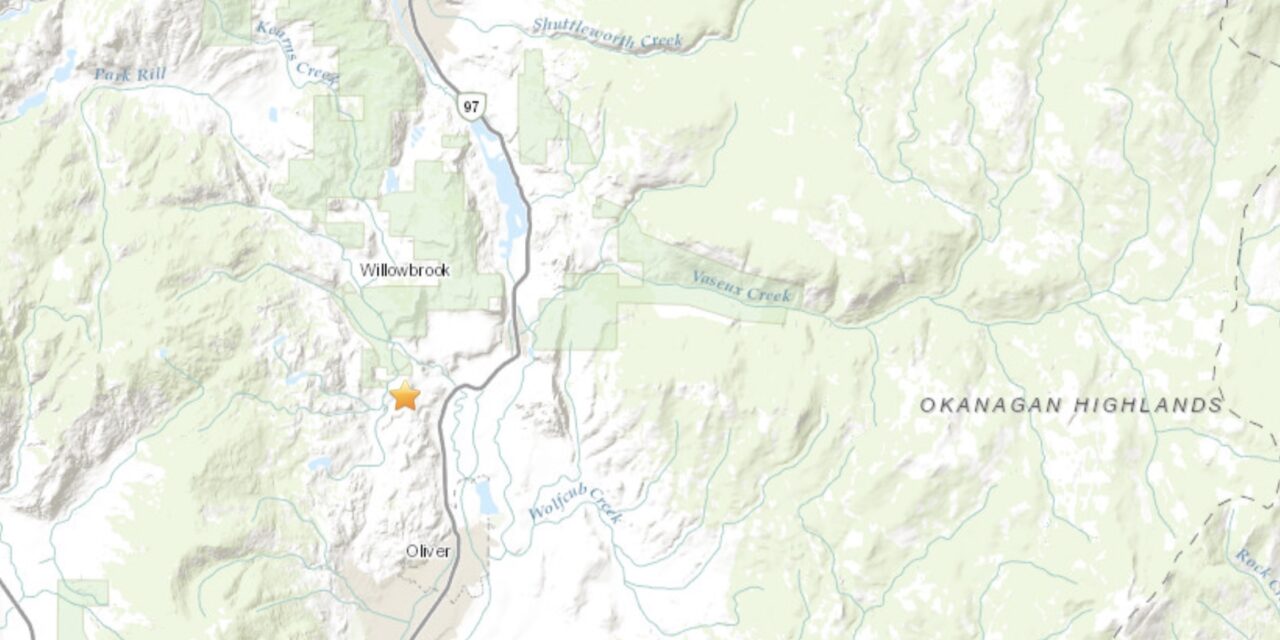
John Cassidy an Earthquake Seismologist with Natural Resources Canada, Geological Survey of Canada based in Victoria confirmed to the Times Chronicle that it was a naturally occurring earthquake of 3.1 magnitude which occurred at a depth of 5.6 km at an epicentre just off of Willowbrook Road north of Secrest Hill Road about 7 km north of Oliver.
Cassidy said Natural Resources Canada analysts determined it was not the result of explosions related to mining operations. The US Geological Survey had originally shown the quake as a 3.3 “explosion earthquake”, but Cassidy noted the US analysts would likely not be as familiar with the Okanagan. The USGS later changed it to “earthquake” and lowered the magnitude slightly to 3.2.
He noted that the Canadian seismologists know where the mines are located and record blasts nearly every day. “Our analysts are used to seeing blasts and their conclusion was this really was an earthquake, it had the signature of an earthquake and was not near known blast sites.”
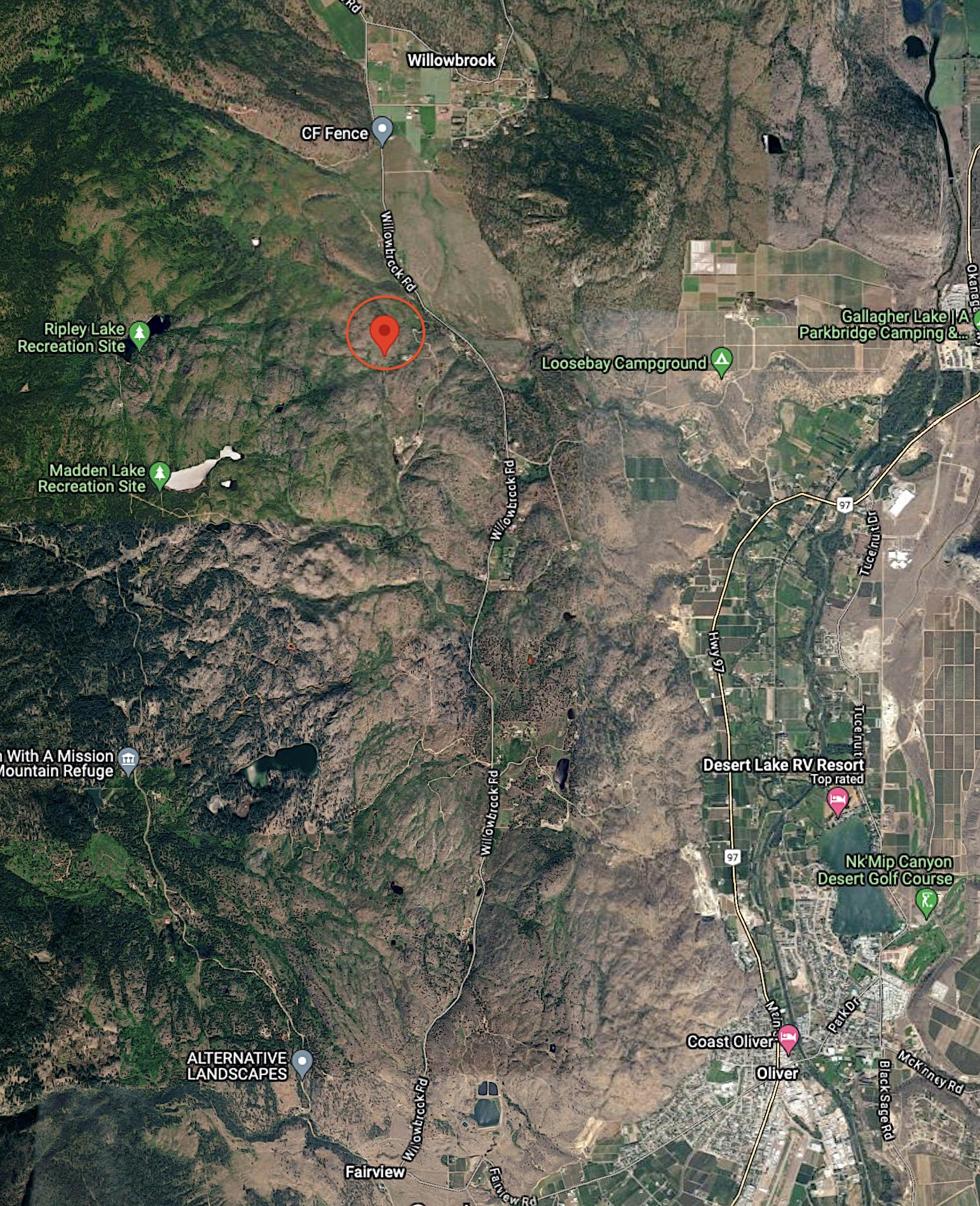
Location of the earthquake off of Willowbrook Road north of Secrest Hill Road about 7 km north of Oliver according to Earthquakes Canada. Google map image
“We do see earthquakes through the Okanagan on occasion, but they are relatively rare but magnitude three earthquakes do happen in the region every year.” Cassidy said there have been larger earthquakes in the 3-4 magnitude over the years with the largest ever recorded in the Okanagan dating back to 1936 with a 4.5 magnitude earthquake near Vernon. Some chimney damage and broken dishes were reported from that quake.
Cassidy says it’s fair to say it would be unlikely to see anything larger than the 4.7, “but we can’t say impossible . . . large earthquakes are possible but I would say they are very, very, very rare events.”
Since 1985 (38 years), Cassidy says they have located 126 earthquakes within a 50-km radius of today’s event. The largest was a M4.1 on September 10, 2016. Most earthquakes in this region are small (less than magnitude 2).
He says the rough ballpark figure for an earthquake to cause structural damage would be around a magnitude 5 quake. Because the magnitude scale is logarithmic today’s 3.1 magnitude earthquake was 100 times too small to cause any damage. He also said it would be unlikely for there be any aftershocks.
As for the sound of an explosion that many people heard, Cassidy says it’s not uncommon for people to report hearing that kind of sound, especially for shallower earthquakes such as the one today at only 5.6 km depth. The quake could have been anywhere from surface level to five or 10 km in depth he notes, but 5.6 km depth is the estimation.
He explains that because the frequency of the sound waves from the earthquake is a little bit higher than most people can hear, the sound they reported is “most likely the waves from the earthquake interacting with buildings or local infrastructure,” which then makes it audible and “it’s often reported that it sounds like an explosion,” he adds.
The Oliver Fire Department reported that it received a couple of calls from residents reporting shaking.