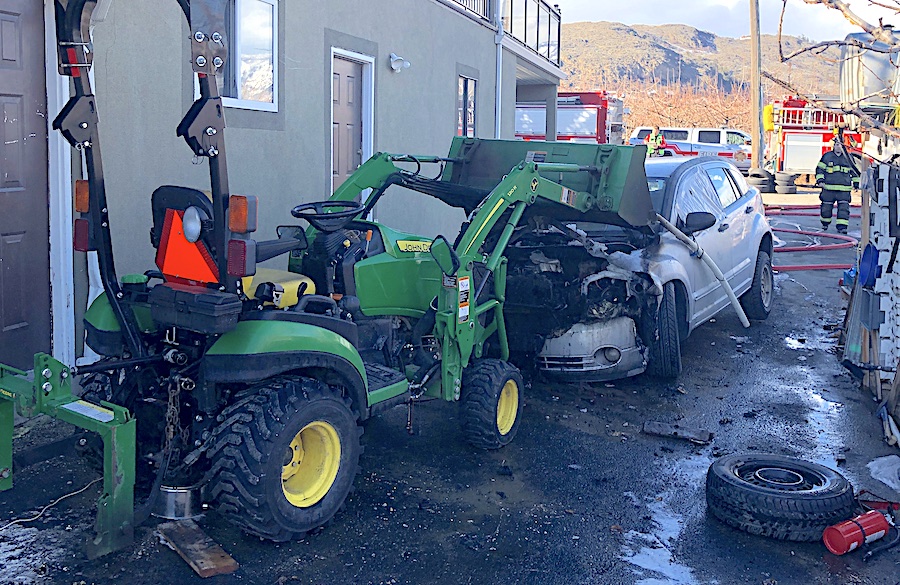
A quick thinking homeowner and exterior stucco helped save their house from potentially severe damage after a car parked next to it caught fire and spread to the structure on the morning of Saturday, Jan. 28.
Osoyoos Fire Rescue Chief Corey Kortmeyer said the fire started on the outside of the house located on 168th Ave. “We believe that it started with a small vehicle and then extended to the property. So it was a quick save,” he added.
Kortmeyer said the property owner did a lot of things correctly on the scene including having a fire extinguisher and using some water, “but the fire got a little bit bigger than those things could handle.”
The homeowner also used a small tractor to push the burning car away from the building, although the fire chief noted this was risky for the homeowner’s own safety given that the outside of the house was already burning.
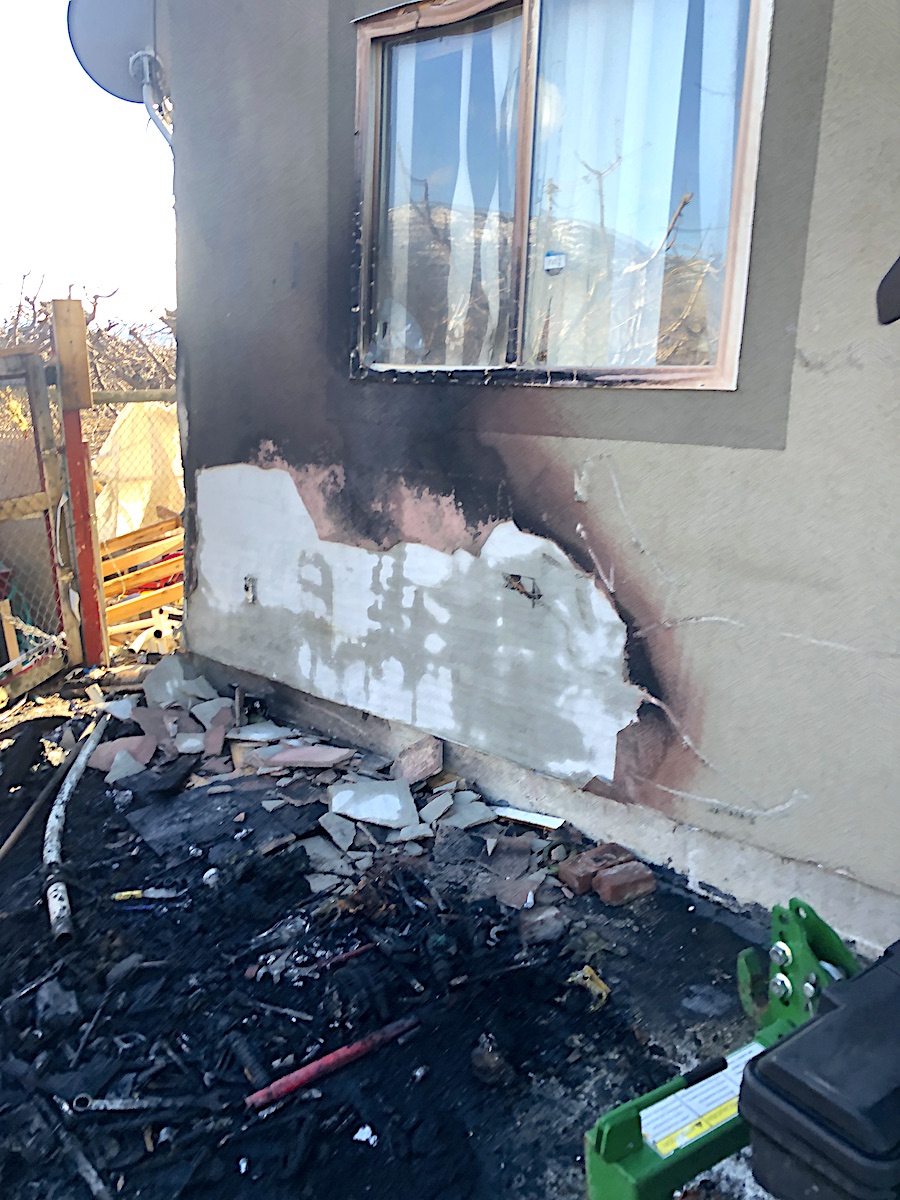
Quick thinking by the homeowner along with the stucco exterior cladding helped slow the spread of the fire. Osoyoos Fire Rescue photo.
“We were called in and kept the fire from getting from outside of the house to the inside,” he said. The OFR was on scene for three to four hours.
Although Kortmeyer emphasized the cause is still under investigation, he noted that with colder weather drivers often plug in their car’s block heaters, typically leaving them on overnight. “Usually it’s the block heaters that are plugged in overnight that either they fail or they get too hot and once they do fail, it doesn’t take very much for the engine to catch on fire.”
The fact that the house exterior was stucco helped delay the spread of the fire, the chief added. “The exterior cladding of the home actually participated in a really good save,” he said. “If it was vinyl siding with that much heat it would’ve been a different outcome.”
He said many people are now starting to appreciate what the exterior of their home is clad in, whether HardiePlank boards or stucco in comparison to vinyl siding. “Obviously the plastic melts and catches on fire, and once the exterior of the house is on fire it can burn quite rapidly.”
Kortmeyer also highlighted that with spring not far off, it’s the perfect time for people to start thinking about “firesmarting” their property. Most importantly, get as much of the combustible materials away from the perimeter of the house as possible.
He said fire often starts on the exterior of the house on some sort of plantation bed or bark mulch that people are using, or even things that are connected to the home like fences, or wood piles adjacent to the house.
“The exterior of the house can catch on fire to the point where it actually starts to impinge on the structure itself, and then it moves up the wall sometimes very fast, and if it gets into the attic space it has the potential to turn your house into a ‘convertible’ quite quickly. So getting combustibles away from the side of your home is essential,” he urged.
He agreed that many people see FireSmart as more of a rural necessity, but says it’s very much relevant for those living in town as well. “Most definitely,” he said.
“Many people have dead or dying shrubbery next to their house. In the summer it surprises me how many cedar hedges there are in yards here. They take a considerable amount of water and it doesn’t take a lot of energy especially if they’re dry in the summer for them to go up in flames,” he cautioned.