
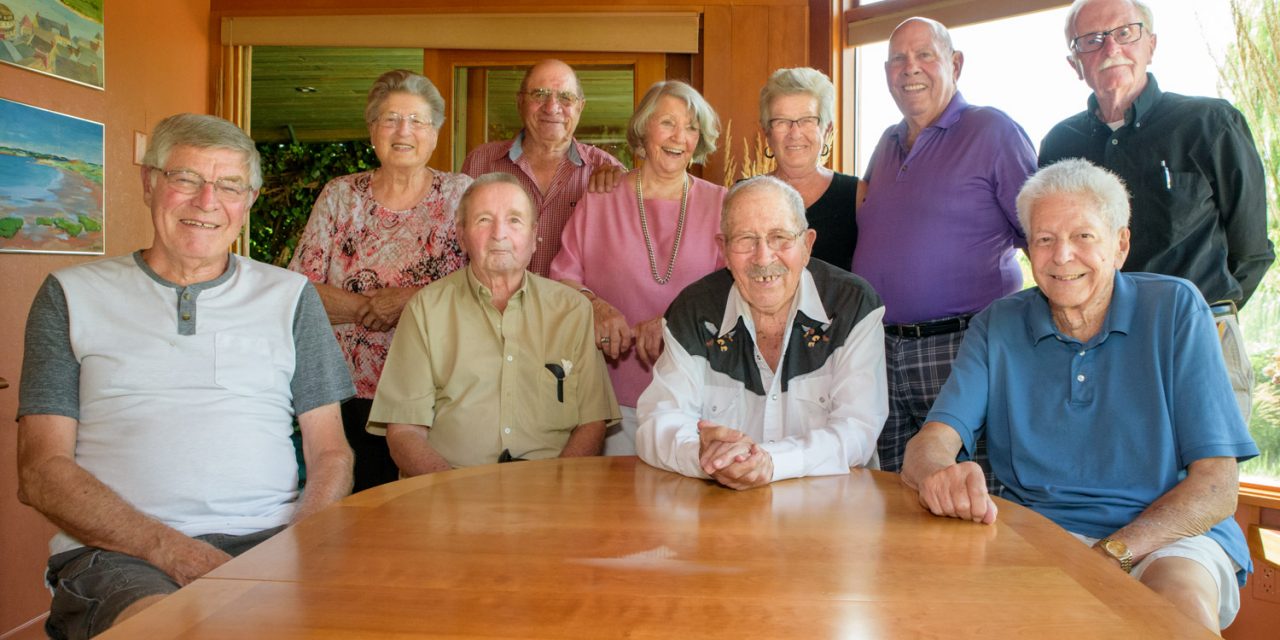

This group of Osoyoos old-timers gathered on July 8 at the home of Ruth Schiller, back row centre, to reminisce with the Osoyoos Times about the way Osoyoos was in their youths. Front from left: Walter Lemke, 76, Hans Hohler, 86, Jim Pendergraft, 85, and George Fraser, 82. Back from left: Anne Stappler, 90, Gerald Pendergraft, 82, Schiller, 93, Doris Walton, 82, Don Brunner, 80, and Terry Schorn, 84. (Richard McGuire photo)
If you totalled the ages of the 11 seniors gathered at Ruth Schiller’s home on a recent Sunday, you had 914 years of Osoyoos history seated together.
Schiller, 93, and Don Brunner, 80, got the idea recently to bring together a group of Osoyoos old-timers to share stories from this community’s past.
It all started with The Way We Were on April 24 when we told the story of how Schiller, as a teenager, worked at Carlson’s grocery store. She remembers Brunner, then a toddler, as an out-of-control “heathen kid,” as Mrs. Carlson called him. He would grab things from the shelves, uncontrolled by his mother Margaret.
Former Mayor Stu Wells teased Schiller that she should apologize to Brunner for telling us the story.
“I phoned her up and I said I hadn’t slept in two nights I was so upset,” Brunner chuckles, obviously not taking it seriously.
They decided to bring together a group of contemporaries, mostly born in the 1930s, though a few were from the 1920s and 1940s.
“You’ll get the truth from the rest of the people that Don Brunner was not a bad little boy,” said Brunner as the reunion got underway.
The two-hour discussion was fascinating, although at times there were multiple discussions happening simultaneously.
The seniors talked about early farming, the war years, interesting local characters, local war heroes, their family backgrounds, immigration, the post-war growth, crossing the border with undeclared purchases, rivalry with Oliver and a lot more.
I’ll try to tell some of those stories in future papers, but there isn’t space here.
For now though, there’s the question of whether Brunner was in fact a bad little boy.
Taking part in the discussion were Brunner’s cousins, Jimmy Pendergraft, 85, and Gerald Pendergraft, 82. Brunner’s mother Margaret was a Pendergraft and was their aunt.
Brunner is a great storyteller with a sense of humour. You’re never quite sure when he’s exaggerating.
Born in 1937, he first attended school at what is now town hall. In 1949, a new 13-room elementary school opened in the building that is now the Sonora Community Centre.
The land had been bulldozed, and Brunner recalls there were rocks everywhere – thousands of rocks.
“If you’d done something wrong in class, the teacher would take a hammer and put four sticks in the ground,” said Brunner. “Depending on the severity of your crime, that would be the size of the plot.”
Brunner was out there regularly with a wheelbarrow, rake and shovel, moving rocks from his plot to the edge of the hill and dumping them.
“I think I probably did about two thirds of that whole property,” said Brunner, whose offence was usually running in the halls. Or so he says.
To this day, he looks at the bank next to the Sonora Centre and remembers the many rocks he moved.
In the postwar years, “peddling” fruit from the Okanagan was strictly illegal – that meant selling it directly without the necessary license.
But Brunner, when he was 16, saw a great business opportunity. And he’d learned many lessons from Frank Smith, who bought and sold everything from fruit to horses.
Young Brunner would get up early in the morning and three times a week he would drive a 1951 Ford pickup loaded with fruit across the border, through Republic, Washington, and back into Canada near Trail and Rossland. It was the only blacktop route in those days.
“The guy that owned the Supervalu in Rossland and Trail, and his wife, got to be my best buddy,” said Brunner.
Brunner brought them tomatoes, peaches and whatever else was in season.
“I was making three loads every week,” said Brunner. “Illegal as hell. Into Rossland and Trail and back home by 3:30 or four in the afternoon. That’s how you made money in the fruit business.”
Brunner had a run-in with a man from the company licensed to distribute fruit, but it didn’t deter him.
Only when a fruit inspector caught him running a load of apples to Nelson with Gerald Pendergraft did he finally stop.
“I made damn good money all summer,” said Brunner. “And I was only 16 years old.”
Brunner also remembers bringing items across the border from Washington.
There were the times he went down to Oroville with the Pendergraft boys to an all-you-can-eat restaurant where they stuffed themselves and drank beer by the quart.
Brunner was wearing cowboy boots and he stuffed a bottle of beer in each boot and pulled his jeans down over them when the boys returned to the border. The inspector made them step out of the truck.
“I could barely stand up and he said, ‘OK boys, you’d better get into the truck and go straight home now,’” Brunner recalls.
Some of the customs officers, he said, would be drunk on confiscated liquor and the boys would just sail right through.
But the one inspector they feared most was Iris Tweedy, who was strict and played by the rulebook. She was thorough and they wouldn’t take chances if they knew she was on duty.
Many Osoyoosites bought saddles from a saddle maker in Oroville and smuggled them back to Osoyoos during the big rush after the Saturday night movie ended.
Brunner wasn’t taking chances though, so he drove his saddle over to Molson, hiked through the bush with it, and buried it by a tree on the Canadian side near Wagonwheel Ranch. He later went back though Canada to recover it.
The stories continued, but Brunner didn’t say very much to prove his innocence.
“Maybe Ruth is right,” he said. “Maybe I was the bad little bugger.”
RICHARD McGUIRE
Osoyoos Times



Aloha from Kona Hawaii. I was excited to see this picture of some old timers from Osoyoos. I was originally from Osoyoos but left in 1949 to venture into the world. My name is Thomas Helmuth Martin, 85. The people that I knew from the picture is Hans Kohler ( everyday when we went to school Hans had #2.00 to spend on candy and stuff), another person that I met at Walter Pfingstagg’s funeral was Ruth Shiller, and Jim Pendergraft.