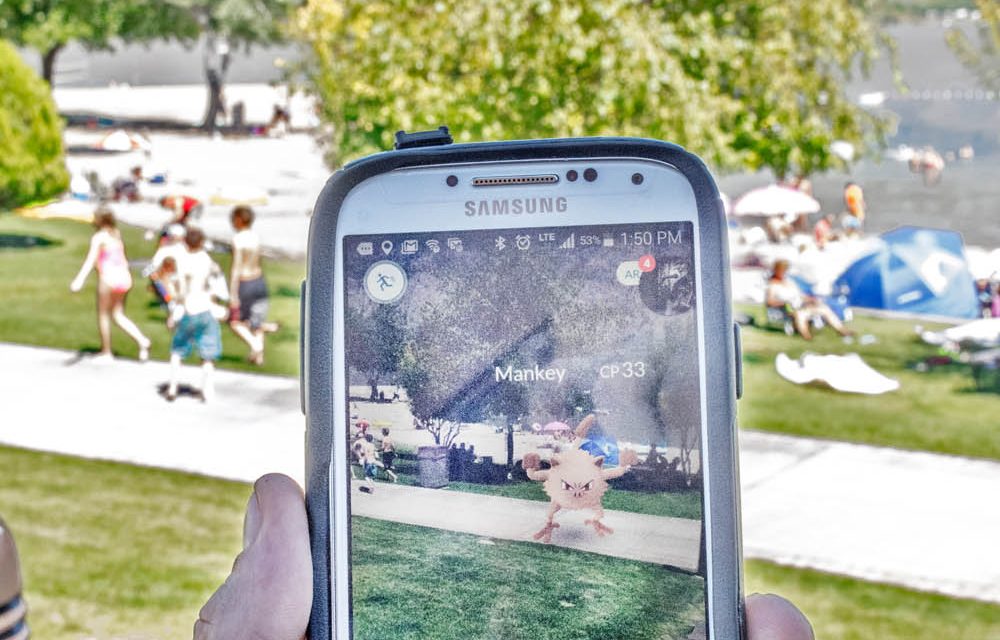
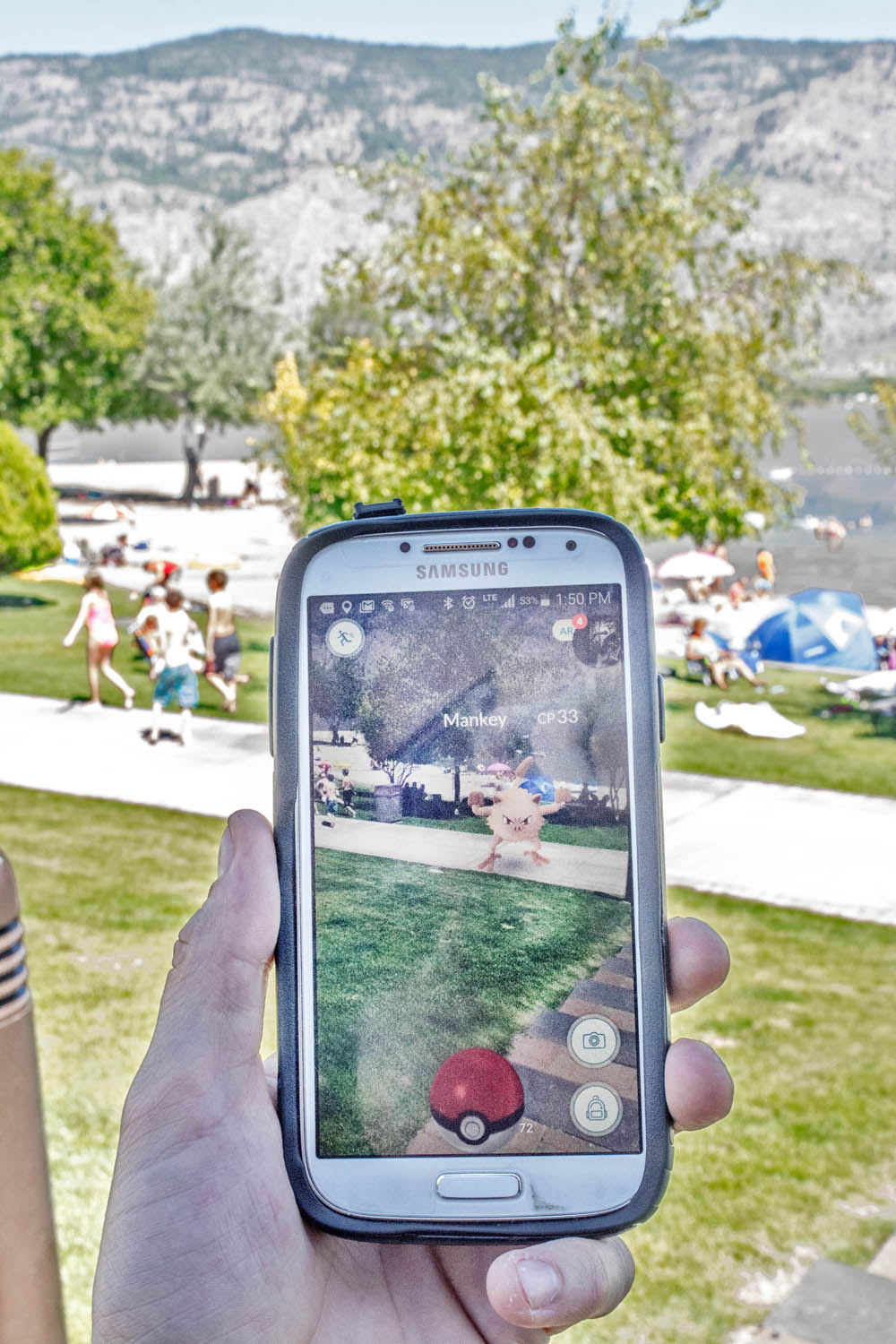
Pokemon Go visits Gyro Beach in Osoyoos. The popular game is encouraging people to get out and explore. (Dan Walton photo)
Osoyoos has been absorbed by the Pokemon franchise’s recent and ubiquitous expansion.
With the advent of Pokemon Go, every smartphone owner can now view the real streets of the Okanagan, and anywhere else in the world, through the lens of the Pokemon world.
To those who were young in the 1990s, often referred to as millennials, few franchises sewed the seeds for nostalgia as powerfully as Pokemon. And while most of the original fans grew up and lost interest in Pokemon, the new smartphone app, Pokemon Go, manages to offer powerful feelings of rediscovery.
Using the GPS and camera on any smartphone, the program augments reality by displaying virtual Pokemon in the real world, though a user has to be viewing real-world Pokemon through the screen on their phones. It’s similar to using Google Maps software to navigate around town, and once a Pokemon has been encountered, the screen switches to camera mode and the trainer tries to catch it by throwing Pokeballs at it.
Trainers only have a limited number of Pokeballs however, and restocking requires exercise. Through a series of complex algorithms, the software uses local points of interest as Pokestops, where useful items can be collected. In Osoyoos, the Post Office and Museum in Osoyoos are among the many locations programmed as Pokestops.
Pop culture was overwhelmed by the world of Pokemon in the late 1990s. An anime-style cartoon of ambitious trainers who wander around territory similar to present-day life, but instead of sharing the world with animals, humans in the Pokemon world inhabit the land with 150 imaginary animal-like species that are both wild and tamed. The highest goal of a Pokemon trainer is to own all 150, which happens through various means: catching wild Pokemon, enticing metamorphosis (evolution) and by trading. Some characters will train their Pokemon for peaceful and practical purposes, but the protagonists almost always train their Pokemon to battle. With a team of Pokemon that are good at fighting, it makes it easier to both capture wild Pokemon and to defeat gym leaders. Each gym leader has a certain niche of Pokemon (water, fire, electricity), and trainers who are able to defeat gym leaders are rewarded with a badge.
That concept of Pokemon gyms has been adapted into the real world, and anybody training in Osoyoos will find a gym at the Golden Chopstick Buffet. There are several other gyms in Osoyoos, and the top local trainers to prove themselves are given the title of gym leader at each location.
Pokemon fights are like a complicated game of Rock, Paper, Scissors – every Pokemon is susceptible to some species and dangerous to others.
Pokemon come in a wide range of varieties, such as giant worms made of rocks, fire-breathing dragons, fire-breathing Bengal tigers, an electric mouse, a mime, as well as less-majestic creatures, like moths, magnets, moles, seals and eggs.
The concept of Pokemon became popular on many platforms since first breaking through. The television series was well-positioned for after-school audiences; tens of millions of copies of a Pokemon video game were sold for Gameboy; and the popularity of their trading cards eclipsed every other school playground fad in the 1990s.
Anybody who wants to get hunting for Pokemon that hasn’t started yet can download Pokemon Go completely free through the Google Play store.
DAN WALTON
Regional Reporter