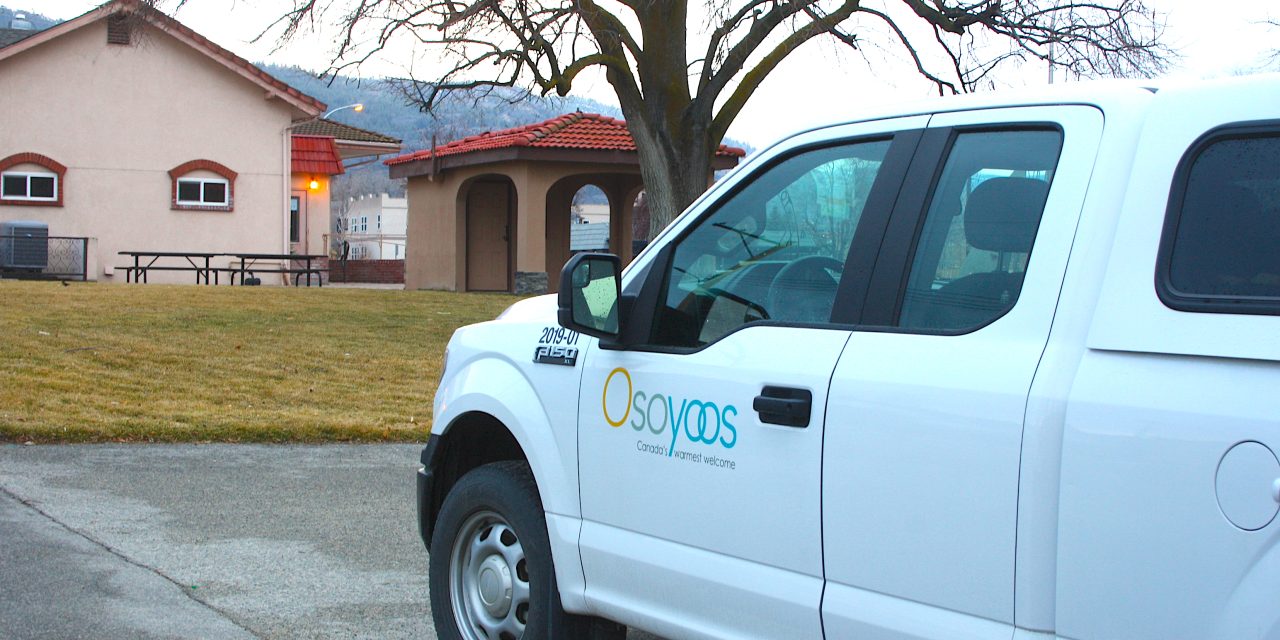
Osoyoos Council has approved the purchase of nearly $900,000 worth of vehicles after finding itself in a “financial pickle” from not keeping on top of fleet replacement.
Following the presentation of the Fleet Assessment and Replacement Strategy to council on February 22, town staff were requested to provide further details on the specific units scheduled for replacement in 2022.
A fleet asset management plan was first initiated in 2020 but was delayed due to staffing changes and the ongoing pandemic, according to town staff.
A total of five units were identified for replacement in 2022 including some of the older units in the fleet that have “far exceeded their useful life,” according to Jared Brounstein, Director of Operational Services.
The five vehicles include a 2006 Ford LCF55, a 2006 International flatbed c/w with mobile knuckle boom, a 1995 International five-ton dump truck, a 1997 Dodge three-quarter-ton pickup landscape maintenance unit c/w water tan, and a 2007 Ford half-ton pickup.
The first three will be replaced like-for-like while the 1997 Dodge will be replaced by a landscape maintenance unit c/w water tank, and the 2007 Ford will be replaced by a hybrid SUV.
With the substantial $896,875 sticker price associated with the replacements, Councillor Myers Bennett asked whether the expenditure could be spread out over the coming years.
“If we start deferring vehicles out and out and out we’re going to compound the problem down the road,” replied Brounstein. “What we’re doing now is playing catch up with our fleet, we’ve let things go too long without being replaced,” he warned.
“The fleet assessment indicated the Town should be allocating $400,000 a year for fleet replacement whether we’re replacing them or not so that at the end of the 20-year cycle we’re not diving further into debt. So, to the question of deferring, it’s not going to help the financial pickle we’re in.”
Brounstein added that next year there is $180,000 in fleet replacement, but if the fleet replacement strategy is followed, “‘we budget $400,000 so that the extra $320,000 gets put away in reserve so that when year 10 comes and it’s time to replace the vehicles, that money is already sitting in the pot ready to go and then there’s no debt service and no financial impact on the community,” he said.
Director of Finance Jim Zakall noted that no borrowing is necessary for this purchase as money will be drawn from the town’s water, sewer and general reserves for the purchase.
But concerns over fleet replacement and budgeting may well turn out to be a tempest in a teapot as Brounstein says it’s highly unlikely any vehicles can be delivered this year. That means any fallout from the faltering fleet replacement and associated budgeting will land on the shoulders of the next council which will be elected this fall.
“Due to the ongoing supply chain issues, electronic chip shortages and other related vehicle sourcing issues, we are anticipating that the equipment replacements outlined in this report will not be delivered until late 2023 or 2024,” Brounstein said. As an example, he noted that Ford officially closed orders last month for 2022.
Despite these hurdles, two separate RPs (requisition to purchase) will be issued – one for the lighter duty vehicles and one for the heavier duty.
With this now being the reality of equipment sourcing, equipment slated for replacement in 2023 may be delayed up to two years from time of order to time of delivery making the cost of these purchases “uncertain and hard to manage”, he cautioned.