By Roy Wood, Special to the Times Chronicle
Despite a warning from the mayor of “too many possible hiccups,” and a less than enthusiastic response to a public opinion survey, Osoyoos council has decided to go ahead with a plan to develop the town’s airport.
At Tuesday’s committee of the whole meeting, council made two key decisions. The first was to approve the Airport Master Plan and Financial Analysis report as the roadmap for the development of the Osoyoos Airport.
And the second was to agree to hand the management of the airport over to the Osoyoos Airport Development Society (OADS), a non-profit group of airport advocates, which has been raising money over several years for airport infrastructure.
The master plan and financial analysis was first presented to council in May. The nominal time frame for the plan is 10 years, but the presenters told council the actual timing will depend on market demand.
The first phase of the plan would see a three-bay hangar including a lounge and washroom, expansion of the access road, more parking and additional tie downs.
The master plan chart outlining developments over the ensuing years envisions an aviation fuel station, additional hangars, a paved taxiway and more parking and tie downs.
According to the financial analysis accompanying the plan: “Finding a small number of individuals prepared to pay 100 per cent of the capital and operating costs of the hangar buildings will be key to the project moving forward.”
Addressing the plan with council this week, CAO Rod Risling said: “It’s a plan; it’s a strategy. … Conceptually, this shows that council is in favour of development to start occurring at the airport. … (But I am) 100-per cent certain that this plan will not unfold exactly as written (and) that things will change or evolve.”
The financial analysis foresees no negative financial impact on the town, which currently budgets $10,000 for the airport for such things as snow clearing, runway maintenance and fence maintenance.
The analysis sees the town realizing $10,000 per year from property taxes by 2035.
“It’s important (to note) that no matter where council goes, the airport will not be self-funded from a purely financial perspective,” said Risling. “We’re always going to have to repair the fence or repair the pavement. …
“What we have heard from Oliver is that they do have to fund (its airport) with property tax revenues. … Regardless of whether the plan is approved, the airport is going to require taxpayer dollars.”
Risling also pointed out that any grants that OADS receives from senior levels of government could adversely affect the town’s ability receive grants.
“Deep down the government does look at how many grants are given to different communities,” he said. “And so, in the grand scheme of things if there are a lot of grants awarded to the airport, it will impact the grants the town is looking for (to fund its) infrastructure.”
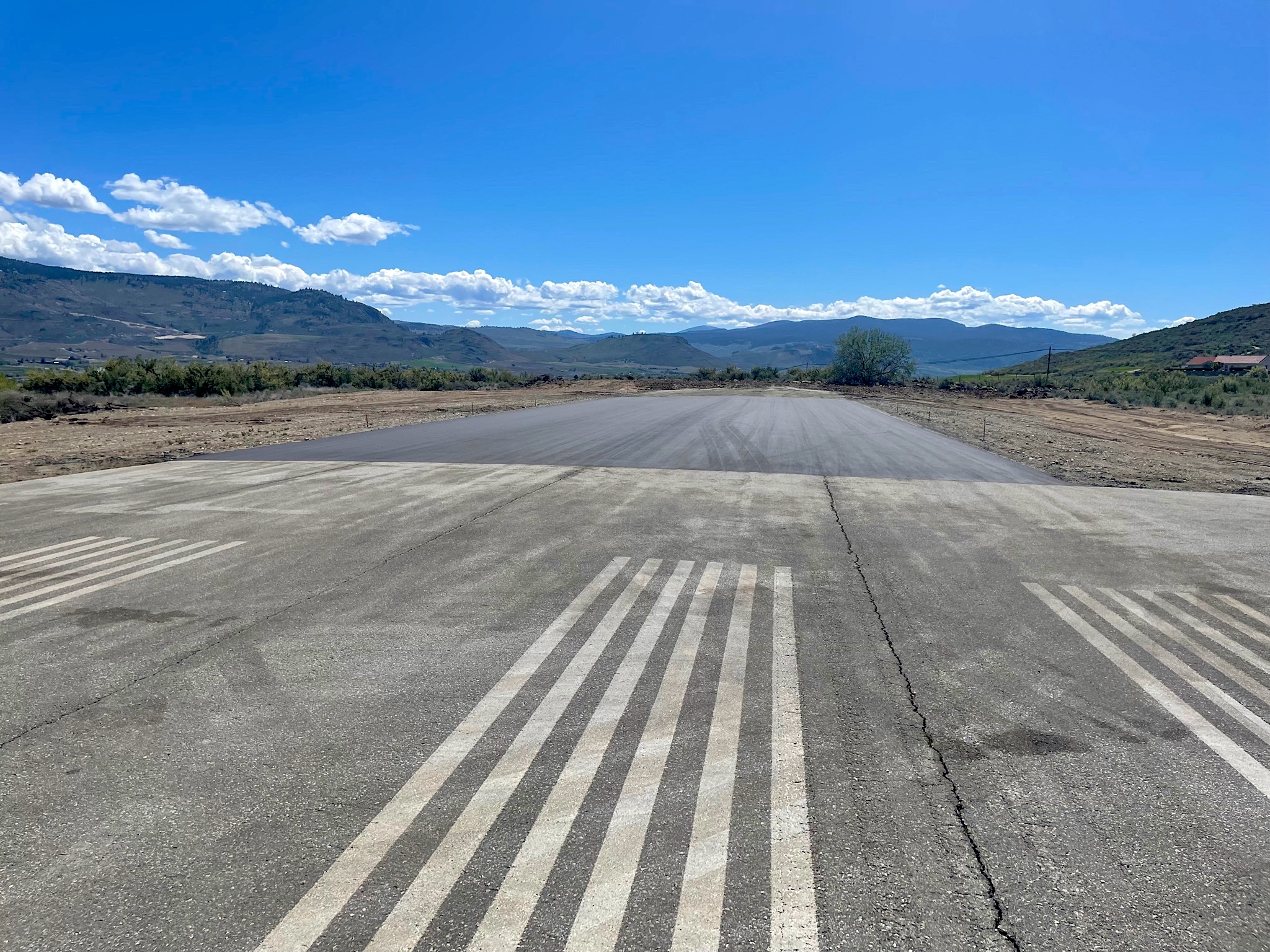
The 91.4 metre (300 foot) extension to the southern end of the runway provides a “balanced field length” as required by Transport Canada for aircraft providing charter flights.
File photo
As the approval of the report came to a vote after lengthy discussion, Mayor Sue McKortoff told council, “Before we take the vote, I want to tell you I am not supporting this.
“I totally understand all the options that have been put forward. I just think there are too many possible hiccups. … I’m okay with what’s being handled (at the airport) right now. The number of planes that are coming in. The small ones. … I think there are options for people who want hangars to go to Oliver.”
The motion – “That Council approves the Airport Master Plan and Financial Analysis report and supports the development” – passed with only McKortoff opposed. Councillors Myers Bennett, Jim King, Johnny Cheong and Zach Poturica voted in favour.
The decision Tuesday to enter into a management agreement with OADS culminates a process that began in 2021 when council instructed staff to “negotiate and enter into an operating agreement” for the operation of the airport.
The actual signing of the agreement likely won’t happen until the fall after OADS has met the requirements of the provincial societies act to get itself in “good standing.” The main thing it needs to do is hold an annual general meeting.
Once the agreement is in place, OADS will take over the day-to-day operation of the airport and begin to move toward the goals of the master plan, particularly finding potential hangar tenants.
In his written report, Risling said: “The OADS has done a significant amount of volunteer work over the years and has improved the airport from an infrastructure perspective. …
“Having a group manage the airport as well as filter potential development opportunities will reduce staff time that has been allocated to unsuccessful inquiries. The intent of the agreement is to also have dedicated volunteers ensure the airport remains safe and meets federal regulations.”
Risling pointed out that to reduce the risks of possible oversights in the new operating agreement, the term is for just one year.
He also assured council that any improvements or developments at the airport will need to be approved by council. “OADS can’t just go and do whatever they want. It’s still going to be a collaborative effort.”
McKortoff expressed her concern about what would happen if OADS were to disband. “Unfortunately, there have been non-profit groups in town (for whom) this has happened. … It reverts to the town and that means a huge town liability. Is that correct?”
Risling acknowledged that were OADS to cease operating, management of the airport would fall to the town. “We would have to hire staff to do it. (There) could be a potential impact.”
Back in May, when the master plan was first presented to council, part of the instruction to staff was to seek public input on the issue. That input took the form of an on-line survey of opinion.
Some 84 people responded. 64 respondents said they are Osoyoos residents. 31 said they use the airport while 53 said they do not. 15 respondents described themselves as “aviators.”
Of the non-aviator respondents who said they use the airport, nearly all said they are involved as participants or spectators at the Wine Country Racing Association’s summer drag racing series.
On the question of whether they support the master plan, 45 respondents said no while just 36 said yes.
Many of the respondents who oppose the master plan left comments. Here is a sampling:
• I have watched this town council increase taxes beyond belief because of poor planning and management of their water supply. To remotely consider any type of plan that will increase taxes has convinced me not to move to this town ever. I watched the presentation; it is obviously full of exaggerations and expectations;
• I oppose all of it. Why would any taxpayer want more taxes going towards the rich kids club;
• I don’t think Osoyoos needs this expansion to the airport. I don’t believe the investment will bring the additional traffic which is being talked about. There is a great airport in Oliver. I don’t believe that the population and air traffic can support two airports within 20 km;
• Osoyoos residents are heavily taxed and the town’s outstanding debt for essential services such as fire, sewer, and water which benefits all citizens needs to be the immediate priority of the town’s budget; and
• I oppose the airport master plan because I do not believe we can afford it, and it is too ambitious for a small town of just over 5,000 residents. An airport is for those who are wealthy enough to be able to fly for personal or family pleasure. In Osoyoos, I know of no-one who owns or uses a private plane and needs a place to store it. Oliver airport has the facilities that this plan promises over its length of development and is being used by locals and by non-residents who fly in and out for vacation purposes. Flying is a rich-person sport. It benefits few people in any population.