
By Sebastian Kanally, Times Chronicle
Oliver’s first look at the billing portion of the water conservation puzzle faces heavy criticism from council.
The town of Oliver has developed a Water Conservation Plan, and a key recommendation in this plan is to implement a conservation-oriented tiered rate structure for billing water.
The town of Oliver developed this plan along with TRUE Consulting, and the outline of the plan was originally presented to town council on April 8, 2025. But at their recent April 22 meeting, council listened to a presentation specifically on the tiered rate structure.
The plan faced heavy criticism from multiple councillors and was referred back to town staff for more information and other potential ideas.
The tiered rate structure seeks to provide a financial incentive for users to reduce water usage.
There would be three separate tiers of water users with incrementally higher charges as water used increases. The plan would only be applied to single-family residential customers and would not be applicable to multi-family, commercial, institutional or industrial customers.
The plan would see about 60 per cent of accounts in the lowest tier. Then 30 per cent of accounts in the second tier and the final 10 per cent of accounts in the highest tier would have to pay the most.
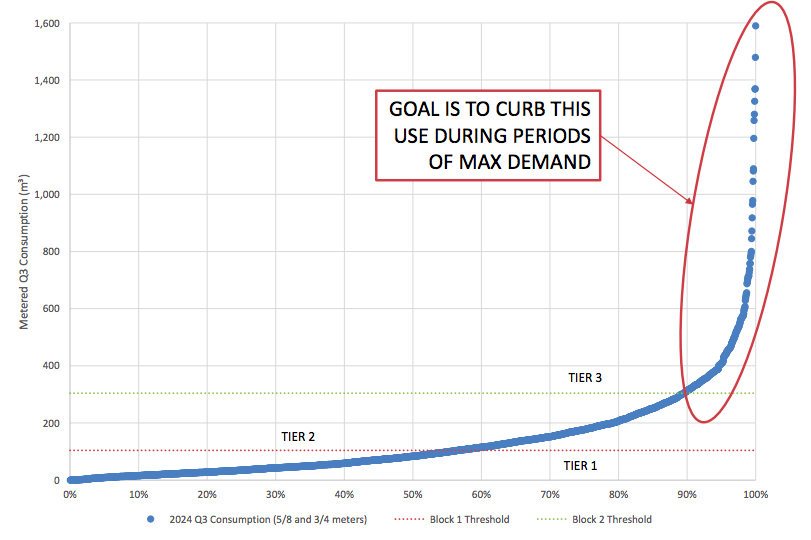
Chart showing the three proposed tiers for billing, and the highest users the plan would target.
Town of Oliver graphic
Water councillor Rick Machial was the first to express his disagreement with the plan.
“I don’t agree with this . . . Effectively, you are punishing somebody and charging them more than what it costs us to provide that water to that person, the high-tier user. It doesn’t cost us that high of a price to actually provide that water. I think it’s regressive and I definitely don’t agree with it.”
Machial continued to try and drive home his point by saying, “If you have four kids or a bigger lawn than your neighbour, it’s punishing you.”
Councillor David Mattes also explained that he did not like the tiered billing structure.
“Moving to this type of a system, all it does is move the billing. It doesn’t create conservation.”
He explained that he has not seen any connection between a tiered billing structure and actual water conservation. Until he is shown that there is a direct connection, he said he is not in favour of the plan.
“There are other things we can do before we change the rate structure.”
Mayor Martin Johansen had a different perspective. He explained, “We need to do something for water conservation. I think this is a piece of the puzzle. It may not be the right time for it, but it’s for sure a piece of the puzzle. People do not make adjustments unless they have to pay.”
Sean Curry, at TRUE Consulting, explained in his presentation that the “city of Penticton was an example that we utilized, but we made a very town of Oliver-specific analysis.”
Water Councillor Bhupinder Dhaliwal thought it was not a good idea to compare the towns.
He explained that “you can’t compare Oliver to the city of Penticton. We have seasonal work here. Families work six months out of the year, and the other six they are at home. We have a retirement community with fixed income, we have a lower yearly income in the region of Oliver with higher expenses.
“What you are doing is punishing 262 families for using water. I am wondering since when was green a bad thing. Most of that water usage is in the summer for the irrigation of green space. We are just making something positive into something negative. So, I’m really against this tiered system.”
Councillor Aimee Grice was the most positive about implementing this plan, or at least considering it.
Grice explained that “from what we have seen in the past, the water restrictions are not working. So I think we need to try something else, and I think a carrot-and-stick program will be what works. I wouldn’t completely throw this out. I think it’s worth a try.”
Council referred the plan back to staff to gather more information on fixing leaks on high users for water conservation, other methods for water conservation, and to gather more data on if there is a direct correlation between this method of billing and water conservation in other towns.
Wayne Anderson, chief administrative officer for the town, reminded council that the tiered billing structure is but one tool in the toolkit for water conservation.